
PILLAR 1: HEAD-TO-HEAD COMPARISON
The definitive breakdown of court footprints, paddle physics, serve rules, and scoring—plus the 5 bad tennis habits you must unlearn on day one.
When comparing pickleball vs tennis, it is easy for casual observers to see two racket sports played over a net and assume they are virtually identical. Both sports require hand-eye coordination, quick footwork, tactical angles, and competitive stamina.
However, the moment a seasoned tennis player learns what is pickleball and steps onto the court, the illusion shatters. That beautiful, looping 90-mph tennis forehand suddenly flies twenty feet out of bounds. The aggressive charge to the net ends in an immediate violation of pickleball kitchen rules. And the instinct to smash an overhead winner gets neutralized by a patient pickleball dinking strategy dropping soft balls into the kitchen.
While pickleball shares genetic DNA with traditional lawn tennis, its spatial constraints, aerodynamics, and official rules create an entirely different athletic challenge. Governed respectively by USA Pickleball and the United States Tennis Association (USTA), each sport offers a unique balance of physical endurance and strategic touch.
Whether you are a lifelong tennis player curious about transitioning to North America’s fastest-growing sport, or a beginner deciding which game to pick up first, this definitive pickleball vs tennis guide breaks down the seven fundamental differences every player must understand.
⚡ The 30-Second Pickleball vs Tennis Comparison Matrix
Short on time? Here is how the two sports compare across core technical metrics:
| Feature / Metric | Pickleball | Tennis |
|---|---|---|
| Court Dimensions | 20′ × 44′ (880 sq ft) | 36′ × 78′ Doubles (2,808 sq ft) |
| Net Height | 36″ Sidelines • 34″ Center | 42″ Posts • 36″ Center |
| Equipment | Solid composite paddle & plastic wiffle ball | Strung carbon racquet & pressurized felt ball |
| The Serve | Mandatory underhand or drop serve below waist | Aggressive overhead weapon hit from any height |
| Non-Volley Zone | 7-Foot Kitchen (No air volleys permitted) | None (Players can volley directly at the net) |
| Scoring System | Side-out 3-number call to 11 (Win by 2) | 15-30-40 games, sets, and matches |
1. Court Size & Spatial Footprint in Pickleball vs Tennis
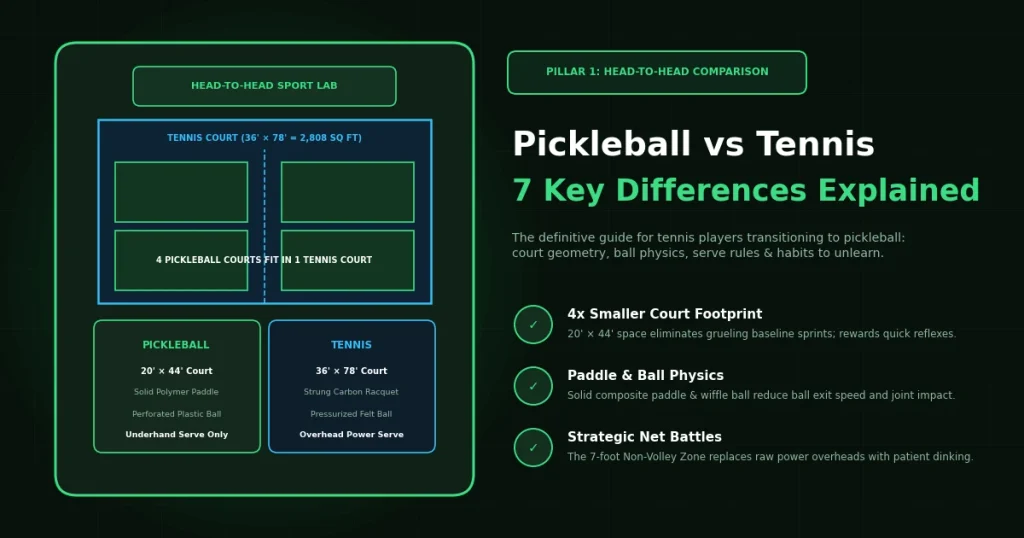
The most immediate physical contrast in pickleball vs tennis is court geometry. A standard regulation tennis court measures 78 feet long by 36 feet wide for doubles play, encompassing 2,808 square feet of playable area.
By contrast, official pickleball court dimensions measure exactly 20 feet wide by 44 feet long—a total footprint of just 880 square feet. This compact footprint is a primary driver behind the facility boom, as a single tennis court is more than three times larger than a pickleball court.
In fact, parks and recreation departments can comfortably fit four full pickleball courts inside the footprint of a single standard tennis court enclosure. According to International Tennis Federation (ITF) court standards, tennis players regularly cover miles of sprinting distance during a single three-set match.
In pickleball, the compact dimensions drastically reduce the need for grueling full-court sprints. However, because the court is smaller, reaction times at the kitchen line are four times faster than baseline rallies in tennis, shifting the athletic demand from raw aerobic stamina to twitch-reflex hand speed.
2. Equipment Physics: Paddles & Balls Compared
Examining equipment physics reveals why shots behave completely differently in pickleball vs tennis. Everything from weight to aerodynamics alters how power and spin are generated:
Paddles vs. Strung Racquets
Tennis racquets feature large, open frames strung with synthetic or natural gut strings under 45 to 60 pounds of tension. This string bed creates a pronounced “trampoline effect,” launching pressurized balls at exit velocities exceeding 100 mph with heavy topspin.
As detailed in our pickleball paddle guide, paddles are solid instruments without strings. Constructed from lightweight honeycomb polymer cores wrapped in raw carbon vs fiberglass pickleball paddle faces, they weigh between 7.5 and 8.5 ounces. Because there is no string trampoline effect, players cannot rely on equipment rebound to generate explosive power—every ounce of velocity must come from mechanical leg drive and core rotation.
Plastic Wiffle Balls vs. Pressurized Felt Tennis Balls
A standard tennis ball is made of hollow, pressurized rubber covered in woven felt. It weighs approximately 58 grams and bounces vigorously off hard courts, retaining speed as it cuts through the air.
A pickleball is a lightweight (26 grams) molded polymer sphere perforated with 26 to 40 drilled holes. Because of its perforated aerodynamic design, a pickleball encounters significant air resistance in flight. The ball decelerates rapidly after bouncing and does not pop high into the air, forcing players to bend their knees and stay low to the court surface.
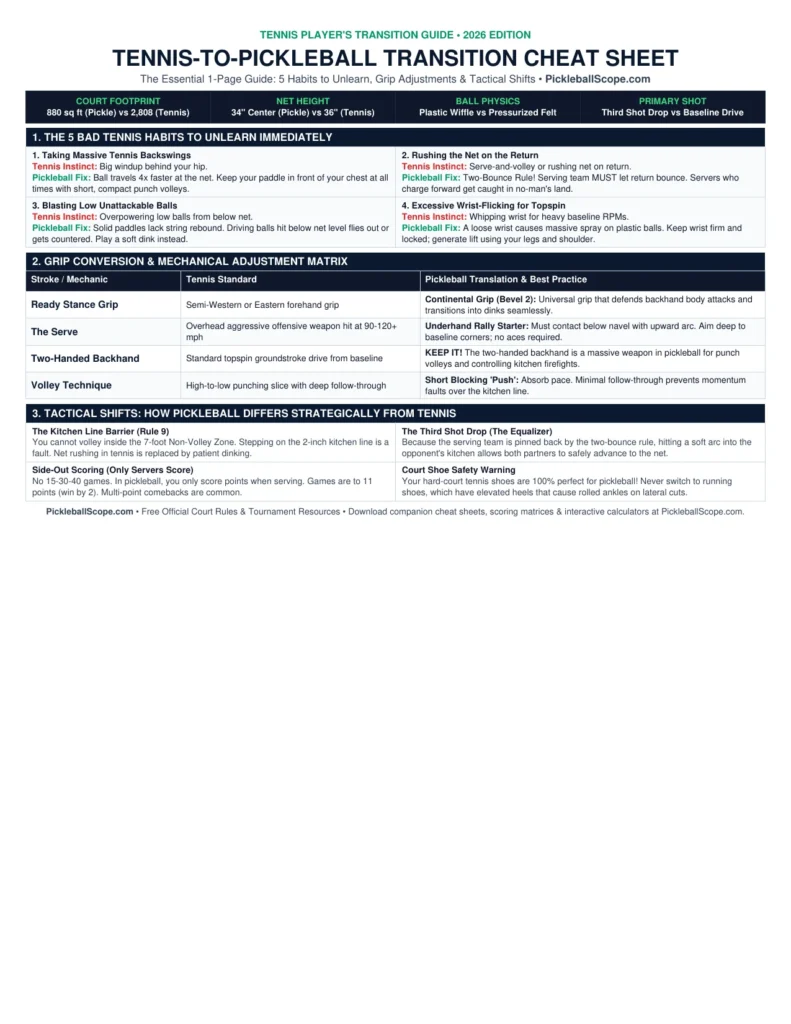
📄 Download the Tennis-to-Pickleball Transition Cheat Sheet (PDF)
Transitioning from tennis to pickleball? Keep this 1-page printable pocket guide in your bag. Covers the 5 bad tennis habits to unlearn, grip conversion charts, and third-shot drop fundamentals.
3. Pickleball vs Tennis Serve Rules: Underhand vs. Overhead Power
Perhaps no rule illustrates the philosophical difference in pickleball vs tennis better than the service motion. In competitive tennis, the serve is the ultimate offensive weapon. Tall players toss the ball high and strike downward at velocities reaching 120 to 140 mph, hunting for clean aces.
In pickleball, USA Pickleball Rule 4.A intentionally neutralizes the serve. The serve is strictly designed as an underhand rally starter:
- Upward Swing Arc: The server’s arm must move in an upward arc at the moment of contact.
- Contact Below the Navel: Paddle contact with the ball must occur strictly below the server’s waist level.
- Paddle Head Below Wrist: The highest point of the paddle head cannot sit above the wrist joint upon impact.
Alternatively, under official pickleball serve rules, players may use the Drop Serve (Rule 4.A.8), where the ball is released from natural height and struck off the bounce. Because the 5 basic rules of pickleball mandate a two-bounce rule, aces are exceptionally rare—the goal is simply to push the receiver deep and initiate a controlled rally.