
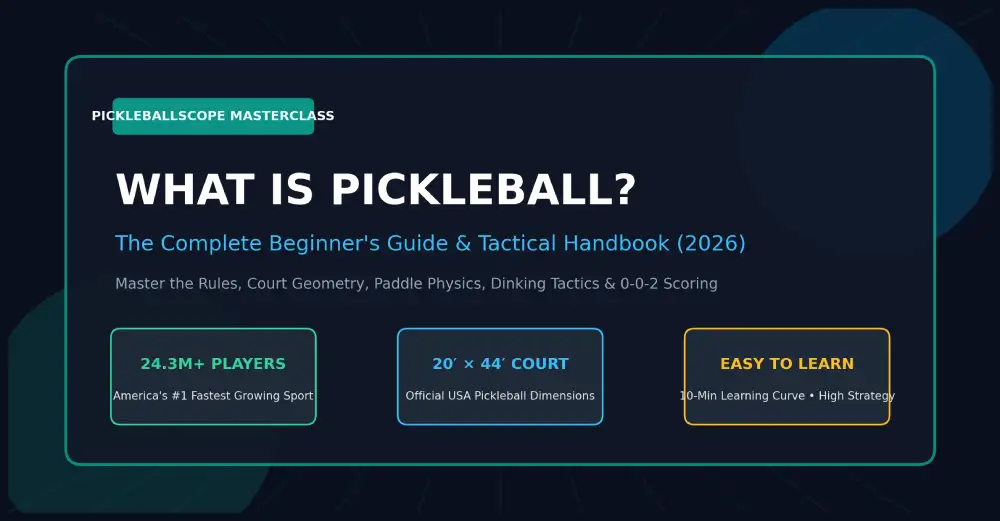
What is pickleball? Pickleball is a fast-paced, low-impact paddle sport that combines the core mechanics of tennis, badminton, and table tennis. It is played on a 20 × 44-foot court with a 34-inch center net, solid composite paddles, and a perforated polymer ball (similar to a wiffle ball). Played in either singles (2 players) or doubles (4 players), points can only be scored by the serving team, and standard games are played to 11 points (win by 2).
If you have walked past a neighborhood park, tennis club, or community recreation center recently, you have almost certainly heard the rhythmic, unmistakable pop-pop-pop of a pickleball match before you even saw the court boundary lines.
Pickleball is no longer just a recreational pastime played in active-adult communities—it is a full-blown global cultural movement. With over 24.3 million active players in the United States alone and participation exploding by more than 171.8% over the past three years, pickleball has held the undisputed title as America’s fastest-growing sport for five consecutive years.
Grand Slam tennis champions, NFL superstars, NBA legends, and millions of everyday families have embraced the game. But what is pickleball at its core, how did this peculiar sport originate, and what do you need to know before stepping onto the court for your very first match?
Whether you are picking up a paddle for the first time, curious about the rules, or looking to understand why everyone from your neighbors to your co-workers is obsessed, this definitive beginner’s handbook covers everything you need to know.
1. The Origin Story: How a Bored Family on Bainbridge Island Changed Sports History
To truly understand what is pickleball, you have to travel back to the summer of 1965 on Bainbridge Island, Washington, just a short ferry ride across Puget Sound from downtown Seattle.
Three longtime friends and fathers—Joel Pritchard (a Washington State Congressman), Bill Bell (a successful businessman), and Barney McCallum—returned to Pritchard’s home on a Saturday afternoon after a round of golf. They found their families restless and their children complaining that there was nothing to do.
Pritchard owned an old, overgrown asphalt badminton court on his property. The fathers searched the garage for badminton equipment, but they could not find a complete set of shuttlecocks or rackets. Improvising with what they had, they grabbed a perforated plastic wiffle ball, lowered the badminton net from 60 inches down to 36 inches, and hand-sawed crude rectangular paddles out of scrap plywood in Barney McCallum’s nearby workshop.
Over the following weeks, the three men codified a set of rules designed with a single overarching philosophy: the game had to be fun, accessible to the entire family, and based on hand-eye coordination, touch, and strategy rather than sheer physical power or sprinting speed.
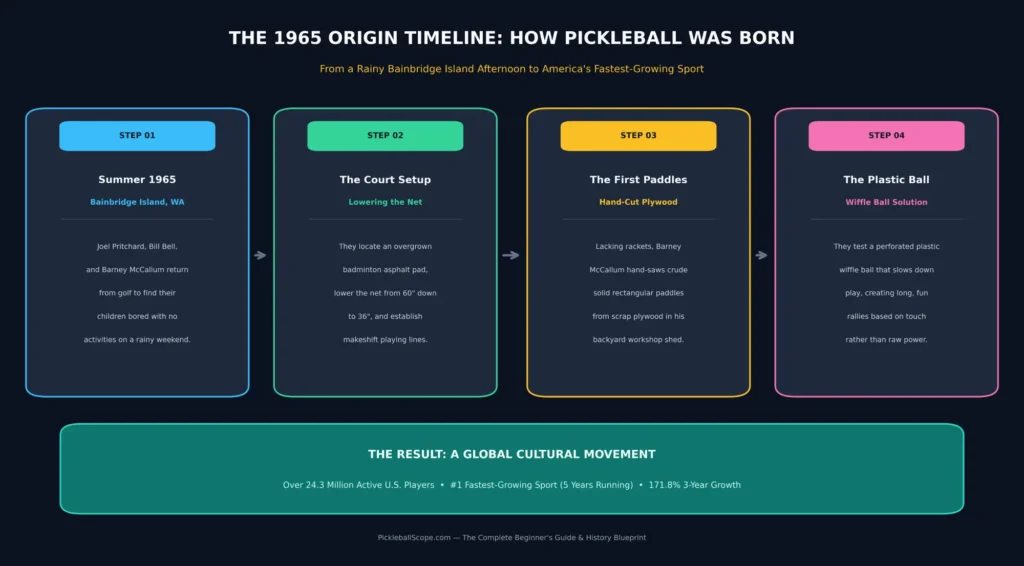
| Milestone Year | Strategic Development |
|---|---|
| Summer 1965 | Joel Pritchard, Bill Bell, and Barney McCallum invent the game on Bainbridge Island, WA. |
| 1972 | The founders incorporate Pickleball, Inc. to protect the sport and manufacture official gear. |
| 1984 | The United States Amateur Pickleball Association (now USA Pickleball) is formed to govern the official rulebook. |
| 2021 – 2026 | Participation explodes to 24.3M+ players; professional leagues (PPA Tour & MLP) air on national television. |
The Mystery of the Name: Where Did “Pickleball” Come From?
There are two competing historical accounts behind the peculiar name:
- The Pickle Boat Account (The True Story): According to Joel Pritchard’s wife, Joan Pritchard, she named the game after the “pickle boat” in competitive collegiate rowing crew. In rowing, the pickle boat is a thrown-together shell manned by leftover rowers from different schools who did not make the primary varsity boats. Because the new game was cobbled together from the leftover pieces of tennis, badminton, and ping-pong, Joan started calling it pickle ball.
- Pickles the Dog (The Beloved Legend): A popular myth claims the game was named after the family’s Cockapoo puppy, Pickles, who used to chase the plastic ball and run away with it during games. However, family records confirm that Pickles was born in 1968—three years after the sport was officially invented and named.
2. The Anatomy of Pickleball: Court, Net, Paddle & Ball
Pickleball’s genius lies in its spatial geometry and equipment physics. Everything is scaled down compared to tennis, which dramatically reduces joint wear and long-distance sprinting while keeping reaction times fast, tactical, and thrilling.
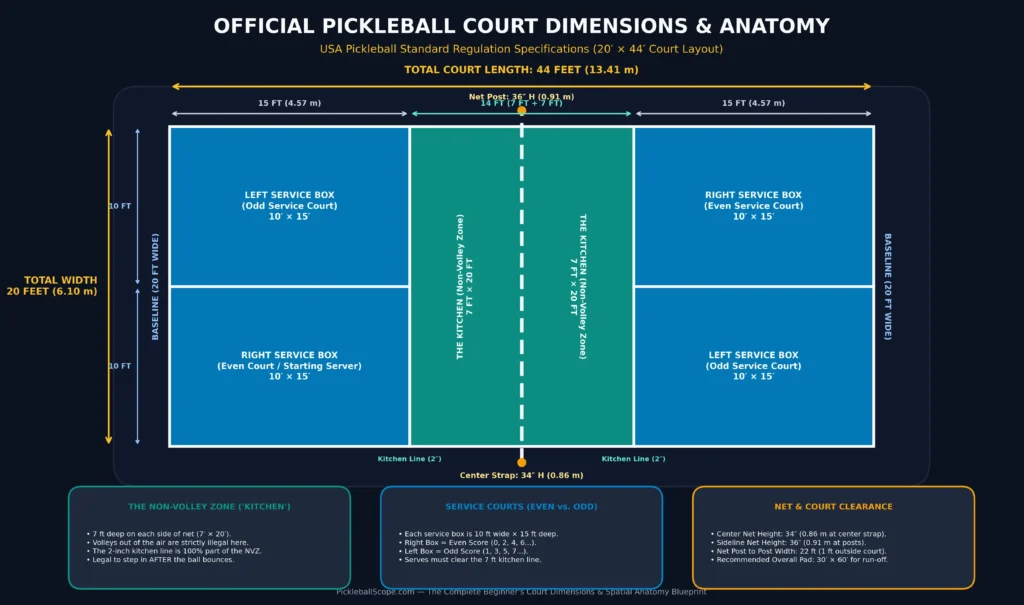
Official Regulation Court Dimensions
| Court Zone / Feature | Standard Imperial Measurement | Metric Equivalent | Tactical Function |
|---|---|---|---|
| Total Playing Area | 20 Feet Wide × 44 Feet Long | 6.10 m × 13.41 m | Exact size of a doubles badminton court (1/4 the size of tennis). |
| The Non-Volley Zone (“Kitchen”) | 7 Feet Deep (from net) × 20 Feet Wide | 2.13 m × 6.10 m | Prevents players from smashing volleys directly at the net cord. |
| Left & Right Service Boxes | 10 Feet Wide × 15 Feet Deep each | 3.05 m × 4.57 m | Diagonal target boxes for legal serves. |
| Center Net Height | 34 Inches at Center Strap | 0.86 m | Lowest point of the net; encourages cross-court dinking. |
| Sideline Net Height | 36 Inches at Net Posts | 0.91 m | Attached to posts set 22 feet apart (12 inches outside sidelines). |
| Boundary Line Width | 2 Inches Wide | 5.08 cm | All lines are considered “in” except the kitchen line on a serve. |
| Recommended Overall Pad | 30 Feet Wide × 60 Feet Long | 9.14 m × 18.29 m | Full concrete footprint to provide safe run-off buffer for lobs. |
1. The Paddle: Materials, Cores & Surfaces
Unlike stringed tennis or racquetball rackets, pickleball paddles feature a solid, high-tech composite face:
- Polypropylene Honeycomb Core (13mm vs. 16mm): Over 95% of modern paddles use a polymer honeycomb core. Thinner cores (13mm to 14mm) provide explosive power and pop, while thicker cores (16mm) absorb shock, expand the sweet spot, and deliver superior control and vibration damping.
- Surface Materials (Raw Carbon Fiber vs. Fiberglass): Raw carbon fiber (such as Toray T700) features microscopic friction texture that grips the plastic ball to generate 2,000+ RPM topspin and backspin slice. Fiberglass faces provide maximum rebound pop for aggressive power hitters.
- Size Regulations: The combined length and width of a legal paddle cannot exceed 24 inches, and the maximum length cannot exceed 17 inches.
2. The Ball: Indoor vs. Outdoor Physics
Pickleball uses a durable, seamless plastic polymer ball perforated with smooth molded holes:
- Outdoor Balls (e.g., Franklin X-40, Dura Fast 40): Heavier (~26 grams) with 40 small, precision-drilled holes designed to resist wind drift and withstand abrasive outdoor asphalt.
- Indoor Balls (e.g., Onix Fuse, Gamma): Lighter and softer with 26 larger holes that deliver higher bounce consistency and reduced skidding on indoor wooden basketball gym floors.
3. How a Match is Played: The 6-Phase Rally Flowchart
A typical doubles pickleball rally unfolds through a clear strategic progression that balances power groundstrokes, transition resets, and patient kitchen dinking.
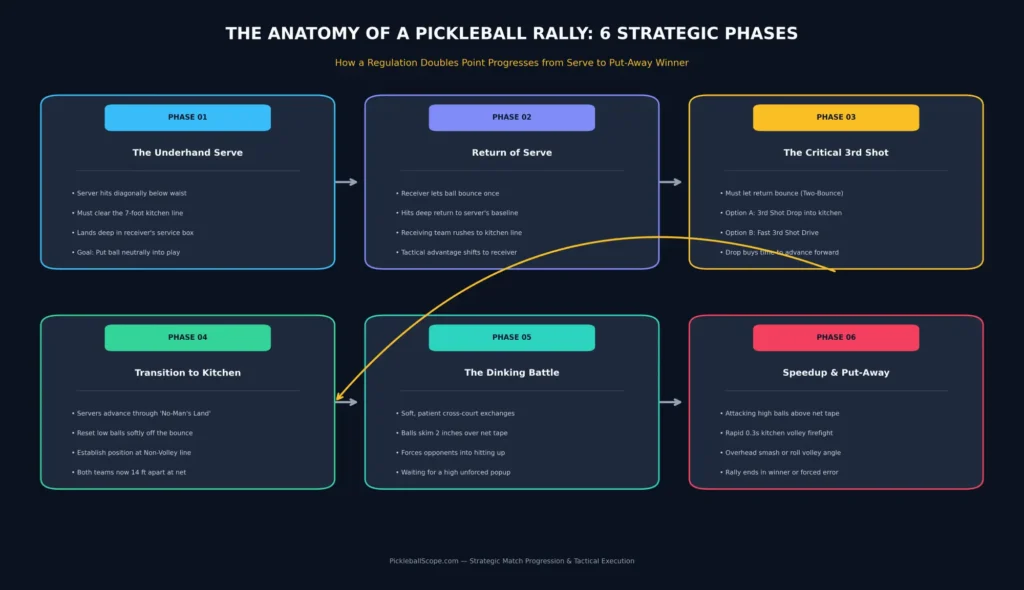
| Rally Phase | Player Execution & Rules | Tactical Objective |
|---|---|---|
| Phase 1: The Underhand Serve | Server hits underhand below waist level diagonally into opponent’s service box. | Must clear the 7-foot kitchen line and land deep in the receiver’s court. |
| Phase 2: Deep Return of Serve | Receiver lets the ball bounce once, then strikes a deep return to server’s baseline. | Pins the serving team back and allows the receiving team to immediately take the kitchen line. |
| Phase 3: The Critical 3rd Shot | Serving team lets return bounce (Two-Bounce Rule), then executes a soft Drop or hard Drive. | The Third Shot Drop arcs softly into the opponent’s kitchen, allowing servers to walk up to the net. |
| Phase 4: Transition to the Kitchen | Serving team advances forward through “No-Man’s Land” while resetting low balls. | Establishes equal offensive positioning 7 feet away from the net. |
| Phase 5: The Dinking Battle | All 4 players engage in patient, cross-court dinks skimming 2 inches over the net. | Neutralizes opponent power and waits for an opponent to pop the ball above net height. |
| Phase 6: Speedup & Put-Away | An attackable high ball appears; players exchange fast-hands volleys for a put-away winner. | Capitalizes on opponent popups with overhead smashes or aggressive roll volleys. |
4. The 5 Basic Rules Every Beginner Needs to Know
You do not need to memorize a 90-page tournament rulebook to enjoy your first day on the court. By understanding these five fundamental rules from the official USA Pickleball Rulebook, you will be fully prepared to play anywhere.
Rule 1: The Underhand Serve Must Be Diagonal
Every rally begins with an underhand serve that must satisfy three strict biomechanical conditions under USA Pickleball Rule 4.A:
- Continuous Upward Arc: The server’s arm must move in an upward arc at the moment of contact.
- Contact Below the Navel: Paddle contact with the ball must occur strictly below the server’s waist.
- Paddle Head Below the Wrist: The highest point of the paddle head cannot be above the highest part of the wrist joint when the ball is struck.
- Diagonal Landing: The ball must travel diagonally cross-court, land inside the opponent’s service box, and completely clear the 7-foot kitchen line.
Rule 2: The Two-Bounce Rule (Double Bounce Rule)
The Two-Bounce Rule is pickleball’s most brilliant strategic equalizer. It prevents the serving team from serving and immediately rushing the net to smash easy put-aways:
- Bounce #1: The receiving team must let the serve bounce before returning it.
- Bounce #2: The serving team must let the return of serve bounce before hitting their third shot.
- Once the ball has bounced once on each side of the net, both teams are legally permitted to either volley the ball out of the air or hit it off the bounce.
Rule 3: The Non-Volley Zone (“The Kitchen”)
The 7-foot by 20-foot area on both sides of the net is officially designated as the Non-Volley Zone (NVZ), universally known as The Kitchen:
- No Volleying Inside the Zone: You can NEVER strike the ball out of the air (a volley) while touching the kitchen floor or the 2-inch kitchen line.
- Momentum Carries the Fault: If you strike a legal volley while standing safely behind the line, but your forward momentum causes you, your paddle, your hat, or your sunglasses to touch the kitchen line after the shot, it is an immediate fault—even if the ball is already dead!
- Bounced Balls Are Legal: If an opponent hits a soft shot that bounces inside your kitchen, you can legally step right into the kitchen, hit the ball, and step back out.
Rule 4: Traditional Side-Out Scoring
In standard recreational and tournament pickleball:
- Points are only scored by the team that is currently serving.
- If the receiving team wins a rally, no point is awarded; instead, the serving team loses their serve.
- In doubles, both partners get a service turn before the ball is turned over to the opposing team (called a Side-Out).
Rule 5: Games to 11 Points (Win by 2)
- Standard recreational games are played until one team reaches 11 points.
- A team must win by a margin of at least 2 points. If the game is tied at 10 – 10, play continues until one team gains a two-point advantage (e.g., 12 – 10, 14 – 12).
5. Decoding the 3-Number Score Call in Doubles (0-0-2 Explained)
The single most intimidating hurdle for new pickleball players is learning how to call the score. In doubles, the score is always announced out loud as three numbers in sequence:
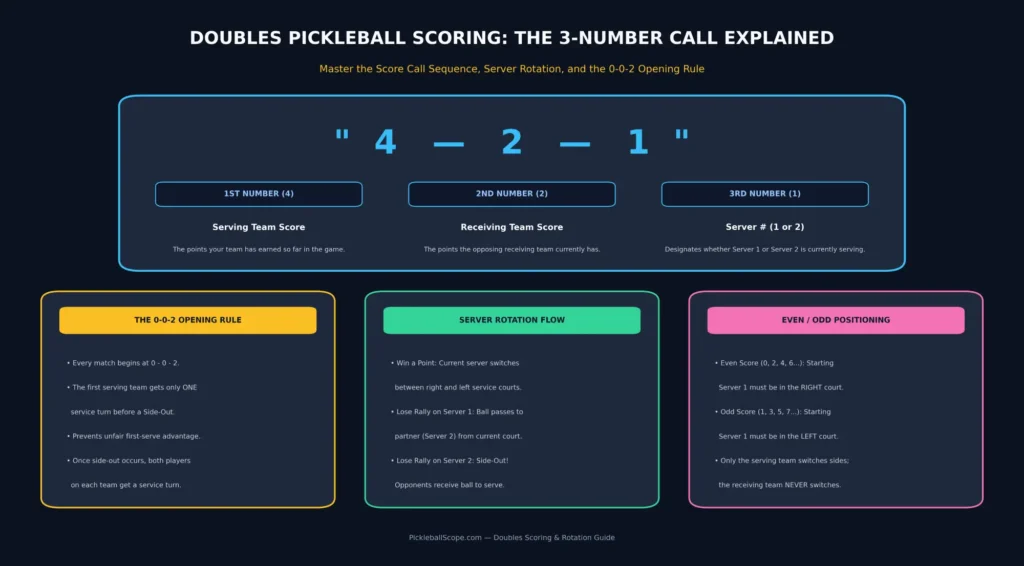
| Score Call Component | Example Value | Meaning |
|---|---|---|
| 1st Number | 4 | Serving Team’s Current Score |
| 2nd Number | 2 | Receiving Team’s Current Score |
| 3rd Number | 1 | Current Server Number on Serving Team (1 or 2) |
Example: Calling “4 – 2 – 1” means the serving team has 4 points, the receiving team has 2 points, and Server #1 is currently serving.
The Famous “0 – 0 – 2” Opening Rule
At the very start of every doubles game, the team that wins the coin toss or opening serve is only awarded one service turn before a side-out occurs. This rule eliminates the massive statistical advantage of serving first.
Therefore, the very first serve of every match is called as: Zero – Zero – Two (0 – 0 – 2). When that first server faults, service immediately transfers to the opponents as a Side-Out, and both players on each team will receive a turn to serve from that point forward.
6. Pickleball vs. Tennis: 7 Key Differences
While both sports are net-based racket games requiring hand-eye coordination, treating pickleball like miniature tennis leads to unforced errors. Here is how the two sports compare:
| Feature | Pickleball | Tennis | Tactical Distinction |
|---|---|---|---|
| Court Dimensions | 20 × 44 ft (880 sq ft) | 36 × 78 ft (2,808 sq ft Doubles) | Pickleball covers 1/4 the surface area; prioritizes reflexes over sprinting. |
| Equipment | Solid Composite Paddle (13–16mm) | Stringed Graphite / Carbon Racket | Hard paddle face produces short dwell time (~4ms) vs deep string pocket (~15ms). |
| The Ball | Perforated Plastic Polymer (26g) | Pressurized Rubber with Felt (58g) | Plastic balls do not bounce above chest height; rewards soft touch. |
| Serve Mechanics | Strictly Underhand (Below waist) | Overhead Power Weapon | Pickleball serve is tactically neutral; tennis serve seeks offensive aces. |
| Non-Volley Zone | 7-Foot Kitchen on both sides | None (Players can volley at net tape) | The Kitchen eliminates unreturnable net smashes. |
| Physical Joint Stress | Low to Moderate (Short lateral bursts) | High (Long sprint decelerations) | Delivers 400 cal/hr cardio with 70% less knee and shoulder strain. |
| Learning Curve | 10–15 Minutes to play fun games | Months of coaching for fluid rallies | Immediate accessibility across all age demographics. |
7. Why Is Pickleball So Addictive? (The 5 Secret Ingredients)
- Near-Zero Barrier to Entry: Unlike golf (which requires months of lessons to hit a straight drive) or tennis (which demands complex footwork and stroke mechanics), anyone can pick up a paddle and sustain a 10-shot rally on Day 1.
- The Great Strategic Equalizer: Because the kitchen prevents tall players from standing inches from the net and smashing every ball, a patient 65-year-old with exceptional placement can routinely defeat a 22-year-old college athlete who relies solely on power.
- The Hyper-Social “Paddle Stack” Culture: Pickleball uses an open-play system at public courts. You can show up alone, place your paddle into the queue rack, and rotate into games with complete strangers who welcome you immediately.
- Joint-Friendly Longevity: The compact court requires short lateral side-steps rather than punishing full-court sprints, allowing players to compete well into their 70s and 80s.
- Addictive Dopamine Rallies: Because plastic balls move at manageable speeds across a short 14-foot net gap, doubles points frequently feature 15 to 30 rapid-fire exchanges per rally.
8. Essential Beginner Gear Checklist (Getting Started Under $100)
You do not need to spend hundreds of dollars on pro-tier equipment to begin playing:
| Equipment Item | Recommended Specifications | Price Range | Why It Matters |
|---|---|---|---|
| Pickleball Paddle | 16mm Polypropylene Core with Raw Carbon Fiber face | $40 – $70 | 16mm thickness cushions impact and prevents tennis elbow. |
| Pickleball Balls | 3-pack of outdoor balls (Franklin X-40 or Dura Fast 40) | $10 – $14 | Standard USAP-approved tournament balls for consistent bounce. |
| Dedicated Court Shoes | Tennis or court shoes with lateral outrigger support | $60 – $90 | CRITICAL SAFETY RULE: Avoid running shoes with elevated heels that roll ankles! |
| Eye Protection & Grip | Polycarbonate sunglasses or sports goggles | $10 – $15 | Protects against deflected balls during fast kitchen firefights. |
9. 7 Rookie Traps to Avoid on Your First Day
- Backpedaling Upright on Lobs: Never walk backward upright to chase an overhead lob—you risk falling backward and hitting your head. Turn your hips sideways, drop-step, and sprint forward.
- Creeping Onto the Kitchen Line: Beginners frequently stand directly on the 2-inch kitchen line. Keep your toes 3 inches behind the painted line to ensure your volley momentum does not cause a foot fault.
- Over-Swinging at the Net: Pickleball at the kitchen line is a game of compact 6-inch push-punches. Big looping tennis backswings will make you late on 50 mph firefights.
- Attacking Balls Below the Net Tape: If the ball is below net height, do not try to smash it downward. Hit a soft cross-court dink and wait for your opponent to pop the ball up.
- Rushing the Net on Your Serve: Remember the Two-Bounce Rule! You must remain behind the baseline until the receiver’s return bounces once on your side.
- Death-Gripping the Paddle: Hold your paddle with a relaxed 4 out of 10 grip pressure. A loose wrist softens your hands and absorbs hard incoming drives.
- Lingering in “No-Man’s Land”: Either stay deep at the baseline or advance completely to the kitchen line. Never get stuck standing in the middle of the service box.
10. Frequently Asked Questions (FAQ)
What is pickleball and why is it so popular?
Pickleball is a paddle sport combining elements of tennis, badminton, and ping-pong played on a compact 20×44 ft court. It is the fastest-growing sport in America because of its 10-minute learning curve, low joint impact, highly social open-play culture, and deep tactical strategy.
Is pickleball easier to play than tennis?
Yes. Pickleball is significantly easier for beginners to learn than tennis because the court is one-fourth the size, the paddles are lighter and stringless, the underhand serve is easy to execute, and the ball moves at slower, manageable speeds.
Can you play pickleball with only 2 players?
Yes! While doubles (4 players) represents over 85% of all play, singles pickleball is played with 2 players using the exact same court dimensions and underhand serving rules, offering an intense cardio workout.
Why is the non-volley zone called the “Kitchen”?
The term was borrowed from shuffleboard, where the scoring area closest to the baseline where players can lose points is called the kitchen. In pickleball, the 7-foot Non-Volley Zone was designed to prevent tall players from standing right against the net to smash unreturnable shots.
How long does a standard pickleball game take?
A standard recreational game to 11 points (win by 2) typically takes between 12 and 20 minutes. A best 2 out of 3 tournament match lasts approximately 45 to 60 minutes.
Summary & Key Takeaways
- The Sport: Pickleball is a low-impact paddle sport played on a 20 × 44-foot court using composite paddles and a perforated plastic ball.
- The Non-Volley Zone (The Kitchen): You can never strike a ball out of the air while standing in or touching the 7-foot zone near the net.
- The Two-Bounce Rule: Both the serve and the return of serve must bounce before anyone can hit a volley.
- Scoring: In traditional side-out scoring, only the serving team can earn points; games are played to 11 points (win by 2).
- Next Steps: Grab a 16mm paddle, a 3-pack of outdoor balls, wear dedicated court shoes, and join open play at your local community court!
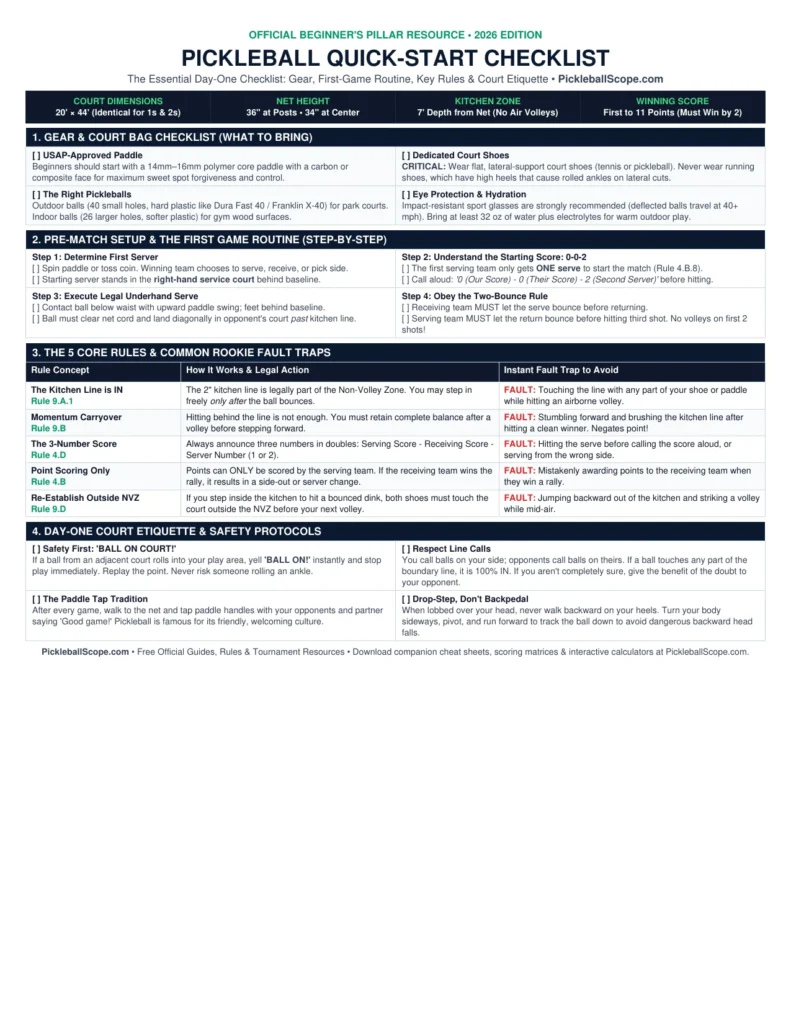
📄 Download the Free Pickleball Quick-Start Checklist (PDF)
Heading to the court for your first game? Keep this printable 1-page beginner checklist in your paddle bag. It covers essential gear, pre-match setup, the starting 0-0-2 score routine, key fault traps, and essential court etiquette.