
PILLAR 2: TECHNICAL GEAR & INDUSTRY LAB
The definitive masterclass on paddle core thickness, raw carbon vs. fiberglass faces, weight physics, shape geometry, and pro-level selection frameworks.
Finding the right gear starts with a comprehensive pickleball paddle guide that cuts through commercial marketing hype and focuses on the engineering principles that dictate real-world court performance. With hundreds of new brands flooding the market, picking the right paddle is no longer a matter of grabbing whatever colorful racquet catches your eye on a sporting goods shelf.
Today, paddles are high-tech composite instruments. The combination of internal core cell thickness, surface friction coatings, weight balance distribution, and handle ergonomics directly shapes whether your third-shot drops land softly in the kitchen or float up into an opponent’s smash zone. Playing with an mismatched paddle creates an invisible ceiling on your skill progression.
Under official equipment standards enforced by USA Pickleball and cataloged in the USA Pickleball Equipment Certification Lab, tournament-approved paddles must comply with rigorous dimensional, deflection, and surface roughness parameters. Navigating these technical specifications is essential whether you are an ambitious beginner buying your first serious paddle or a tournament veteran optimizing your competitive setup for your DUPR (Dynamic Universal Pickleball Rating).
This authoritative pickleball paddle guide serves as your master blueprint to paddle architecture. We will deconstruct the four fundamental pillars of paddle engineering—core thickness, surface materials, dynamic weight physics, and geometry—giving you the exact knowledge required to choose a paddle customized to your strengths.
⚡ The 30-Second Pickleball Paddle Selection Matrix
Short on time? Here is the quick-reference decision framework summarizing the four core paddle variables:
| Specification | Core Options | Primary Court Impact | Best Player Archetype |
|---|---|---|---|
| Core Thickness | 13mm / 14mm / 16mm / 20mm | Governs dwell time, pop, and vibration dampening. | 13mm = Singles Power 16mm = Doubles Control |
| Face Material | Raw Carbon (T700) vs. Fiberglass | Dictates rotational spin RPM and elastic rebound. | Carbon = 2,100+ RPM Spin Fiberglass = Trampoline Pop |
| Weight Class | Light (7.3–7.8oz) / Mid (7.9–8.4oz) / Heavy (8.5oz+) | Controls kitchen hand speed vs. baseline plow-through. | Midweight (8.0–8.2oz) is the gold standard for 80% of players. |
| Shape Geometry | Standard (16×8″) vs. Elongated (16.5×7.5″) | Balances sweet spot surface area against reach & whip. | Standard = Huge Sweet Spot Elongated = Power & Leverage |
1. Core Thickness Architecture: Pop vs. Control in This Pickleball Paddle Guide
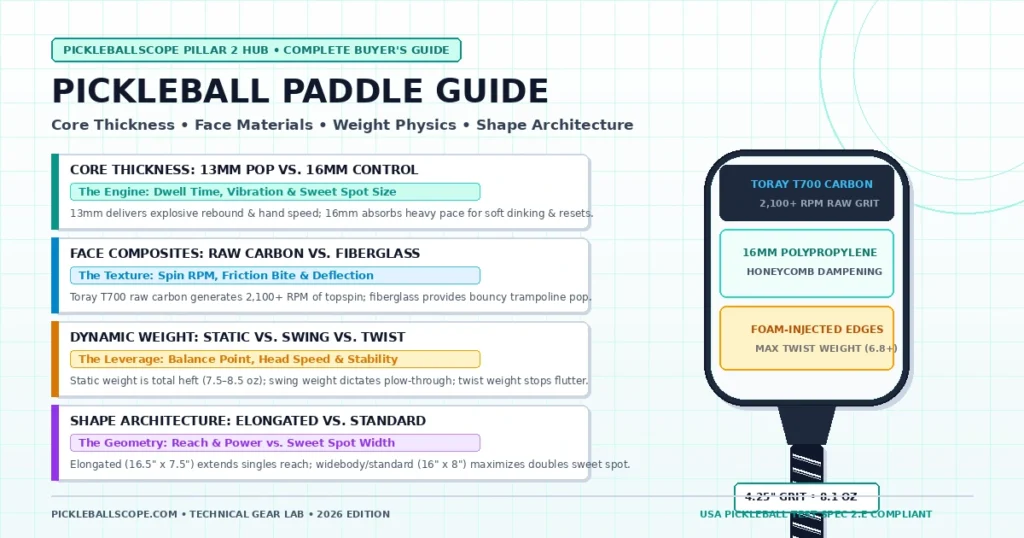
The single most defining internal specification explored across this pickleball paddle guide is core thickness. The internal polymer honeycomb core functions as the shock absorber and engine of the paddle, dictating how long the ball remains compressed against the face upon contact.
13mm & 14mm Cores: Explosive Pop and Fast Hands
Thinner cores (typically 13mm to 14mm) feature shorter, stiffer polypropylene honeycomb cell walls. Because there is less depth for the core to compress under impact, the ball rebounds off the face almost instantaneously with high kinetic return, generating what players describe as “pop.”
Thin cores excel in aggressive singles play, high-speed kitchen reflex volleys, and baseline passing shots. However, they provide a smaller active sweet spot and higher torsional vibration, making soft third-shot drops and defensive resets more challenging to control.
16mm Cores: The Gold Standard for Control and Forgiveness
A 16mm core features approximately 23% deeper honeycomb cells than a 13mm board. This extra depth cushions the ball upon impact, dramatically increasing dwell time. The paddle absorbs incoming pace rather than bouncing it immediately back.
This dampening effect is why over 75% of competitive tournament doubles players choose 16mm paddles. As explored in our deep-dive on 13mm vs 16mm pickleball paddle cores, the plush feel neutralizes aggressive banger drives, keeps dinks unattackable beneath the net tape, and expands the usable sweet spot across the perimeter frame.
2. Face Materials Breakdown: Raw Carbon Fiber vs. Fiberglass Composite
While the core governs internal energy absorption, the face material dictates external ball interaction: surface grip, spin rate, and elastic launch angle.
Raw Carbon Fiber (Toray T700 / 3K Weaves)
Raw carbon fiber represents the current pinnacle of tournament paddle technology. Premium manufacturers utilize Japanese Toray T700 carbon fabric textured with a specialized “peel-ply” curing process. This creates microscopic structural ridges molded directly into the composite resin without requiring external sprayed grit.
Raw carbon paddles generate elite spin rates between 1,950 and 2,250+ RPM. This massive rotational torque creates heavy topspin dips on groundstrokes and razor-sharp slicing bites on roll volleys. Furthermore, because the texture is permanent composite structure, raw carbon maintains its spin performance for 9 to 15+ months of regular play.
Fiberglass (Composite Glass Fibers)
Fiberglass faces consist of woven glass filaments that flex elastically upon ball impact. Glass fibers possess a lower stiffness modulus than carbon, acting like a miniature trampoline that springs forward to produce effortless driving depth on compact swings.
However, because fiberglass cures with a smooth surface, manufacturers must spray external silica grit or textured paint over the face to generate spin. In our head-to-head laboratory testing of raw carbon vs fiberglass pickleball paddle surfaces, this external grit abrades away after 50 to 100 hours of heavy play. While fiberglass remains an exceptional budget choice, competitive players gravitate toward raw carbon for durable tournament spin.
3. Weight Dynamics: Static Weight vs. Swing Weight vs. Twist Weight
A common error we address in this pickleball paddle guide is evaluating a paddle based purely on its static scale weight. In modern performance testing, three separate weight metrics govern how a paddle moves through the air:
| Weight Metric | How It Is Measured | Court Performance Impact | Ideal Target Range |
|---|---|---|---|
| Static Weight | Total paddle mass on a digital scale (ounces/grams) | Overall arm fatigue and baseline heft. | 7.9 – 8.3 oz (Midweight) |
| Swing Weight (SW) | Rotational moment of inertia around the wrist pivot | Dictates baseline drive plow-through vs. kitchen hand speed. | 108 – 116 (All-Around) 118 – 125+ (Power) |
| Twist Weight (TW) | Resistance to twisting along the vertical axis on mishits | Defines sweet spot width and stability during off-center blocks. | 6.2 – 6.8 (Standard) 6.9 – 7.5+ (Elite Stability) |
As we demonstrate in this pickleball paddle guide, two paddles weighing an identical 8.0 ounces can feel entirely different in hand. A paddle with mass concentrated in the head has a high swing weight (120+), swinging like a heavy hammer that crushes drives but lags during kitchen firefights. Conversely, a paddle with mass concentrated near the throat has a low swing weight (110), allowing lightning-fast reflex resets at the non-volley zone line.
4. Paddle Shape & Geometry: Elongated vs. Standard Widebody vs. Hybrid
In this comprehensive pickleball paddle guide, every regulation paddle must comply with USA Pickleball dimensional limits: the combined length plus width cannot exceed 24 inches, and overall length cannot exceed 17 inches. Within these boundaries, manufacturers engineer three distinct geometries:
The 3 Primary Shape Geometries:
- Standard / Widebody (16″ Length x 8″ Width): The widest legal hitting surface. Maximizes twist weight, expands sweet spot forgiveness, and keeps swing weight low. Ideal for doubles players who prioritize consistency and minimizing mishit unforced errors.
- Elongated (16.5″ Length x 7.5″ Width): Adds a half-inch of reach and shifts the balance point toward the tip. Creates maximum lever-arm torque for heavy baseline drives and overhead smashes, but narrows lateral sweet spot width.
- Hybrid (16.3″ Length x 7.7″ Width): The modern tournament standard. Blends the aerodynamic reach of an elongated paddle with the forgiving sweet spot width of a widebody frame.
5. Handle Length and Grip Sizing: Finding Your Ergonomic Match
Even the most expensive paddle will feel awkward if the handle geometry clashes with your grip mechanics. Two physical handle dimensions demand careful evaluation:
Handle Length: 1-Handed vs. 2-Handed Backhands
Standard handles range from 4.75 to 5.0 inches long, leaving more surface area on the paddle face for ball striking. However, players who utilize a two-handed backhand drive or reset require a minimum handle length of 5.25 to 5.5 inches to fit both hands comfortably on the grip.
Grip Circumference: The Index Finger Sizing Test
Most commercial paddles feature a standard grip circumference between 4.125 inches (thin) and 4.375 inches (medium). To verify your correct grip size:
- Hold the paddle in your dominant hand using an Eastern or Continental grip.
- Slide the index finger of your opposite hand between your fingertips and the heel of your palm.
- Your finger should fit snugly in the gap. If your fingertips touch your palm, the grip is too small; if there is wide extra space, the grip is too large.
Pro Tip: When in doubt, always choose the smaller grip circumference. You can easily build up a thin grip by adding an inexpensive cushioned overgrip, but you cannot shrink a grip that is manufactured too bulky.
6. Buyer Personas: Matching Your Skill Level & DUPR Division
To streamline your purchase decision in this pickleball paddle guide, we have translated complex engineering specs into four field-tested player profiles:
Profile A: The Improving Intermediate
Goal: Reduce pop-ups, build dinking confidence, and expand sweet spot forgiveness.
- Specs: 16mm Polymer Core • Toray T700 Raw Carbon Face • Standard/Hybrid Shape • 7.9–8.2 oz Midweight.
- Benefit: The thick core cushions hard opponent drives and keeps resets low in the kitchen.
Profile B: Competitive Tournament Doubles
Goal: Master the soft game while maintaining offensive speed-up power and 2,100+ RPM spin.
- Specs: 16mm Thermoformed Core • Raw Carbon with Foam Walls • Hybrid Shape • 8.1–8.4 oz.
- Benefit: Unibody construction provides perimeter stability without losing touch.
Profile C: Singles Attacker & Power Banger
Goal: Overpower opponents with baseline passing drives, heavy serves, and overhead putaways.
- Specs: 13mm or 14mm Core • Elongated Shape (16.5″) • High Swing Weight (118+) • 8.3–8.6 oz.
- Benefit: Maximizes lever-arm leverage and trampoline pop to penetrate transition zones.
Profile D: Arm Relief & Joint Comfort
Goal: Eliminate harsh impact vibrations and protect joint health by switching to certified quiet pickleball paddles while developing a soft pickleball dinking strategy at the net.
- Specs: 16mm or 20mm Foam-Dampened Core • Raw Carbon Face • Midweight (8.1 oz) with throat tape.
- Benefit: Deep honeycomb walls trap shock before vibrations reach the forearm.
7. Price Tiers & Value Breakdown: What Does Your Money Buy?
Paddle pricing ranges from $30 budget sets up to $280 professional tour flagships. Understanding what separates price tiers prevents overpaying for unnecessary features:
- Budget Tier ($40 – $80): Typically features basic non-thermoformed honeycomb cores with painted fiberglass or entry-level carbon faces. Excellent for beginners learning court positioning, but grit wears smooth quickly.
- Value Performance Tier ($90 – $140): The modern sweet spot for amateur players. Brands in this tier (such as Vatic Pro, Ronbus, and Spartus) offer premium Toray T700 raw carbon faces and durable 16mm cores without charging premium sponsorship markups.
- Pro Flagship Tier ($160 – $260): The highest level of composite engineering. Features fully thermoformed unibody frames, perimeter foam injection, carbon-wrapped edge seams, and bespoke balance tuning used by professional touring athletes.
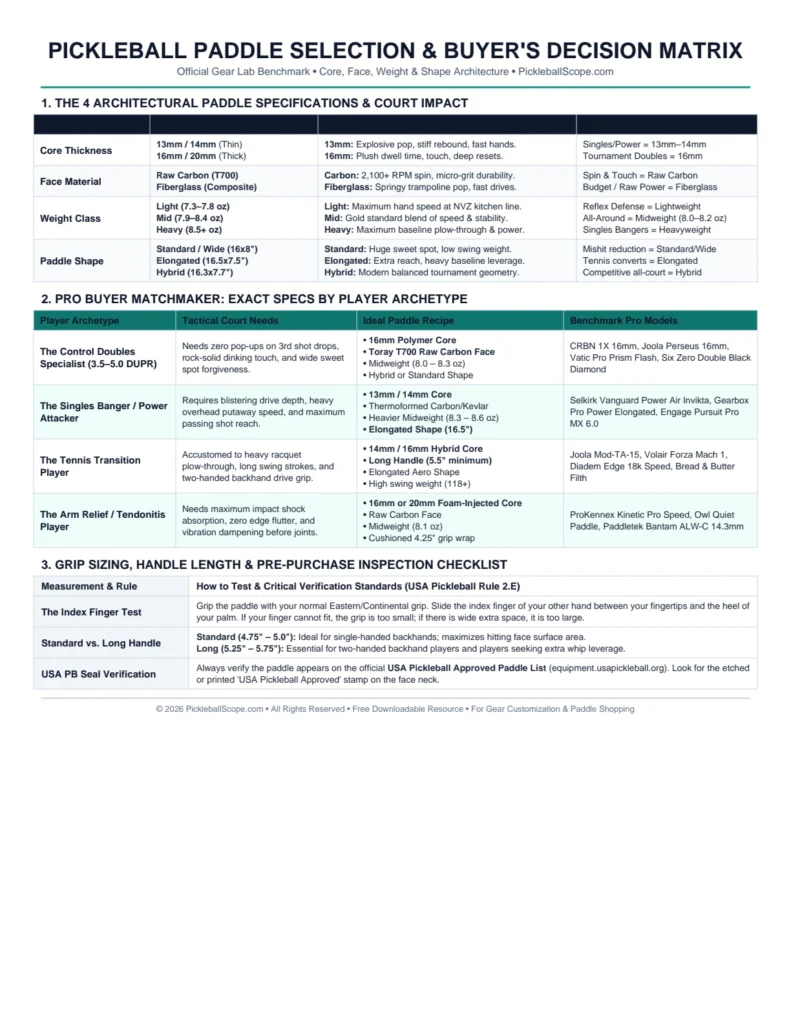
📄 Download the Free Paddle Selection & Buyer’s Matrix (PDF)
Take the confusion out of paddle shopping. This 1-page printable reference card features our complete buyer’s flowchart, spec comparison charts, grip sizing rules, and weight benchmarks for your gear bag.
Frequently Asked Questions in Our Pickleball Paddle Guide
How often should I replace my pickleball paddle?
For players competing 2 to 3 times per week, a quality raw carbon paddle typically maintains peak structural integrity and surface grit for 9 to 15 months. Frequent tournament competitors playing 4+ times weekly often replace paddles every 6 to 9 months to ensure maximum spin RPM and core responsiveness.
What is the difference between a control paddle and a power paddle?
Control paddles feature thicker cores (16mm) and raw carbon faces that absorb ball energy to prolong dwell time, making soft dinks and resets easy to execute. Power paddles feature thinner cores (13mm–14mm) and flexible fiberglass or stiff thermoformed faces that launch the ball with explosive rebound speed.
Is a heavier or lighter pickleball paddle better?
Midweight paddles (7.9 to 8.3 ounces) provide the ideal balance of hand speed and stability for the vast majority of players. Lighter paddles (under 7.8 oz) increase kitchen hand speed but flutter on off-center hits; heavier paddles (over 8.4 oz) deliver heavy plow-through power but can cause arm fatigue.
What does “thermoformed” mean in pickleball paddle construction?
Thermoforming is an advanced manufacturing process where heat and pressure fuse the carbon face sheets, foam-injected perimeter walls, and honeycomb core into a single seamless unibody structure. Thermoformed paddles offer significantly higher torsional stability, larger sweet spots, and enhanced durability compared to traditionally glued sandwich paddles.
Can I customize my paddle weight after buying it?
Yes. As detailed in our complete pickleball lead tape guide, you can alter the swing weight, twist weight, and balance point of any approved paddle by adding adhesive lead or tungsten tape along the perimeter edge guard. Customizing with weighted tape is 100% legal under USA Pickleball Rule 2.E.5b.
Key Takeaways: Mastering This Pickleball Paddle Guide
- Core thickness governs your touch: Choose 16mm for soft doubles resetting and sweet spot stability; choose 13mm/14mm for singles drive penetration.
- Raw carbon maximizes spin: Woven Toray T700 carbon delivers 2,000+ RPM of topspin with permanent structural durability.
- Watch swing weight over static weight: How weight is distributed between the tip and handle dictates hand speed far more than total ounces.
- Match shape to your format: Standard/widebody shapes forgive mishits in doubles; elongated shapes provide reach and leverage for passing shots.
- Start with a midweight 16mm hybrid: If you are unsure where to begin, a 16mm raw carbon hybrid paddle (8.0–8.2 oz) represents the most versatile foundation in the sport.