
PILLAR 2: TECHNICAL GEAR & INDUSTRY LAB
The definitive material science breakdown of Toray T700 raw carbon vs. composite fiberglass, spin RPM benchmarks, grit decay, and playstyle selection.
Deciding between a raw carbon vs fiberglass pickleball paddle is one of the most critical gear choices you will make on the court. While the internal honeycomb core dictates baseline thickness and vibration absorption, the exterior face material directly controls ball friction, rotational spin, exit velocity, and how the paddle performs over months of aggressive play.
For years, traditional fiberglass (often labeled “composite”) dominated the market by offering explosive trampoline pop and vibrant painted graphics at budget-friendly prices. However, the introduction of raw carbon fiber—specifically Japanese Toray T700 carbon weaves with peel-ply textures—has sparked a total equipment revolution among competitive players and touring professionals.
According to certified equipment testing protocols published by USA Pickleball Equipment Standards and verified by USA Pickleball, paddle faces must comply with strict surface roughness thresholds (under 40 micro-inches Ra). The key distinction lies in how that roughness is achieved: while fiberglass relies on external sprayed-on grit that quickly wears down, raw carbon embeds permanent microscopic texture directly into the woven composite fabric.
Whether you want explosive power for baseline singles drives or elite topspin dipping to dominate high-level doubles exchanges, this definitive raw carbon vs fiberglass pickleball paddle guide breaks down material science, real-world RPM benchmarks, durability timelines, and selection rules to find the perfect paddle face for your game.
⚡ The 30-Second Raw Carbon vs Fiberglass Pickleball Paddle Cheat Sheet
Short on time? Here is how raw carbon fiber and fiberglass stack up across key lab benchmarks and court metrics:
| Performance Metric | Raw Carbon Fiber (Toray T700 / 3K) | Fiberglass (Composite / Glass-Fiber) |
|---|---|---|
| Primary Personality | Elite Spin, Plush Control & Predictable Touch | Explosive Pop, Trampoline Power & Lively Drives |
| Average Spin Rate | 1,950 – 2,250+ RPM (Tier 1 Benchmark) | 1,450 – 1,750 RPM (Moderate Tier) |
| Surface Texture Type | Naturally woven carbon weave with peel-ply texture | Smooth fiberglass with sprayed-on silica/paint grit |
| Grit Lifespan | 9 to 15+ Months (Permanent structural friction) | 3 to 6 Months (External grit polishes smooth) |
| Ball Dwell Time | Longer, cushioned contact (absorbs hard shots) | Short, instantaneous rebound (snappy launch) |
| Vibration & Stiffness | Stiff composite weave; transfers clean feedback | Flexible glass fibers; produces spring-like bounce |
| Ideal Player Level | Tournament Doubles Competitors (3.5 – 5.5 DUPR) | Beginners, Rec Bangers & Singles Power Hitters |
1. Material Anatomy: What Is Raw Carbon Fiber vs. Fiberglass Composite?
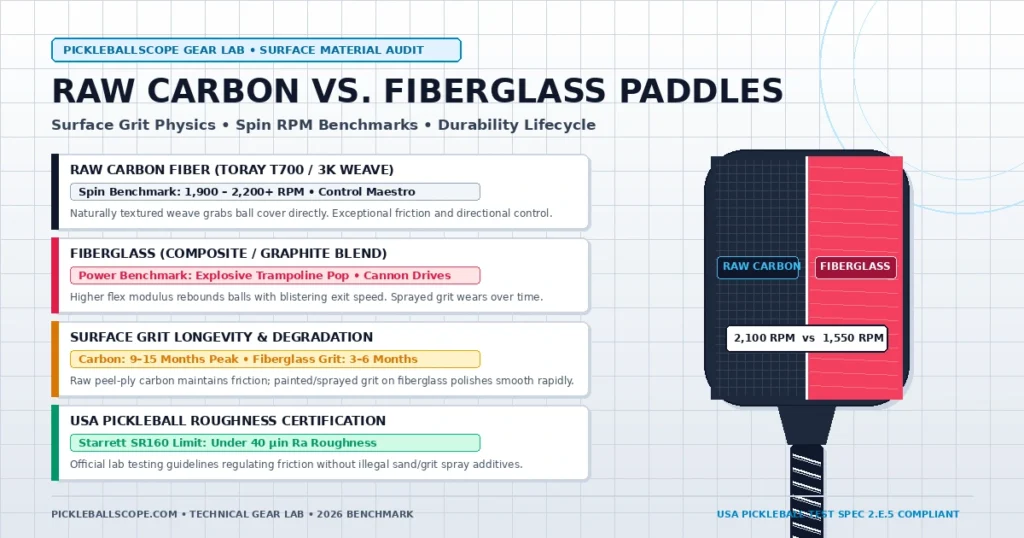
To grasp the performance differences in a raw carbon vs fiberglass pickleball paddle, you must understand how these two composite materials are fabricated in modern manufacturing facilities.
The Anatomy of Raw Carbon Fiber (Toray T700)
Raw carbon fiber paddles are built using sheets of polyacrylonitrile (PAN) carbon fibers that are heated, aligned, and woven into high-tensile fabric mats. The gold standard in tournament pickleball is Toray T700 carbon, recognized for its ultra-high tensile strength and fatigue resistance.
What makes “raw” carbon unique is the absence of painted topcoats or glossy polyurethane sealants. During the heated mold curing process, manufacturers press a specialized textured fabric called “peel-ply” directly against the carbon mat. When peeled away, it leaves a raw, exposed microscopic carbon texture that grips the soft plastic surface of the pickleball.
The Anatomy of Fiberglass (Composite Glass Fibers)
Fiberglass paddle faces consist of woven glass filaments embedded in an epoxy resin matrix. Glass fibers have a significantly lower stiffness modulus than carbon fibers, allowing the material to flex and bend elastically upon ball impact.
Because cured fiberglass naturally cures with a mirror-smooth finish, manufacturers cannot achieve regulation spin through the raw fibers alone. Instead, they apply colorful screen-printed graphics over the face and spray an external grit mixture—consisting of silica sand, crushed glass particles, or polyurethane texturing agents—across the surface.
2. Spin Mechanics and RPM Benchmarks: Raw Carbon vs Fiberglass Pickleball Paddle Face Grip
Spin is the great equalizer in modern pickleball. A drive loaded with 2,000 RPM of topspin dives sharply into the opponent baseline, while a dipping roll volley forces opponents to hit upward from below the net tape.
When comparing a raw carbon vs fiberglass pickleball paddle on an optical spin tachometer, raw carbon paddles consistently deliver 400 to 600 more revolutions per minute (RPM). While standard fiberglass paddles typically peak around 1,500 to 1,750 RPM, premium Toray T700 raw carbon paddles regularly break 2,100 to 2,250+ RPM.
This massive spin disparity comes down to friction mechanisms. When a plastic ball compresses against a raw carbon face, the microscopic ridges of the carbon weave physically “bite” into the ball skin without slipping. With fiberglass, the ball slides across the smooth painted surface until it catches on scattered silica grit particles, resulting in less uniform rotational torque.
For players executing third-shot drops and aggressive dipping drives, the enhanced RPM of raw carbon allows you to swing with full acceleration while trusting the aerodynamic Magnus effect to pull the ball down inside the boundary lines.
3. Power, Pop, and Dwell Time: Why Fiberglass Rebounds Harder
While raw carbon dominates the spin category, fiberglass maintains a massive advantage in pure exit velocity and effortless offensive power. If you struggle to hit deep groundstrokes or want blistering pace on overhead smashes, fiberglass delivers an unmistakable trampoline effect.
Because glass fibers flex more easily than rigid carbon strands, a fiberglass face deforms inward during ball contact, storing kinetic energy like a drawn bowstring. As the ball rebounds, the face springs forward, launching the ball off the paddle with explosive pop even on short, compact swings.
Conversely, a raw carbon face is stiff, rigid, and non-elastic. It absorbs incoming ball momentum rather than bouncing it immediately back. In laboratory testing, this extended contact window is called dwell time. The ball stays connected to the carbon face for crucial milliseconds longer, giving your fingers sensory feedback to shape delicate dinks and reset heavy drives into the kitchen.
However, that fiberglass trampoline pop can become a liability during fast kitchen exchanges. If an opponent drives hard at your chest, a fiberglass paddle tends to launch the ball slightly too high, turning defensive blocks into floating putaways for your opponents.
4. Grit Longevity and Durability: The Hidden Cost of Sprayed-On Texture
Perhaps the most significant contrast in this raw carbon vs fiberglass pickleball paddle evaluation is how the hitting surface ages over weeks and months of competitive play.
Surface Degradation Breakdown:
- Sprayed Fiberglass Grit (Rapid Decay): Because the grit on fiberglass paddles is an external coating sprayed over paint, it wears off rapidly through friction. After 50 to 100 hours of aggressive hitting, the center sweet spot polishes smooth, causing spin rates to plummet by 30% to 40%.
- Raw Carbon Peel-Ply (Structural Durability): Raw carbon texture is molded directly into the composite fibers and cured resin. It does not peel, flake, or chip off. A quality raw carbon paddle maintains peak spin capabilities for 9 to 15+ months of regular play.
While a brand-new $70 fiberglass paddle might feel surprisingly gritty out of the retail package, that texture is temporary. By month three, you are effectively playing with a slick, spin-less board. For long-term tournament value, raw carbon paddles justify their higher initial price tag by maintaining consistent friction across an entire season.
5. Decision Framework: Matching Face Materials to Your Playstyle & DUPR Rating
To choose between a raw carbon vs fiberglass pickleball paddle, evaluate your tactical identity, physical strengths, and current skill division:
Choose Raw Carbon Fiber If:
- You play competitive doubles: You prioritize third-shot drops, reset consistency, dinking touch, and minimizing pop-up unforced errors.
- You rely heavily on topspin and slice: You shape angles with rolling topspin drives, dipping kitchen volleys, and aggressive curving serves.
- You have a higher DUPR (Dynamic Universal Pickleball Rating) (3.5 – 5.5): You generate your own swing power and demand maximum control and predictability from your equipment.
- You want multi-season durability: You prefer paying for a durable composite surface that will not lose its grip after two months of summer play.
Choose Fiberglass (Composite) If:
- You struggle to generate driving depth: Your swing mechanics lack natural power, and you need the paddle trampoline effect to push opponents to the baseline.
- You play extensive singles: You need maximum putaway velocity, flat passing shots, and deep serves to exploit open court geometry.
- You play casually on a budget: You play once or twice a week recreationally and do not want to spend over $100 on a high-end tournament paddle.
- You prefer flat, penetrating drives: Your strategy revolves around hitting hard, flat shots through transition zones rather than shaping heavy spin.
6. Cleaning and Maintenance: Restoring Spin with a Carbon Paddle Eraser
A common misconception among players testing a raw carbon vs fiberglass pickleball paddle is that raw carbon loses its grit when spin drops after a few weeks. In reality, raw carbon does not wear down—it gets clogged.
When a hard plastic ball strikes a textured carbon face, microscopic plastic shavings shave off the ball and embed themselves inside the carbon weave. Over time, this smooth plastic residue fills the grooves, creating a slick layer that feels like worn-out sandpaper.
To restore raw carbon spin instantly, use a dedicated natural rubber paddle eraser. Rubbing the soft rubber block firmly across the paddle face pulls compacted ball dust out of the weave, returning the carbon to its original factory friction. Cleaning your paddle every two to three sessions can restore 100 to 150 RPM of lost spin.
Warning for Fiberglass Owners: Never use a rubber paddle eraser on a sprayed fiberglass paddle. The aggressive rubber friction will peel the delicate silica grit directly off the paint, permanently ruining the paddle surface.
7. USA Pickleball Surface Regulations: Friction Testing & Rule 2.E.5
Every commercial paddle face must adhere to strict regulatory standards enforced by USA Pickleball under Rule 2.E.5. These rules ensure that manufacturers do not create unfair spin advantages through illegal surface treatments.
The USA Pickleball Equipment Certification Lab measures surface roughness using a Starrett SR160 profilometer. An approved paddle cannot exceed an average surface roughness (Ra) of 30 to 40 micro-inches, and maximum peak roughness (Rz) must remain under strict tournament caps.
This is why raw carbon has become the dominant technology among tournament competitors. By molding controlled peel-ply textures directly into carbon resin, manufacturers can engineer surfaces that sit precisely at the legal roughness threshold without risking disqualification from aftermarket grit flaking.
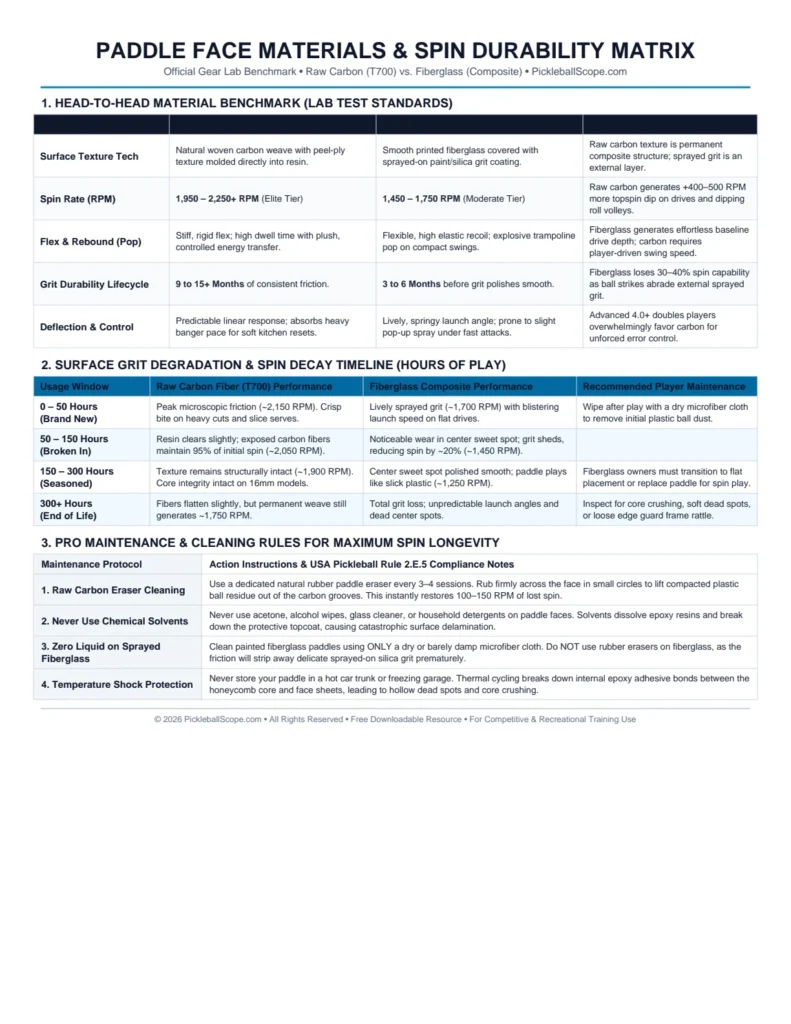
📄 Download the Free Paddle Face Materials & Spin Matrix (PDF)
Need a quick, 1-page printable reference sheet for your gear bag or paddle testing? Download our lab benchmark matrix comparing spin RPM, grit decay timelines, and cleaning rules.
Frequently Asked Questions About Raw Carbon vs Fiberglass Pickleball Paddles
Can a fiberglass paddle spin as well as a raw carbon paddle?
When brand new, a high-grit fiberglass paddle can generate respectable spin (up to 1,700 RPM). However, it cannot match the elite 2,000+ RPM of raw carbon, and its sprayed-on grit degrades significantly faster after a few weeks of heavy use.
Why are raw carbon fiber paddles more expensive than fiberglass?
Toray T700 carbon fiber is a specialized aerospace-grade composite that costs substantially more to source and process than woven fiberglass mats. Additionally, the peel-ply thermoforming manufacturing process requires higher heat, pressure, and precision tooling.
What is a hybrid paddle face?
Several modern brands blend materials by weaving carbon fiber and fiberglass (or Kevlar) together in a crosshatch pattern. These hybrid faces aim to deliver the spin and touch of carbon alongside the explosive pop and flex of fiberglass.
How do I know when my paddle grit has worn out?
If you notice your topspin dipping drives sailing out of bounds, your roll volleys losing bite, or the center sweet spot feeling slick and glossy under your thumb, the surface texture has degraded. On fiberglass, this indicates permanent grit loss; on raw carbon, try cleaning it with an eraser first.
Which paddle face material is better for players with tennis elbow?
Raw carbon fiber paired with a thicker 16mm core is significantly better for arm comfort. Raw carbon absorbs ball impact energy, whereas the elastic rebound of fiberglass can transfer sharp shock vibrations down into the forearm and elbow joint.
Key Takeaways: Raw Carbon vs Fiberglass Pickleball Paddle Selection
- Raw carbon excels at spin and control: Woven Toray T700 carbon delivers 2,000+ RPM and exceptional touch for tournament doubles.
- Fiberglass delivers explosive power: Flexible glass fibers create trampoline pop and deep baseline drives on a budget.
- Grit durability favors carbon: Raw carbon texture is permanent composite structure, while sprayed fiberglass grit wears off in months.
- Maintenance matters: Clean raw carbon regularly with a rubber eraser to remove plastic ball dust and restore spin RPM.
- Choose based on playstyle: Pick fiberglass if you lack driving power; pick raw carbon if you want precision, spin, and unforced error control.