PILLAR 1: COURT RULES MASTERCLASS
Master the 3 volley serve requirements, the 2026 drop serve alternative, legal baseline footwork, and illegal pre-spin bans under official USA Pickleball Rule 4.
Understanding official pickleball serve rules is essential for every player who wants to step onto the court with confidence and avoid frustrating illegal serve arguments. Because pickleball intentionally differs from tennis, squash, and racquetball, its service regulations are unique in modern racket sports.
In traditional racket sports, the serve is an aggressive, overhead weapon designed to blast unreturnable aces past an opponent. Pickleball flips this paradigm completely. Under official rules codified by USA Pickleball, the serve is strictly designed as an underhand rally starter meant to put the ball in play in a neutral, balanced fashion.
Whether you are discovering what is pickleball for the first time or reviewing the 5 basic rules of pickleball, the traditional volley serve’s three biomechanical requirements and the newer “Drop Serve” alternative frequently spark rec-court debates. Does your paddle have to move upward? Can you drop the ball from shoulder height? What happens if your toe brushes the baseline?
This comprehensive guide breaks down official pickleball serve rules under USA Pickleball Rule 4, compares the volley serve directly against the drop serve, and details exactly how to execute a legal, unassailable serve on every point.
⚡ The 30-Second Pickleball Serve Rules Summary
If you’re walking onto the court right now, here are the core service mandates you must know:
- Two Legal Serve Options: You can hit a Volley Serve (tossed and hit out of the air) or a Drop Serve (dropped and hit off the bounce).
- The 3 Volley Serve Mandates: If serving out of the air, (1) your arm must move in an upward arc, (2) paddle contact must be below the navel, and (3) the paddle head must sit below your wrist joint.
- The Drop Serve Advantage: If you let the ball bounce first, the upward arc and wrist height rules are completely waived! (Rule 4.A.8).
- Foot Placement: Both feet must remain completely behind the baseline until the paddle strikes the ball. Touching the baseline before contact is an instant fault.
- Diagonal Clearance: The ball must travel diagonally cross-court and clear the 7-foot kitchen line completely. Touching the kitchen line is a service fault.
Why Pickleball Serve Rules Exist: Neutralizing the Offensive Ace
To understand official pickleball serve rules, you must understand the core philosophy behind the sport’s invention. When Joel Pritchard and Barney McCallum codified pickleball in 1965, they realized that permitting tennis-style overhead serves on a compact 20 × 44-foot court would ruin the game.
On a court that small, an athletic adult hitting downward smashes would generate unreturnable aces on virtually every point. The game would become a contest of height and raw shoulder power rather than tactical hand-eye coordination.
By mandating underhand mechanics, pickleball serve rules neutralize the server’s natural advantage. The serving team is forced to initiate the rally from a neutral baseline position, making deep service placement a foundational milestone in learning how to get better at pickleball.
The 3 Mandatory Volley Serve Mechanics Under Pickleball Serve Rules
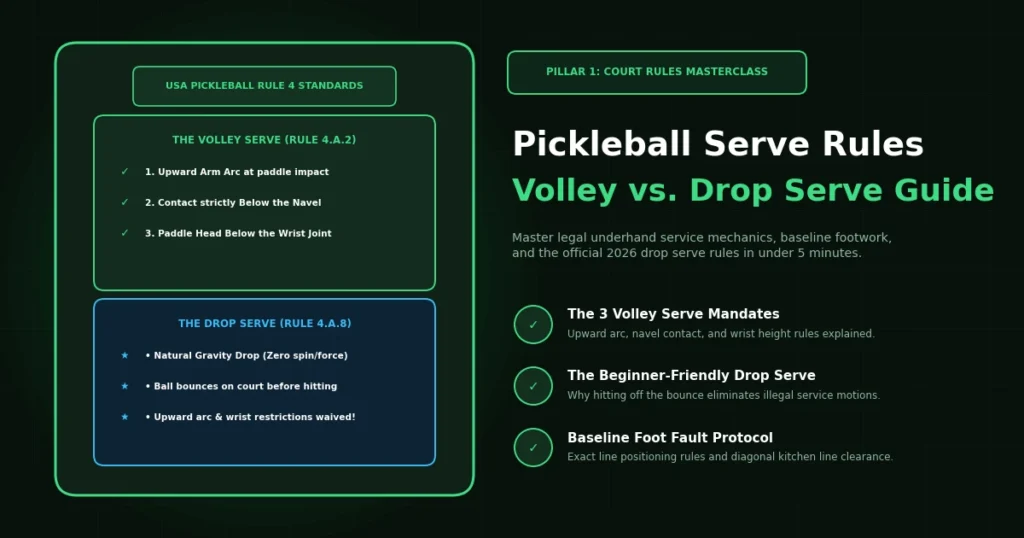
The traditional serve in pickleball is the Volley Serve (Rule 4.A.2), where the server releases or gently tosses the ball and strikes it directly out of the air. To ensure the stroke remains strictly underhand, official pickleball serve rules require three simultaneous biomechanical conditions at the exact moment of paddle impact:
| Mandate # | USA Pickleball Rule Requirement | How to Ensure It’s Legal |
|---|---|---|
| 1. Upward Arm Arc (Rule 4.A.2.a) | The server’s arm must move in an upward arc at the moment of ball contact. | Initiate your stroke from low to high (6 o’clock to 12 o’clock). Horizontal sidearm slashes or downward chops are strictly illegal. |
| 2. Contact Below the Navel (Rule 4.A.2.b) | Paddle contact with the ball must occur strictly below the server’s waist level. | Under the rulebook, waist level is defined as the height of the navel (belly button). If you strike at ribcage height, it is an immediate fault. |
| 3. Paddle Head Below Wrist (Rule 4.A.2.c) | The highest point of the paddle head cannot be above the highest part of the wrist joint upon contact. | Keep the paddle head angled downward. If the paddle face is parallel to the ground or angled upward above your wrist, the serve is illegal. |
Every single volley serve you hit must satisfy all three of these conditions at the exact microsecond of ball impact. If a referee or tournament opponent spots a horizontal sidearm stroke or an impact point at chest height, an illegal service fault will be called immediately.
The Drop Serve Alternative Under Pickleball Serve Rules (Rule 4.A.8)
Because the three volley serve mandates created endless subjective arguments in recreational play—where referees are not present to measure navel heights—USA Pickleball introduced the Drop Serve as a permanent alternative.
Under official pickleball serve rules, a player may choose to execute a drop serve on any point without announcing it beforehand. The mechanics are simple and foolproof:
- The Pure Drop: The server releases the ball from their hand at any natural standing height and lets it bounce on the court surface before striking it.
- Zero Propelled Force: The ball must fall strictly under the natural force of gravity. You cannot throw the ball upward, bounce it downward with force, or add spin with your fingers.
- The Big Regulatory Advantage: When striking a drop serve off the bounce, none of the three volley serve restrictions apply! You can hit sidearm, strike the ball above your navel, or have the paddle head above your wrist.
For beginners or intermediate players transitioning from tennis who struggle with illegal sidearm volley serves, the drop serve is the ultimate equalizer. Because the ball bounces on the ground first, it naturally limits the height and power of your contact point while guaranteeing complete legality.
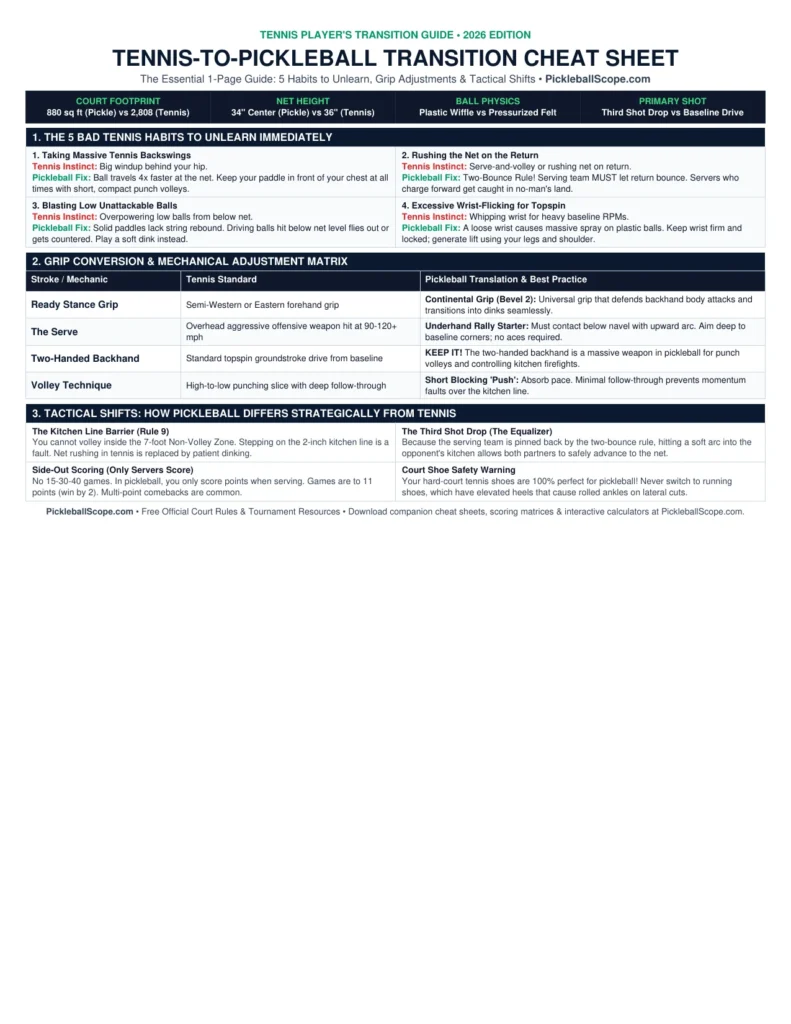
📄 Download the Free Pickleball Serve Rules Cheat Sheet (PDF)
Eliminate service arguments on the court. Keep this high-contrast 1-page printable pocket reference in your bag. Covers the 3 volley serve mandates, drop serve regulations, baseline foot fault rules, and tactical placement zones.
Volley Serve vs. Drop Serve: Direct Head-to-Head Comparison
Review this side-by-side comparison to choose the right service style for your game under current pickleball serve rules:
| Service Characteristic | Traditional Volley Serve | The Drop Serve |
|---|---|---|
| Ball Contact Point | Airborne (Directly out of the air) | Off the bounce on court surface |
| Upward Arm Arc Mandate | Mandatory (Strictly enforced) | Waived (Not required) |
| Contact Below Navel Rule | Mandatory (Waist level cutoff) | Waived (Can strike higher off bounce) |
| Paddle Head Below Wrist Rule | Mandatory (Downward angle) | Waived (Any angle permitted) |
| Ball Release Technique | Gentle drop or upward air toss | Pure gravity drop only (No downward force) |
| Primary Player Benefit | Maximum topspin drive potential | 100% foolproof legality and consistency |
Pickleball Serve Rules for Court Positioning & Baseline Foot Faults
Even if your paddle stroke is flawless, you can still commit an immediate service fault if your feet violate court positioning rules. Under Rule 4.A.4, official pickleball serve rules dictate strict boundary mandates:
1. Feet Behind the Baseline
At the precise moment your paddle makes contact with the ball, at least one foot must be touching the ground completely behind the baseline. Neither foot may touch the painted baseline or the court surface inside the boundary lines until after contact has occurred.
Brushing even a single millimeter of the painted baseline with your shoe sole or toe is an immediate Service Foot Fault, resulting in a loss of the rally.
2. Staying Within Centerline and Sideline Extensions
The server must stand within the imaginary extensions of the court centerline and the outside sideline. You cannot step outside the boundary lines to create an exaggerated angle before hitting your serve.
3. Diagonal Trajectory and the Kitchen Line Exception
The serve must travel diagonally across the net into the diagonally opposite service court according to official court specification standards. In pickleball, all boundary lines (baseline, centerline, sideline) are considered “in”.
However, under official pickleball kitchen rules, there is one critical exception: the 2-inch Non-Volley Zone (kitchen) line is legally considered part of the kitchen! If your serve lands on the kitchen line, it is an immediate service fault. Across regulation pickleball court dimensions, the ball must completely clear the 7-foot kitchen line and land within the 10′ × 15′ service box.
Illegal Serves and the 2026 Spin Serve Ban
Over the past several tournament seasons, regulatory committees have tightened pickleball serve rules to eliminate gimmicky, unreturnable spins. Here are the illegal service motions that referees will penalize immediately:
1. The Finger-Spin Ban (Rule 4.A.5)
In previous years, players like Morgan Evans popularized the “chainsaw serve” and “finger-spin serve,” using their fingers or paddle face to impart violent rotational spin on the ball prior to contact. Today, pre-spinning the ball before release is strictly banned at all skill levels.
The ball must be released from an open, flat hand without any spin imparted by the fingers or palm. If a referee or opponent observes a spin toss, a replay or immediate fault is enforced.
2. Downward Chops on Volley Serves
Striking an airborne ball with a downward chopping motion violates the continuous upward arc mandate. If you want to slice the ball with a downward paddle path, you must use the drop serve.
3. Propelling the Ball Downward on Drop Serves
You cannot slam, bounce, or push the ball downward onto the court surface during a drop serve to make it bounce higher. The ball must drop solely from the natural force of gravity.
4. The 10-Second Service Clock Rule (Rule 4.D)
Once the 3-number score has been called aloud in accordance with pickleball scoring rules, the server has exactly 10 seconds to execute the serve. Stalling or taking excessive practice swings past the 10-second mark results in a time violation fault.
5 Rookie Pickleball Serve Mistakes (And How to Fix Them)
- Toe Grazing the Baseline: Standing with your toes right on the line causes accidental foot faults during your forward weight transfer. (Fix: Plant your ready stance 3 to 4 inches behind the baseline to provide a safety margin).
- Trying to Hit Acing Power Winners: Over-swinging on your serve leads to netted balls and unforced errors. (Fix: Focus on deep placement to the opponent’s backhand rather than maximum velocity).
- Landing on the Kitchen Line: Hitting short serves that land inside the 7-foot zone or clip the line. (Fix: Aim for the back third of the service box near the baseline).
- Tossing the Ball Too High on Volley Serves: High tosses cause the ball to drop with excessive speed, making contact below the navel difficult to coordinate. (Fix: Use a gentle waist-height release or transition to the drop serve).
- Serving Before Calling the Full Score: Striking the ball while still speaking the three-number call violates rule cadence. (Fix: Announce the score completely, pause, and then initiate your stroke).
Frequently Asked Questions About Pickleball Serve Rules
Can you hit a pickleball serve with a two-handed backhand?
Yes. Two-handed serves are 100% legal under official pickleball serve rules, provided the stroke adheres to the upward arc, navel contact, and wrist height requirements (or is hit off a legal drop serve bounce).
What happens if a served ball clips the net cord?
Under USA Pickleball rules, there are no “service lets.” If a served ball clips the top of the net cord and lands legally in the diagonal service box past the kitchen line, the ball is live and play continues. If it clips the net and lands in the kitchen or out of bounds, it is a fault.
Can the server stand outside the sideline extension?
No. Both of your feet must remain within the imaginary extensions of the centerline and sideline. Stepping outside these boundaries before paddle contact constitutes a foot fault.
Can I switch between a volley serve and a drop serve during the same game?
Yes! Official pickleball serve rules allow you to choose either service style on any point. You do not need to announce your choice or stick to one method throughout the match.
Is the serve different in singles vs. doubles pickleball?
The mechanical requirements of the serve (upward arc, navel contact, baseline footwork) are identical in singles and doubles. The only difference is scoring: singles players call two numbers instead of three.