PILLAR 2: TECHNICAL GEAR & INDUSTRY LAB
The complete acoustic engineering breakdown of HOA decibel limits, USA Pickleball Quiet Category standards, foam dampening tech, and the top low-noise paddles.
Investing in certified quiet pickleball paddles has quickly transitioned from a niche luxury into an absolute necessity for players living in master-planned communities, condo associations, and active retirement neighborhoods. As the sport surges across North America, the sharp acoustic “pop” of hard plastic balls colliding with rigid carbon paddles has triggered nationwide neighborhood zoning battles, lawsuits, and strict Homeowners Association (HOA) bans.
The core friction stems from acoustic physics rather than volume alone. Standard pickleball paddles produce an impulse sound spike between 75 and 82 decibels (dBA) at a distance of 50 feet, vibrating at a piercing frequency of 1,000 to 1,200 Hertz. To the human ear, this high-pitched repetition sounds significantly more irritating than the dull, rhythmic thud of tennis balls or passing street traffic.
In response to mounting municipal restrictions, USA Pickleball launched its revolutionary “Quiet Category” certification initiative through the USA Pickleball Equipment Certification Lab. This standard establishes strict acoustic decibel caps and frequency thresholds, incentivizing manufacturers to engineer revolutionary noise-dampening cores that slash sound pressure by more than 50% without compromising tournament-level touch.
Whether you are comparing pickleball vs tennis acoustics or exploring our master pickleball paddle guide, acoustic control is vital. This comprehensive guide to quiet pickleball paddles breaks down decibel science, core dampening tech, and the top-performing low-noise gear on the market.
⚡ The 30-Second Quiet Pickleball Paddles & Decibel Benchmark
Short on time? Here is how standard paddles, quiet category models, and traditional tennis compare across critical acoustic metrics:
| Paddle / Equipment Setup | Peak Decibels (at 50 ft) | Sound Frequency (Pitch) | HOA Residential Status | Court Feel & Performance |
|---|---|---|---|---|
| Standard Thin Core (13mm) | 78 – 82 dBA | 1,100 – 1,250 Hz (High) | Restricted in most HOAs | Lively pop, stiff feedback, loud sharp crack. |
| Thick Core Foam-Injected (16mm) | 70 – 74 dBA | 750 – 900 Hz (Medium) | Borderline (Depends on setback) | Plush touch, softened pop, dampened thud. |
| Certified Quiet Category Paddle | 62 – 68 dBA | 450 – 600 Hz (Low) | Fully Compliant (Green Zone) | Deep acoustic dampening, tournament control. |
| Quiet Paddle + Foam Acoustic Ball | 52 – 58 dBA | 300 – 400 Hz (Very Low) | 100% HOA Safe (Below Tennis) | Muted whisper strike; quieter than conversation. |
1. The Pickleball Noise Crisis: Why HOAs Are Cracking Down on Courts
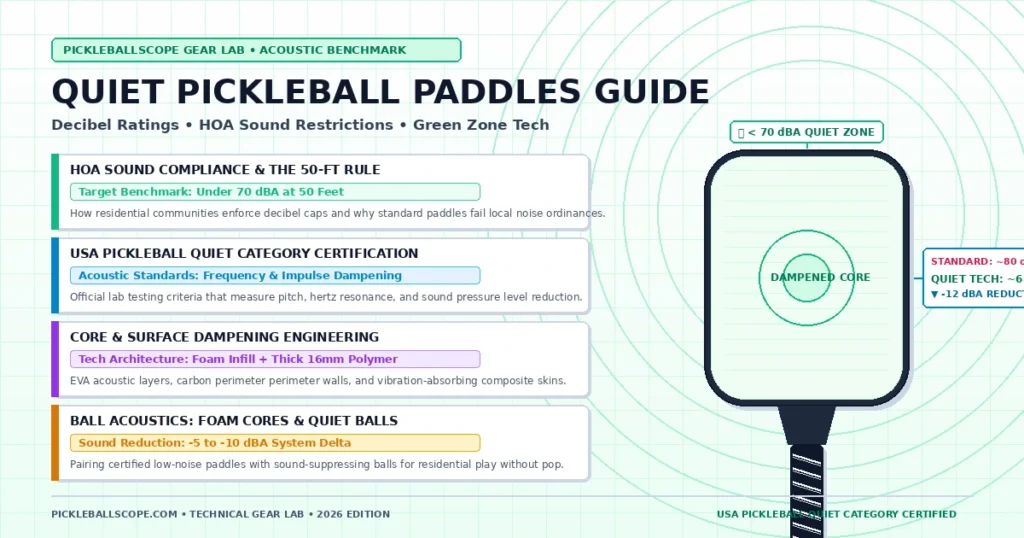
To understand why noise-dampening gear has become essential equipment, one must examine the legal and civil battles unfolding across suburban America. Over the past three years, local city councils and HOA architectural review boards from Florida to California have issued emergency moratoriums, enacted 8:00 PM lighting curfews, and locked private court gates due to persistent neighbor noise complaints.
Unlike tennis, which utilizes pressurized felt balls and flexible string beds that produce a low-frequency thump (around 60 to 64 dBA), pickleball relies on hard, non-pressurized polyethylene balls striking rigid composite paddle faces. When these two dense surfaces collide, they generate an instantaneous impulse sound with an acoustic rise time under 10 milliseconds.
This rapid impulse noise easily penetrates exterior residential drywall and standard double-pane glass windows. Furthermore, because a standard doubles game features between 30 and 50 ball strikes per minute, nearby residents experience an unending barrage of rhythmic high-frequency pops. For homeowners trying to work remotely or enjoy backyard patios, the noise quickly becomes an unbearable nuisance.
2. The Acoustic Science: Decibels (dBA), Pitch (Hz), and Annoyance Factors
Understanding the Decibel Scale (dBA)
Decibels are measured on a logarithmic scale rather than a linear one. This means that an increase of just 10 decibels represents a tenfold increase in sound energy and sounds approximately twice as loud to human ears. A standard paddle registering 80 dBA is not 10% louder than a quiet paddle registering 70 dBA—it is twice as loud.
Most residential zoning codes set ambient property-line noise limits at 60 to 65 dBA during daytime hours and 50 to 55 dBA in the evening. Standard pickleball play routinely exceeds these thresholds at distances under 100 feet, making non-modified paddles an immediate violation of local noise ordinances.
The Role of Pitch and Frequency (Hertz)
Volume is only half the battle. Human hearing is uniquely sensitive to frequencies between 1,000 Hz and 4,000 Hz—the exact frequency band where infant cries and alarm sirens register. Standard paddles produce peak acoustic resonance right in this 1,000–1,200 Hz zone, triggering an instinctive annoyance response in the brain.
Advanced quiet pickleball paddles resolve this by shifting acoustic resonance downward into the 400–600 Hz spectrum. Even if a paddle only reduces decibels by 5 dBA, lowering the pitch transforms a jarring plastic “crack” into an unnoticeable, bass-heavy “thump” that rapidly dissipates across open air.
3. USA Pickleball Quiet Category Certification: The Green Zone Testing Standards
To establish an objective, scientific benchmark for acoustic performance, USA Pickleball introduced the official “Quiet Category” testing framework. This initiative provides municipal planners, parks directors, and HOA boards with an authoritative standard to regulate noise without banning play.
Under the testing protocol administered by the USA Pickleball Equipment Certification Lab, paddles and balls are evaluated inside an acoustic testing chamber using calibrated laboratory microphones. Equipment that meets the strict standard receives an official Quiet Category certification seal, proving it delivers a measurable 50% or greater reduction in acoustic impact compared to standard gear.
By establishing this “Green Zone” tier, USA Pickleball has created a roadmap for residential communities. Instead of completely shutting down courts, forward-thinking HOAs now amend their bylaws to require that all players use certified quiet pickleball paddles and low-noise balls, preserving neighborhood harmony while keeping the courts vibrant and active.
4. Core Engineering: How Manufacturers Build Quiet Pickleball Paddles
Building acoustic paddles requires complex engineering. Just as 13mm vs 16mm pickleball paddle cores alter dwell time, acoustic engineers combine thick honeycomb cells with proprietary perimeter dampening technologies to suppress noise without sacrificing tournament pop:
Key Acoustic Dampening Technologies:
- Acoustic EVA Foam Core Infill: Rather than leaving the honeycomb polypropylene cells hollow, quiet paddles inject specialized ethylene-vinyl acetate (EVA) or acoustic dampening foam into the chambers, trapping vibrational waves internally.
- Thick 16mm to 20mm Core Cross-Sections: Deeper cores flex more gradually upon ball impact, lengthening dwell time and preventing the instantaneous, high-pressure rebound that produces loud cracking sounds.
- Vibration-Absorbing Multi-Layer Carbon Faces: Specialized layers of basalt fiber, woven Kevlar, and raw carbon fiber dissipate surface vibrations across the entire perimeter frame instead of projecting noise forward.
- Thermoformed Foam-Injected Perimeters: Encasing the edge walls in dense polyurethane foam stabilizes the perimeter, deadening frame flutter and hollow acoustic resonance.
5. Top Quiet Pickleball Paddles for HOA-Restricted Courts
If you need to purchase certified low-noise equipment, several breakthrough models have established the benchmark for acoustic suppression and tournament playability:
| Paddle Model | Acoustic Technology | Sound Level | Playing Style Fit | MSRP |
|---|---|---|---|---|
| The Owl Paddle | Proprietary Acoustx Multi-Layer Foam Core | 60 – 63 dBA (Ultra-Quiet) | All-Court Touch & Kitchen Reset Specialist | $169 |
| Engage Pursuit Pro EX 6.0 | MachPro Polymer Core + Inner Dampening Skin | 68 – 71 dBA (Subdued Thud) | High-Level Doubles Power & Spin Competitors | $259 |
| ProXR Zane Navratil The Standard | 16mm Shock-Absorption Poly Core | 69 – 72 dBA (Muffled Pop) | Balanced Tournament Competitor (3.5 – 5.0 DUPR) | $209 |
| Diadem Hush / First Strike | Vibration-Shield Foam Core Architecture | 62 – 65 dBA (Low Resonance) | Recreational HOA Player Seeking Soft Touch | $139 |
| Paddletek Tempest Wave Pro (v3) | Advanced High-Grade Polymer Honeycomb | 70 – 73 dBA (Deep Tone) | Precision Dinking & Drop Shot Maestro | $209 |
Among these options, dedicated models like The Owl Paddle stand out as the benchmark for strict HOA compliance. Designed from the ground up to meet USA Pickleball Quiet Category standards, it cuts acoustic decibels down to the low 60s while providing reliable touch for players competing across various DUPR (Dynamic Universal Pickleball Rating) skill divisions.
6. The Ball Factor: Why Pairing Quiet Balls Is Essential for Full Compliance
Even the most technologically advanced sound-dampened paddles can only mitigate approximately 50% of total court sound if players continue using ultra-hard, seamless outdoor plastic balls. To achieve full neighborhood compliance, pairing your paddle with certified low-noise balls is mandatory.
Traditional outdoor balls—such as the Dura Fast 40 or Franklin X-40—are manufactured from rigid, durable plastics designed to withstand windy conditions and rough asphalt. When these dense balls hit a paddle face, the hard plastic shell acts like an acoustic megaphone, projecting a sharp, piercing snap.
Acoustic balls (such as the Gamma Quiet Ball or foam-core training balls) replace brittle plastics with elastomeric, rubberized compounds or high-density foam interiors. While they bounce with genuine regulation height, their softer outer shell eliminates the high-frequency snap upon paddle contact, reducing total decibel levels by an additional 6 to 10 dBA. For courts located less than 75 feet from residential property lines, this paddle-and-ball combination is the silver bullet for resolving noise complaints.
7. The HOA Compliance Playbook: How Communities Can Allow Play Without Lawsuits
If you serve on an HOA board managing facilities built to official pickleball court dimensions, court closure is never the only solution. By adopting this four-step compliance playbook, neighborhoods can dramatically slash acoustic impact while keeping active amenities open:
4-Step HOA Sound Mitigation Playbook:
- Step 1: Adopt a Mandatory Quiet Equipment Rule: Update your HOA sports facility bylaws to require that all players use USA Pickleball Quiet Category certified paddles or 16mm acoustic-dampened models. Prohibit ultra-thin, loud power paddles on community courts.
- Step 2: Install Perimeter Acoustic Sound Curtains: Hang mass-loaded vinyl sound barriers (such as Acoustifence) on 8-to-10-foot perimeter fences facing neighboring homes. These heavy sound curtains absorb direct acoustic waves and diffract escaping sound upward into the atmosphere.
- Step 3: Establish Clear Operational Curfews: Institute sensible hours of play—such as 8:30 AM to 7:30 PM on weekdays and 9:00 AM to 7:00 PM on weekends. Prohibit early-morning and late-night rallies when ambient neighborhood noise drops.
- Step 4: Conduct a Certified Decibel Baseline Audit: Hire an independent sound technician to measure baseline court noise before and after implementing quiet paddles. Presenting verifiable sub-65 dBA data provides legal immunity against frivolous nuisance lawsuits.
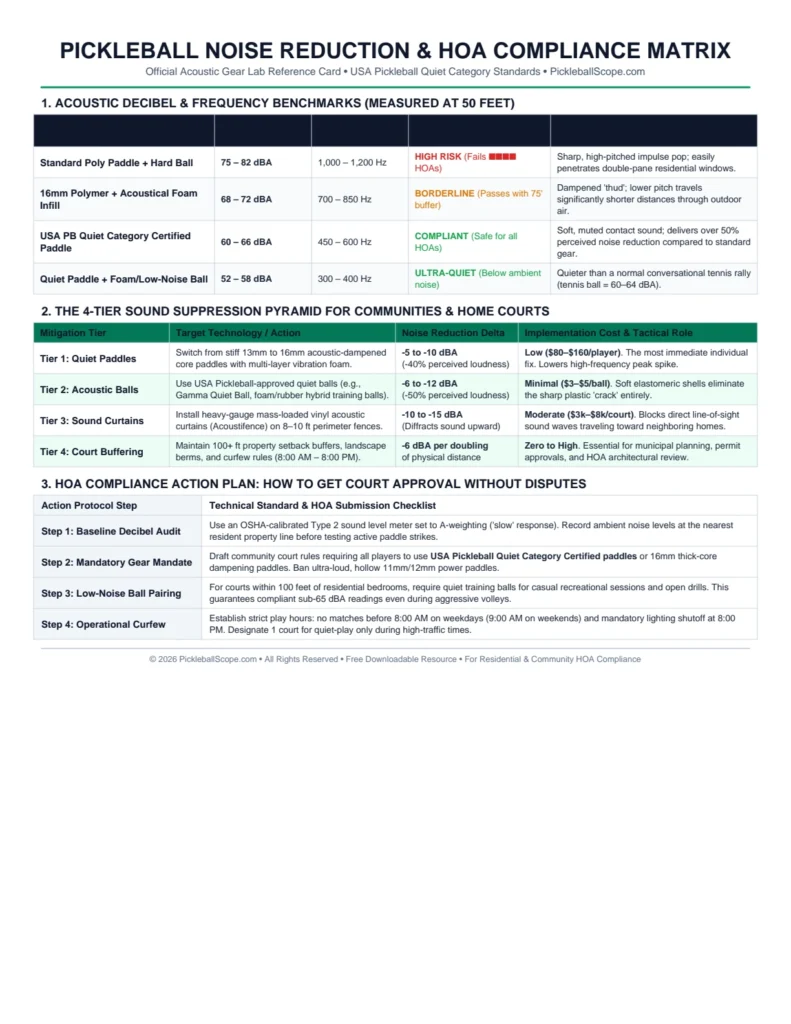
📄 Download the Free Noise Reduction & HOA Compliance Cheat Sheet (PDF)
Frequently Asked Questions About Quiet Pickleball Paddles
Are quiet pickleball paddles legal for USA Pickleball tournaments?
Yes. As long as a quiet paddle appears on the official USA Pickleball Approved Paddle List and complies with surface friction and deflection guidelines, it is 100% legal for tournament competition.
Do quiet pickleball paddles lose power compared to regular paddles?
While quiet paddles slightly reduce instantaneous “pop” due to their foam-dampened cores, they maintain excellent overall power on full swings. In fact, many players find that the plush dwell time improves control, directional accuracy, and spin generation.
How much quieter are quiet paddles compared to standard paddles?
Certified quiet paddles deliver a 5 to 10 dBA reduction in sound pressure level, which corresponds to an approximate 40% to 50% reduction in perceived human loudness. More importantly, they shift sound frequency from an annoying 1,200 Hz down into a mellow 500 Hz tone.
Can I make my current paddle quieter without buying a new one?
You can slightly reduce paddle resonance by applying a thicker cushioned grip wrap or silicone dampening bands around the throat. However, because acoustic sound originates from internal core cell resonance, a dedicated quiet paddle is necessary for significant noise reduction.
What decibel level do HOAs typically require for pickleball courts?
Most residential HOAs and municipal noise ordinances enforce a daytime sound threshold of 60 to 65 dBA measured at the property line of adjacent homes. Standard pickleball often registers 75 to 80 dBA, making sound-dampened gear essential.
Key Takeaways: Navigating Quiet Pickleball Paddles & Sound Rules
- Pitch causes the annoyance: High-frequency sound spikes (1,000–1,200 Hz) trigger complaints more than raw volume alone.
- USA Pickleball Quiet Category leads the way: Official Green Zone certifications provide clear guidelines for compliant residential equipment.
- Foam core technology works: Injected EVA foam and 16mm+ polymer cores absorb impact shock, lowering decibels by 5 to 10 dBA.
- Pair paddles with acoustic balls: Combining low-noise paddles with soft elastomeric balls achieves complete residential compliance.
- HOAs can preserve play: Sound barriers, reasonable curfews, and equipment rules allow communities to thrive without closing courts.
Displaying Quiet Pickleball Paddles Noise Guide (WordPress Gutenberg Blocks).txt.