
PILLAR 2: TECHNICAL GEAR & INDUSTRY LAB
The definitive guide to paddle core thickness, honeycomb polymer physics, dwell time, sweet spot size, and finding the right match for your playing style.
When selecting a 13mm vs 16mm pickleball paddle, you are making the single most impactful equipment decision in your game. While surface materials like raw carbon fiber, fiberglass, and Kevlar dictate spin and grit, the internal polymer honeycomb core dictates how the paddle physically responds the millisecond a ball strikes the face.
Many intermediate players obsess over surface textures or brand sponsorships. Yet they overlook the baseline mechanical fact: core thickness governs ball dwell time, vibration dampening, energy return, and sweet spot stability. Choosing the wrong core profile turns routine third-shot drops into frustrating pop-ups or strips your drives of offensive pace.
According to certified paddle testing standards established by the USA Pickleball Equipment Certification Lab and regulatory guidelines from USA Pickleball, modern approved paddles range from ultra-thin 11mm speed sticks to beefy 20mm plush defensive boards. However, the tournament battleground centers almost entirely on two benchmark specs: 13mm and 16mm.
Whether you want explosive hand speed at the kitchen line or a plush, forgiving touch that neutralizes aggressive bangers, this complete 13mm vs 16mm pickleball paddle guide breaks down the underlying physics, playing dynamics, and selection framework you need to choose the best core thickness for your game.
⚡ The 30-Second 13mm vs 16mm Pickleball Paddle Cheat Sheet
Short on time? Here is how the two benchmark core thicknesses stack up side-by-side across essential performance metrics:
| Performance Metric | 13mm Pickleball Paddle | 16mm Pickleball Paddle |
|---|---|---|
| Core Thickness (Inches) | ~0.51 inches (Thin Core) | ~0.63 inches (Standard Thick Core) |
| Primary Personality | Explosive Pop, Pure Power & Quick Hand Speed | Soft Touch, Deep Control & Maximum Forgiveness |
| Ball Dwell Time | Short & Crisp (Immediate Rebound) | Long & Cushioned (Deep Core Compression) |
| Sweet Spot Surface Area | Smaller & Concentrated in Center | Larger, Uniform & Forgiving Across the Face |
| Kitchen Hand Speed | Faster (Less Aerodynamic Drag) | Slightly Slower (More Air Resistance) |
| Vibration & Arm Comfort | Stiffer (Transfers Shock to Wrist/Elbow) | Plush & Dampened (Absorbs Impact Shock) |
| Ideal Player Profile | Aggressive Bangers, Singles Players & Power Hitters | Control Specialists, DUPR Tournament Doubles Players |
1. Core Physics: How Thickness Dictates Dwell Time and Pop in a 13mm vs 16mm Pickleball Paddle
To understand the performance gap in a 13mm vs 16mm pickleball paddle, you must examine how a polypropylene honeycomb core reacts under dynamic impact load. When a regulation pickleball collides with a paddle traveling at 40 miles per hour, kinetic energy transfers directly through the carbon face and into the honeycomb cellular walls.
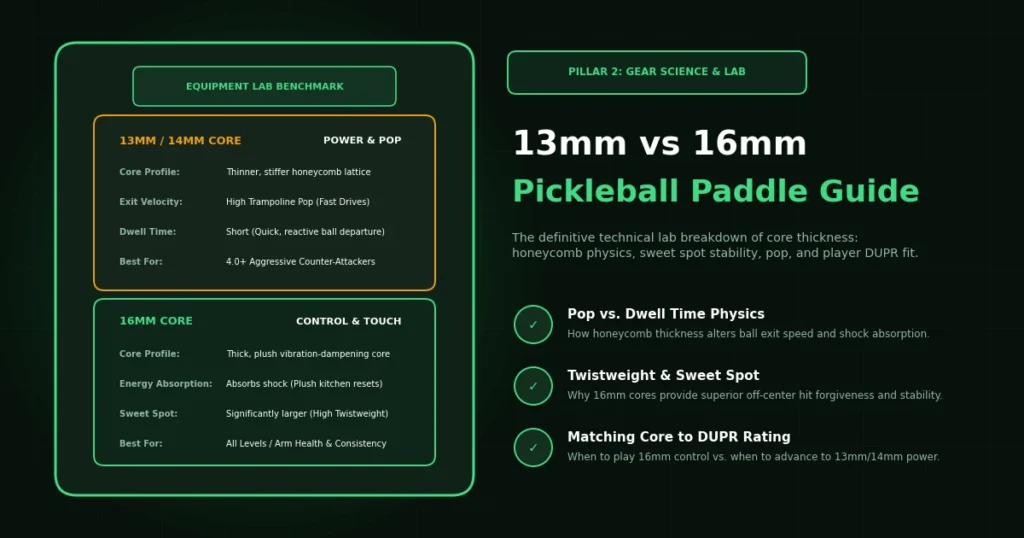
In a 13mm paddle, those honeycomb cell walls are shorter and significantly stiffer along the perpendicular axis. Because the core has less depth to compress, the ball cannot sink deeply into the surface. Instead, the stiff core reflects energy back into the ball almost instantly. This rapid energy return is what competitive players describe as “pop”.
Conversely, a 16mm core features approximately 23% deeper honeycomb cells. Upon ball contact, these taller polypropylene walls compress progressively, allowing the ball to sink deeper into the face for several additional milliseconds before rebounding. In laboratory testing, this extended contact window is known as dwell time.
Dwell time acts as a natural shock absorber. Just as dropping a bowling ball onto a soft mattress deadens its bounce compared to dropping it onto asphalt, a 16mm core absorbs high-velocity pace from incoming attacks. This makes feather-soft dinks and touch resets vastly easier to replicate under tournament pressure.
2. Power and Drive Depth: When a 13mm Pickleball Paddle Dominates the Court
The primary advantage of choosing a 13mm pickleball paddle is raw offensive firepower and lightning-fast hand speed. If your tactical identity revolves around punishing groundstrokes, driving hard through opponent transition zones, and executing rapid punch volleys, thinner cores deliver distinct mechanical advantages.
Because a 13mm paddle returns kinetic energy immediately, you do not need a massive, sweeping swing to generate penetration. With a compact, compact shoulder stroke, a 13mm paddle propels the ball deep into the opponent court with blistering pace. In singles competition, where passing shots and baseline drives decide points, thin cores remain a weapon of choice.
Furthermore, a 13mm paddle cuts through the air with noticeably less aerodynamic drag. When you engage in high-speed hand battles at the kitchen line, even a 3-millimeter reduction in paddle thickness translates to faster reaction time. Getting your paddle face into position two fractions of a second quicker often means the difference between a clean volley winner and a frame mishit.
However, that offensive pop comes with a measurable tax. When you need to drop an aggressive opponent drive softly into the kitchen, the stiff 13mm core tends to launch the ball slightly too high. Unless your soft game touch is exceptionally refined, thin paddles can turn defensive resets into floating setup balls for your opponents.
3. Control, Resetting, and Dinking: Why the 16mm Pickleball Paddle Rules the Kitchen
In modern doubles pickleball, matches are not won by who hits the hardest—they are won by who makes fewer unforced errors during neutral dink rallies. This tactical reality is why the 16mm pickleball paddle has become the undisputed standard choice for tournament doubles competitors.
The hallmark strength of a 16mm core is its ability to absorb incoming velocity. When an aggressive player blasts a drive directly at your chest while you stand at the non-volley zone line, a 16mm paddle deadens the ball upon contact. Instead of bouncing out of bounds or popping up into the kill zone, the ball gently rolls over the net and dies harmlessly in the opponent kitchen.
During extended dinking exchanges governed by pickleball kitchen rules, the increased dwell time gives you enhanced sensory feedback through your fingertips. You can feel the ball compress into the paddle, allowing you to manipulate angles in your pickleball dinking strategy with surgical precision.
For players working to climb the DUPR (Dynamic Universal Pickleball Rating) ladder from intermediate rec play toward competitive 4.0+ brackets, moving to a 16mm core is frequently the single quickest equipment upgrade to stabilize consistency and cut down pop-ups.
4. Sweet Spot Size and Torsional Stability Comparison in a 13mm vs 16mm Pickleball Paddle
Another crucial distinction between a 13mm vs 16mm pickleball paddle lies in off-center forgiveness, technically measured as torsional stability and twist weight. No player hits the ball on the dead center of the paddle face on every stroke.
When you contact a ball near the perimeter edge of a 13mm paddle, the thinner core offers less structural resistance against paddle twisting along its longitudinal axis. This torsional deflection causes the paddle face to open or close unexpectedly in your hand, resulting in a sudden drop in ball exit velocity and erratic spray. The effective sweet spot on a 13mm paddle is tight, rewarding precision ball strikers while severely penalizing mishits.
By contrast, a 16mm paddle possesses substantially higher natural torsional rigidity. The wider cross-section resists twisting during off-center contact. Even if you clip the ball an inch toward the upper corner or outer edge, the 16mm core maintains its plane and transfers uniform energy back into the shot.
This perimeter forgiveness expands the usable sweet spot across nearly the entire face. In scrambles, fast-paced defensive exchanges, and lunging stab volleys, the generous sweet spot of a 16mm core keeps the ball in play when a thinner core would produce a weak pop-up or net fault.
5. What About 14mm Paddles? The Hybrid Middle Ground
As paddle manufacturing technology has matured, several premium brands have introduced 14mm (and 15mm) hybrid core models designed to bridge the gap between pure 13mm power and 16mm control. If you feel torn between the explosive snap of a thin core and the plush stability of a thick core, a 14mm design warrants serious consideration.
A 14mm paddle delivers approximately 80% of the hand speed and pop found in a 13mm frame, while preserving noticeably more torsional stability and touch than an ultra-thin board. Players with athletic tennis backgrounds who already possess soft hands often gravitate toward 14mm models to retain attacking power without sacrificing all kitchen touch.
However, hybrid paddles require an uncompromising compromise: they are neither as explosive as a true 13mm power paddle nor as pillowy and forgiving on defensive blocks as a dedicated 16mm control paddle. If you struggle with resetting hard balls or avoiding pop-ups, committing fully to a 16mm core remains the smarter developmental path.
6. Match Your Playstyle: Decision Framework for 13mm vs 16mm Pickleball Paddle Selection
To determine whether you should play with a 13mm vs 16mm pickleball paddle, evaluate your natural playing tendencies, physical strengths, and frequent game formats using this structured framework:
Choose a 13mm Pickleball Paddle If:
- You play extensive singles: The open court demands baseline passing drives, heavy overhead putaways, and aggressive serving depth.
- You have naturally soft, disciplined hands: You can absorb hard shots using your grip tension and paddle angling without relying on a thick core to do the dampening for you.
- You crave ultra-fast hand speed: In fast-paced reflex battles at the net, you prioritize quick paddle maneuvering over off-center forgiveness.
- You struggle to generate offensive pace: If your natural swing mechanics lack driving power, the lively pop of a 13mm core provides instant exit velocity.
Choose a 16mm Pickleball Paddle If:
- You play primarily competitive doubles: Matches hinge on patience, unforced error prevention, third-shot drops, and neutral kitchen dinking.
- You struggle with pop-ups on resets: A 16mm core deadens hard incoming drives and keeps your third-shot drops low beneath net level.
- You want maximum sweet spot forgiveness: If off-center hits cause inconsistent sprays on your volleys, the higher twist weight of a 16mm core stabilizes your contact.
- You suffer from elbow or wrist soreness: The thicker honeycomb core disperses impact vibrations before they travel up your forearm, protecting vulnerable joints.
7. Modifying Core Performance with Lead Tape and Perimeter Weighting
Before discarding a paddle that feels slightly too poppy, remember that our pickleball lead tape guide shows how to customize both a 13mm vs 16mm pickleball paddle with perimeter weight, especially when balancing raw carbon vs fiberglass pickleball paddle faces.
If you love the lightning-fast pop of a 13mm paddle but despise its narrow sweet spot and edge twisting, adding 2 to 3 grams of lead tape at the 3 and 9 o clock positions dramatically increases torsional stability. This perimeter weighting widens the sweet spot without sacrificing the stiff, explosive rebound of the thin core.
Conversely, if you love the soft touch of a 16mm paddle on dinks but find your drives lacking penetrating plow-through, placing weight at the 10 and 2 o clock positions or along the top edge shifts the balance point toward the head. This adds substantial momentum to baseline groundstrokes while keeping your plush kitchen touch completely intact.
📄 Download the Free 13mm vs 16mm Paddle Core Selection Matrix (PDF)
Want a quick, 1-page printable reference sheet to take to the courts or paddle shop? We compiled a comprehensive decision matrix, swing weight benchmarks, and playstyle match checklist into a clean, printable PDF cheat sheet.
Frequently Asked Questions About 13mm vs 16mm Pickleball Paddle Cores
Can a 16mm paddle hit as hard as a 13mm paddle?
Yes, a 16mm paddle can generate equal or greater overall power on full baseline swings because power comes from swing mechanics and overall paddle mass. However, a 16mm paddle produces less effortless “pop” on compact, flick volleys than a 13mm paddle.
Does core thickness affect spin rate and RPM?
Core thickness does not create surface friction—spin is generated by face texture (such as raw carbon fiber) and swing path. However, a 16mm core increases ball dwell time, which allows the textured face to bite into the ball slightly longer, helping many players shape heavy topspin dips.
Which paddle thickness is best for preventing tennis elbow?
A 16mm paddle is substantially better for players with tennis elbow or joint sensitivity. The deeper honeycomb cells absorb impact shock and dissipate vibrational energy before it transfers into your wrist, forearm, and elbow tendons.
Do professional pickleball players use 13mm or 16mm paddles?
The vast majority of professional touring players in doubles play with 14mm or 16mm paddles for defensive resetting consistency and sweet spot size. Some elite pros, particularly in singles competition, prefer 13mm paddles for offensive firepower and hand speed.
How long do 13mm and 16mm paddle cores last before breaking down?
Both 13mm and 16mm polymer cores typically maintain peak integrity for 6 to 18 months under regular play. However, thinner 13mm cores that experience heavy, high-velocity ball strikes can suffer core crushing or dead spots slightly earlier than beefier 16mm cores.
Key Takeaways: Making the Right 13mm vs 16mm Pickleball Paddle Choice
- 13mm cores focus on pop and speed: Stiff cellular walls return energy instantly, creating explosive pace and fast kitchen hands.
- 16mm cores focus on touch and forgiveness: Deeper cellular walls maximize dwell time, absorbing opponent power and expanding the sweet spot.
- Doubles rewards 16mm consistency: The vast majority of competitive doubles players benefit more from reducing pop-up errors than chasing pure drive velocity.
- Singles favors 13mm aggression: The open court geometry prioritizes baseline penetration, sharp angles, and overhead speed.
- Customization bridges the gap: Strategic placement of lead or tungsten tape can stabilize a 13mm sweet spot or add driving plow-through to a 16mm core.