
PILLAR 1: COURT RULES MASTERCLASS
Master the 3-number doubles call, why games start at 0-0-2, server rotation, side-outs, and court positioning under official USA Pickleball Rule 4.
Mastering pickleball scoring rules is notorious for being the most intimidating barrier for new players. Hearing someone announce a cryptic sequence like “4 – 2 – 1” or “0 – 0 – 2” before a serve sounds like an encrypted code if you come from tennis, ping-pong, or badminton.
When comparing pickleball vs tennis or traditional racket sports, keeping score in tennis is straightforward: 15-love, 30-all, or simple sequential numbers. As anyone exploring what is pickleball quickly discovers, doubles play throws three distinct numbers at you, forces players to rotate sides on some points but not others, and begins every match with an apparent mathematical paradox.
The good news? Once you grasp the simple logic behind the system, official pickleball scoring rules become second nature in less than five minutes. This guide breaks down the three-number call, demystifies the “0-0-2” opening rule under USA Pickleball official standards, and provides a step-by-step match simulation so you never lose track of the score again.
⚡ The 30-Second Pickleball Scoring Rules Summary
If you’re walking onto the court right now, here are the 4 fundamental scoring principles you need to know:
- The 3-Number Call: In doubles, call “Our Score – Their Score – Server Number” (e.g., 4-2-1).
- Only Servers Score: You can only win a point when your team is serving. If the receiving team wins the rally, nobody gets a point—it simply causes a turnover.
- The Match Starts at 0-0-2: The first serving team of the game only gets one server before siding out to the opponents.
- Switch Only on Points: Partners switch right/left sides only after winning a point on their serve. The receiving team never switches sides.
Why Pickleball Scoring Rules Confuse Beginners (And Why They’re Simple)
When newcomers struggle with pickleball scoring rules, the confusion almost always stems from assuming that the third number represents player identity. Beginners frequently think, “I was designated Server 2 at the start of the game, so I must be Server 2 forever.”
In reality, your server number is not tied to your person—it is a rotational status for that specific service turn. Whoever happens to be standing on the right-hand side of the court when your team wins the serve becomes Server 1 for that turn.
According to USA Pickleball, the governing body of the sport, the scoring system was intentionally created to prevent dominant teams from running away with games. By coupling traditional side-out scoring with dual-server rotation, the sport ensures that comebacks are always possible, even when trailing 10-2.
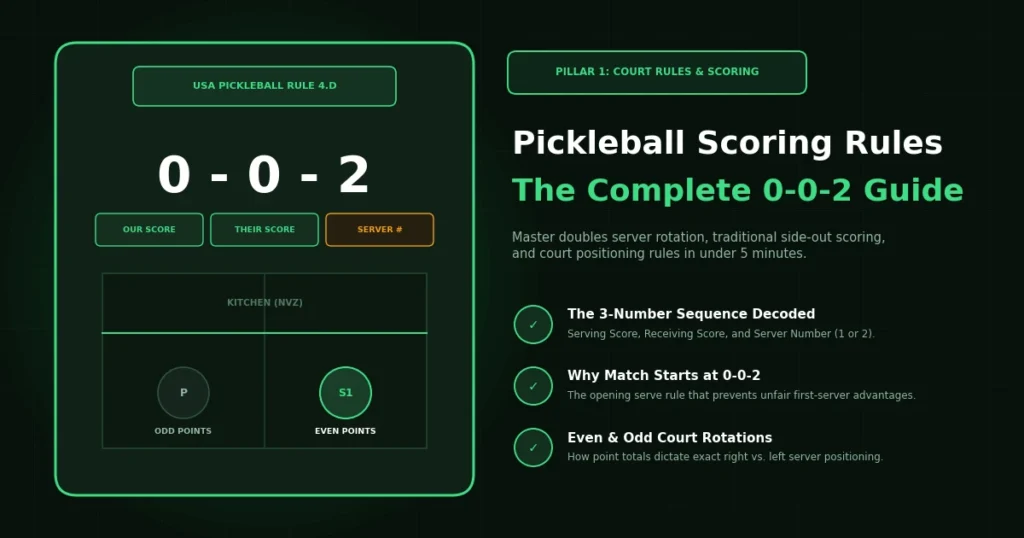
The 3-Number Sequence: How Pickleball Scoring Rules Work in Doubles
Before every serve in doubles play, the server must announce three numbers aloud according to Rule 4.D. Understanding pickleball scoring rules means understanding what each digit represents:
| Score Position | What It Represents | Example (‘4 – 2 – 1’) |
|---|---|---|
| 1st Number | Serving Team’s Score: How many points your team currently has. | 4 Points for the serving team |
| 2nd Number | Receiving Team’s Score: How many points your opponents currently have. | 2 Points for the receiving team |
| 3rd Number | Server Number: Whether the server is Server 1 or Server 2 on this turn. | Server #1 is currently serving |
If the serving team wins the rally at 4-2-1, they earn a point. The score becomes 5-2-1. The server switches to the left side of the court and serves again.
If the serving team loses the rally at 4-2-1—such as hitting a ball out of bounds or violating pickleball kitchen rules—no points are awarded. Under the 5 basic rules of pickleball, the serve simply passes to the second partner, who steps up and announces 4-2-2. Only when Server 2 loses a rally does a Side-Out occur, turning the ball over to the opponents.
The ‘0-0-2’ Starting Rule Explained (USA Pickleball Rule 4.B.8)
The single most common question about pickleball scoring rules is: “Why does every doubles game start at 0-0-2 instead of 0-0-1?”
Under official Rule 4.B.8, the team that wins the opening coin toss or paddle spin and chooses to serve first is permitted only one server for their very first service turn. Because they only get one serve, that opening server is designated as Server 2.
Why did the founders design it this way? Because serving first in pickleball is a statistical advantage. If the opening team were allowed two full servers at 0-0-0, they could easily run off 4 or 5 consecutive points before the opponents ever touched the ball.
By starting the match at 0-0-2, the game equalizes fairness. As soon as the opening serving team commits their first fault, the serve immediately sides out to the opponents at 0-0-1, giving both teams an equitable start.
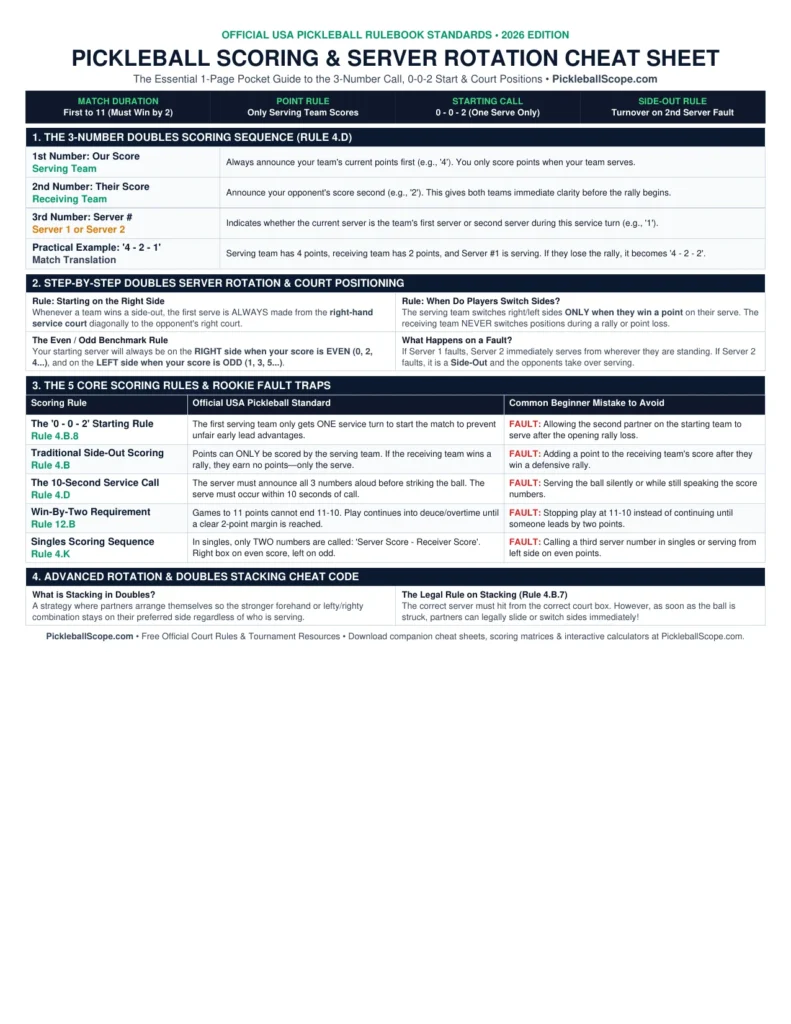
📄 Download the Free Doubles Server Rotation Cheat Sheet (PDF)
Never argue over server position or score again. Keep this high-contrast 1-page printable pocket reference in your court bag. Features the 3-number call breakdown, even/odd court rules, and stacking cheat codes.
Pickleball Scoring Rules for Server Rotation & Court Positions
Court positioning is where physical movement intersects with mathematical scorekeeping. In doubles, pickleball scoring rules dictate strict guidelines for where you stand and when you switch:
1. The Right-Hand Court Rule
Whenever a team wins a side-out and takes over the serve, official pickleball serve rules require that the first serve is always hit from the right-hand service court diagonally across the pickleball court dimensions into the opponent’s right-hand box. It does not matter what the score is—the first serve of a new side-out begins on the right.
2. The Even / Odd Benchmark Rule
If you ever lose track of where you should be standing, use the Golden Benchmark: your team’s starting server will always be on the right side when your score is EVEN (0, 2, 4, 6, 8, 10), and on the left side when your score is ODD (1, 3, 5, 7, 9).
This rule is foolproof. If your team has 5 points and your starting server is on the right side, you are out of position!
3. When Do Players Switch Sides?
The serving team switches right and left sides only when they win a point on their serve. If you serve and win the rally, you swap courts with your partner and serve from the other side.
The receiving team NEVER switches sides during or after a rally. Receivers maintain their court positions regardless of who wins the point.
Real-Match Walkthrough: Step-by-Step Scoring Simulation
To see how pickleball scoring rules unfold during real match play, follow this 8-rally simulation between Team A (Players A1 & A2) and Team B (Players B1 & B2):
| Rally # | Score Call | Server & Court Box | Rally Outcome | Next Score Call & Explanation |
|---|---|---|---|---|
| Rally 1 | 0 – 0 – 2 | Player A1 (Right Box) | Team A Wins Point | 1 – 0 – 2: Team A scores. A1 switches to Left Box. |
| Rally 2 | 1 – 0 – 2 | Player A1 (Left Box) | Team A Commits Fault | Side-Out (0 – 1 – 1): Team A only had 1 serve. Ball passes to Team B. |
| Rally 3 | 0 – 1 – 1 | Player B1 (Right Box) | Team B Wins Point | 1 – 1 – 1: Team B scores. B1 switches to Left Box. |
| Rally 4 | 1 – 1 – 1 | Player B1 (Left Box) | Team B Commits Fault | 1 – 1 – 2: Server 1 lost. Serve passes to B2 (stays in Right Box). |
| Rally 5 | 1 – 1 – 2 | Player B2 (Right Box) | Team B Wins Point | 2 – 1 – 2: Team B scores. B2 switches to Left Box. |
| Rally 6 | 2 – 1 – 2 | Player B2 (Left Box) | Team B Commits Fault | Side-Out (1 – 2 – 1): Server 2 lost. Ball passes to Team A (Player A1). |
| Rally 7 | 1 – 2 – 1 | Player A1 (Left Box) | Team A Wins Point | 2 – 2 – 1: Team A scores. A1 switches to Right Box. |
| Rally 8 | 2 – 2 – 1 | Player A1 (Right Box) | Team A Commits Fault | 2 – 2 – 2: Server 1 lost. Serve passes to partner A2 in Left Box. |
Singles Pickleball Scoring Rules vs. Doubles
Singles play simplifies pickleball scoring rules significantly. Because there are no partners, the third number (Server 1 vs. Server 2) is completely eliminated.
In singles, you only call two numbers: Server Score – Receiver Score (e.g., “5 – 3”).
- When the server’s score is EVEN (0, 2, 4, 6, 8, 10), the server must serve from the right-hand service court.
- When the server’s score is ODD (1, 3, 5, 7, 9), the server must serve from the left-hand service court.
- The receiver always aligns diagonally across the net to receive the serve. When the server faults, it is an immediate side-out.
Traditional Side-Out Scoring vs. Rally Scoring
While traditional side-out scoring is the global standard for USA Pickleball and amateur recreation, professional leagues like Major League Pickleball (MLP) utilize Rally Scoring to fit strict broadcast television windows.
| Scoring Feature | Traditional Side-Out Scoring | MLP Rally Scoring |
|---|---|---|
| Point Awarded On | Only when serving team wins rally | Every single rally, regardless of who served |
| Score Call Format | 3 Numbers (Doubles: 4-2-1) | 2 Numbers (Doubles & Singles: 18-16) |
| Game Duration | Variable (15 to 30+ minutes) | Fixed and rapid (12 to 18 minutes) |
| Game Winning Rule | Play to 11 (Must win by 2) | Play to 21 (Must win on serve at 20) |
| Primary Usage | Rec play & official USAP tournaments | Pro team leagues (MLP) & corporate events |
Advanced Tactics: Stacking and Scoring Integrity
As you progress from recreational play into competitive tournaments tracked by DUPR ratings, you will frequently encounter teams “stacking”.
Stacking is a legal strategic alignment under Rule 4.B.7 where partners arrange themselves so that a dominant forehand or a left-handed/right-handed combination remains on their preferred side of the court regardless of the score.
The golden rule of stacking is simple: the correct server and correct receiver must start the rally in the mathematically required court box. However, the instant the paddle contacts the ball on the serve, players can slide, switch, or cross over to their preferred positions without penalty.
5 Rookie Pickleball Scoring Mistakes (And How to Fix Them)
- Serving Before Calling the Score: Under Rule 4.D, hitting the ball before announcing all three numbers is a fault. (Fix: Call the score clearly, pause for one second, then begin your service motion).
- Calling the Score While Mid-Swing: Trying to shout the score while simultaneously striking the ball distracts opponents and violates rule cadence. (Fix: Stand set behind the baseline, call aloud, and then swing).
- Thinking Server #2 Stays Server #2 Forever: Forgetting that server status resets every side-out. (Fix: Whoever serves first after a side-out is Server 1 for that turn).
- Receivers Switching Sides After Points: Moving across court when the serving team scores. (Fix: Anchor your feet—receivers never swap courts on opponent points).
- Stopping Play at 11-10: Assuming the game ends when someone reaches 11. (Fix: Under official rules, you must win by a margin of at least two clear points).
Frequently Asked Questions About Pickleball Scoring Rules
What happens if a player calls the wrong score before serving?
Under USA Pickleball Rule 4.K, any player may stop play before the return of serve to correct an erroneous score call. If play continues, the rally stands. It is best practice to pause and verify the score before striking the serve.
Can you score points on your opponent’s serve?
No. Under traditional pickleball scoring rules, points are awarded exclusively to the serving team. Winning a defensive rally merely earns your team a side-out or advances the opponents to Server 2.
Why do we call three numbers in doubles but only two in singles?
In doubles, the third number is required to communicate whether the serving team is on their first or second service turn. In singles, each player only gets one serve per side-out, making a third number redundant.
Does the serve change sides if a fault occurs on the first point?
Yes. Because the game begins at 0-0-2, the first serving team only receives one server. If they fault on that opening rally, the serve immediately sides out to the opposing team.
What does ‘Side-Out’ mean in pickleball?
A side-out occurs when the serving team loses their allotted service turns (one server at 0-0-2; two servers during standard rotation). The serve is turned over to the opposing team, who begins serving from their right-hand court.