
PILLAR 1: COURT RULES MASTERCLASS
Master official USA Pickleball Rule 9 in plain English. Learn legal kitchen entries off the bounce, how to avoid momentum foot faults, and how to execute the high-level Erne shot.
Understanding pickleball kitchen rules is the single most important milestone for any developing player. More on-court arguments, confusion, and lost points happen around the 7-foot Non-Volley Zone (NVZ) than anywhere else on the court.
Many beginners think stepping into the kitchen is completely forbidden at all times. Others believe you can jump inside as long as you hit the ball first. Both of these assumptions are dead wrong.
The truth is that the kitchen isn’t an electric fence. Whether you are just learning what is pickleball or brushing up on the 5 basic rules of pickleball, standing in the kitchen is 100% legal under the right conditions. This guide cuts through the confusion, breaks down official USA Pickleball Rule 9 in plain English, and shows you exactly what you can and cannot do at the net.
⚡ The 30-Second Kitchen Rule Summary
If you only have half a minute before your next match, here are the 4 fundamental kitchen facts you must remember:
- No Air Volleys: You cannot hit the ball out of the air while standing in the kitchen, touching the line, or falling into it afterward.
- The Line is “IN”: The 2-inch kitchen line is legally part of the kitchen. Touching it during an air volley is an instant fault.
- Momentum Counts: Even if your volley is a clean winner, stumbling into the kitchen on your follow-through costs you the point.
- Bounces Unlock the Zone: If the ball bounces in the kitchen first, you can legally walk in, stand, and hit it without penalty.
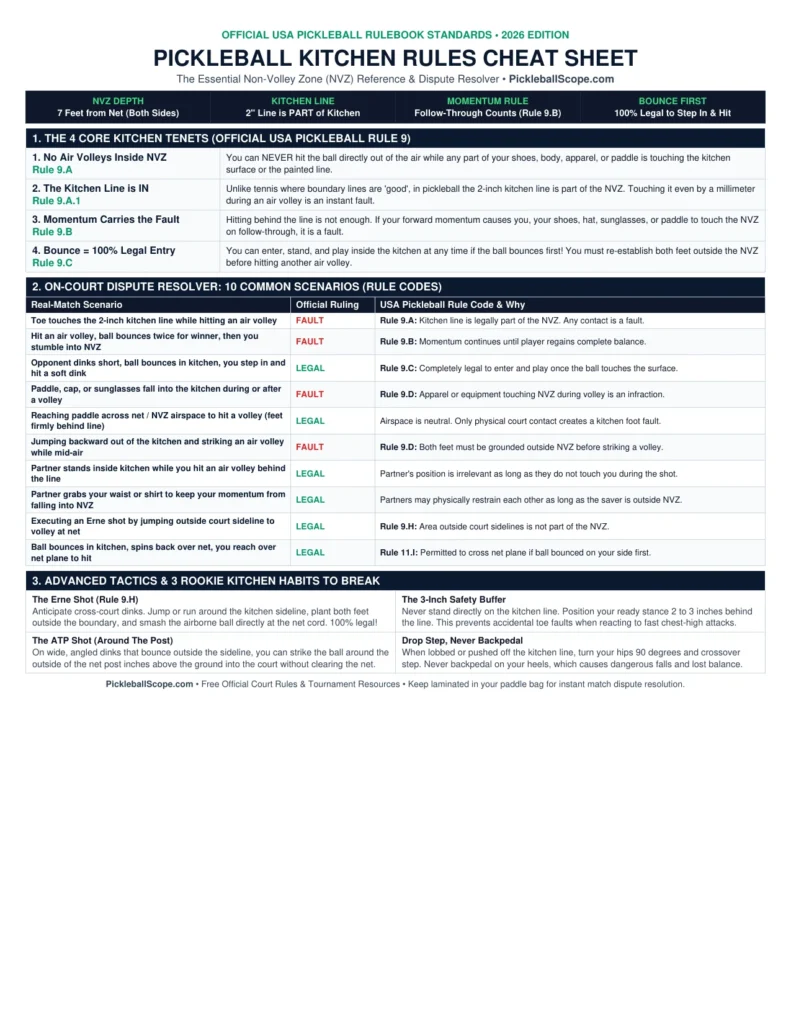
📄 Official Kitchen Rules Cheat Sheet (Printable PDF)
Settle on-court arguments in seconds. Keep this high-contrast 1-page pocket referee card laminated in your paddle bag. Includes the 4 Core Kitchen Tenets, 10 match scenario dispute rulings, and official USA Pickleball Rule 9 codes.
Pickleball Kitchen Rules: Court Geometry & Dimensions
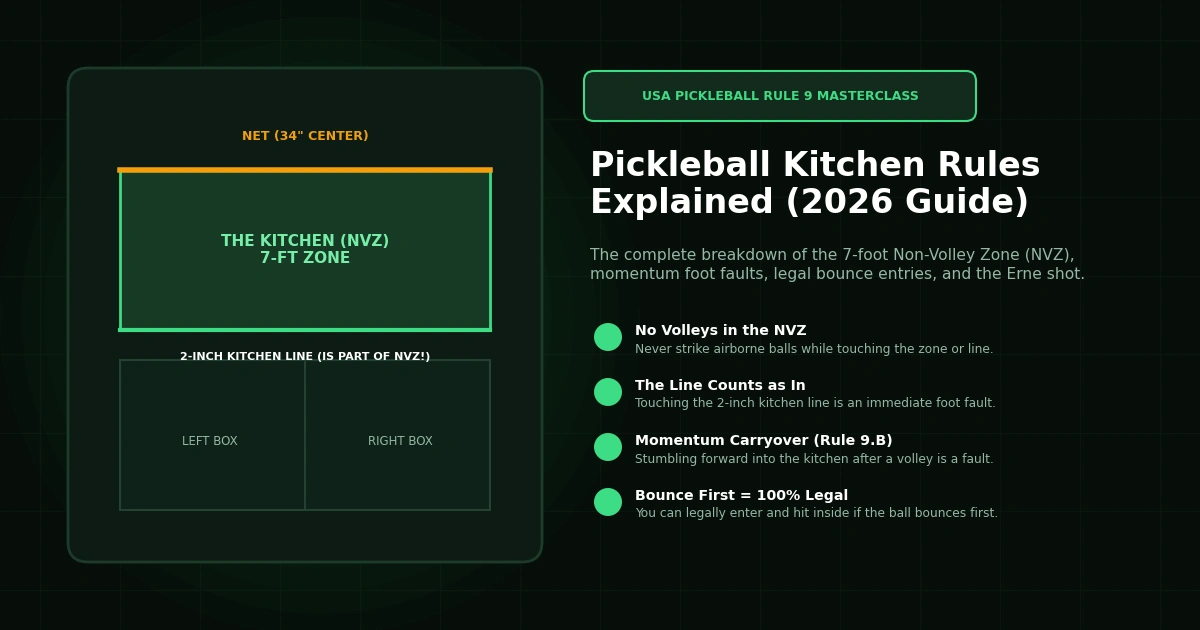
In official rulebooks, the kitchen is formally called the Non-Volley Zone (NVZ). It is a 7-foot deep by 20-foot wide rectangular area that sits directly on both sides of the net.
Under official pickleball court dimensions, the court measures 44 feet long in total, meaning the two 7-foot kitchen zones take up a combined 14 feet right in the middle. The remaining 15 feet on each side make up the left and right service courts governed by pickleball serve rules.
The founders of pickleball created the kitchen for one simple reason: to prevent taller, powerful players from standing right against the net and smashing unreturnable overhead spikes into their opponents’ faces.
By forcing players to stand at least 7 feet back from the net cord to hit balls out of the air, the kitchen transforms pickleball from a contest of brute athletic height into a tactical game of touch, placement, and patient pickleball dinking strategy.
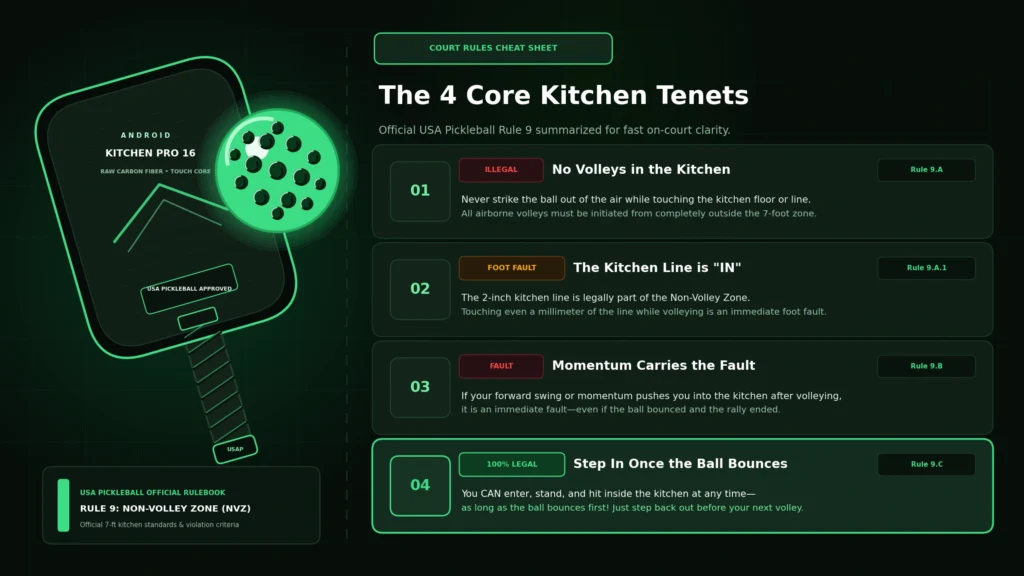
The 4 Core Pickleball Kitchen Rules Under Rule 9
every single rule in pickleball kitchen rules revolves around four principles. Once you master these four concepts, you will never second-guess an on-court call again.
1. No Volleys Inside the Kitchen (Rule 9.A)
A “volley” means striking the ball directly out of the air before it touches the ground. Under Rule 9.A, you cannot hit a volley while any part of your body, clothing, shoes, or paddle is touching the kitchen floor or its boundary line.
It does not matter whether you are standing with both feet inside the zone or just grazing the painted surface with the tip of your shoe laces. If any contact exists when you hit an airborne ball, it is an immediate fault.
Furthermore, this restriction applies to your equipment. If your hat falls off your head or your paddle slips out of your hand and lands in the kitchen during a volley, you have committed a kitchen fault.
2. The Kitchen Line is Legally Part of the Kitchen (Rule 9.A.1)
If you come from a tennis background, this rule requires a mental reset. In tennis, hitting a boundary line means the ball is good and in-bounds.
In pickleball, the 2-inch painted kitchen line is considered 100% part of the Non-Volley Zone. Because it is part of the zone, touching the line carries the exact same penalty as standing dead-center in the kitchen.
If your toe touches even a single millimeter of the painted kitchen line while striking an air volley, you have committed a foot fault. Under official pickleball scoring rules, the rally ends immediately, and your opponents win the point or earn a side-out.
3. Momentum Carries the Fault (Rule 9.B)
In pickleball kitchen rules, the momentum rule is where most heated arguments happen. Under Rule 9.B, the act of hitting a volley includes your swing, your forward balance, and your subsequent follow-through.
Suppose you hit an air volley while standing completely behind the kitchen line. The shot is brilliant, lands in the opponent’s court, and bounces twice for an apparent winner.
However, your forward momentum causes you to stumble forward, and your toe taps the kitchen line after the ball is already dead. Under USA Pickleball rules, this is still an immediate fault.
Your momentum does not end until you have fully regained your balance and stopped moving forward. If that momentum carries you or your gear into the kitchen at any point, the shot is wiped out and you lose the rally.
4. You CAN Step in the Kitchen If the Ball Bounces (Rule 9.C)
This is the biggest misconception in recreational pickleball. Beginners often think stepping into the kitchen is an automatic penalty no matter what.
In reality, the kitchen is only off-limits for volleys. If the opponent hits a soft dink or drop shot that bounces inside your kitchen, you are 100% legally allowed to step into the kitchen to hit it.
You can walk in, stand there, wait for the bounce, and hit a controlled return back over the net. There is no rule against standing in the kitchen—the only rule is that the ball must bounce before you strike it.
Can You Stand in the Kitchen Before the Ball Bounces?
Yes. Believe it or not, USA Pickleball rules do not forbid standing in the kitchen before the ball bounces. You could theoretically stand in the kitchen for an entire rally without committing a fault, provided you never hit a ball out of the air.
However, doing this is tactical suicide. If you stand inside the kitchen, any ball your opponent hits directly at your body will force you into an impossible choice.
If you volley the ball out of reflex to protect yourself, you commit an immediate kitchen fault. If you let it bounce, it will likely hit your feet or body first, which is also an immediate fault.
The smart habit is simple: stand 2 to 3 inches behind the kitchen line in an athletic ready position. Only step forward into the kitchen when you clearly see the ball is going to bounce.
How to Legally Exit the Kitchen After a Bounced Shot
When you step into the kitchen to return a bounced ball, what must you do before you can hit your next volley? This is where Rule 9.D comes into play.
To hit another volley after being in the kitchen, you must completely re-establish both feet on the court surface outside the Non-Volley Zone.
That means both of your shoes must touch the court surface behind the kitchen line before you can strike an airborne ball. If you jump backward out of the kitchen and hit a volley while still floating in the air, you are still legally considered in the kitchen!
Always step out, plant both feet firmly behind the line, and reset your base before preparing for the next fast exchange.
The Erne Shot: How to Legally Attack at the Net Cord
The Erne (named after competitive player Erne Perry) is one of the most exciting, high-level offensive weapons in modern pickleball. It allows a player to smash a ball right at the net without violating kitchen rules.
How is this possible? Because the kitchen only exists between the court sidelines. The area outside the sidelines beyond the net post is completely open territory.
How to Execute a Legal Erne
- Anticipate that your opponent is about to hit a cross-court dink toward your sideline.
- Before or while the ball is traveling, jump or run around the outside edge of the kitchen, planting your feet completely outside the sideline.
- Smash the ball out of the air right next to the net cord.
- As long as your feet were planted outside the court boundary and never touched the kitchen floor or line, the volley is 100% legal.
You can also execute an airborne Erne by jumping from behind the kitchen line, striking the ball in mid-air, and landing completely out of bounds outside the sideline. As long as your shoes never contact the NVZ, you have pulled off a legal Erne.
The Around-The-Post (ATP) Shot and Kitchen Rules
Another specialty shot that confuses beginners is the Around-The-Post (ATP) shot. When an opponent hits a sharp, angled dink that bounces wide toward the sideline, the ball travels outside the plane of the net post.
Instead of trying to hit the ball back over the net cord, you can run wide and hit the ball around the outside of the net post directly into the opponent’s court.
Under USA Pickleball rules, an ATP shot does not need to travel over the net. In fact, you can strike the ball just inches off the ground outside the net post.
Kitchen rules still apply during an ATP: you must let the ball bounce first if you are stepping in the kitchen, or ensure your feet remain outside the NVZ if striking out of the air.
Quick-Reference Table: Legal vs. Illegal Kitchen Actions
Use this reference table to settle common pickleball kitchen rules disputes during rec play or tournament matches:
| On-Court Scenario | Official Ruling | USA Pickleball Rule Citation |
|---|---|---|
| Hitting an air volley while your toe touches the kitchen line | FAULT | Rule 9.A — Kitchen line is 100% part of the Non-Volley Zone. |
| Hitting an air volley behind the line, then stumbling into the kitchen | FAULT | Rule 9.B — Momentum carrying into the NVZ negates the point. |
| Your hat, sunglasses, or paddle drops into the kitchen during a volley | FAULT | Rule 9.D — Any apparel or equipment touching NVZ is an infraction. |
| Opponent dinks short, ball bounces in kitchen, you step in and hit | 100% LEGAL | Rule 9.C — Players may enter the kitchen freely on bounced balls. |
| Standing behind line, leaning paddle over net plane to hit an air volley | 100% LEGAL | Airspace above NVZ is legal; only physical court contact matters. |
| Jumping backward out of kitchen and hitting a volley while mid-air | FAULT | Rule 9.D — Must re-establish both feet on court surface outside NVZ. |
| Partner stands in kitchen while you hit an air volley behind the line | 100% LEGAL | Your partner’s position does not affect your legal volley status. |
| Partner grabs your shirt to pull you back from falling into the kitchen | 100% LEGAL | Partners may hold or push each other to prevent momentum faults. |
| Executing an Erne shot by jumping outside the sideline to volley | 100% LEGAL | Rule 9.H — Outside boundary area is not part of the kitchen. |
| Ball bounces in kitchen, spins back over net, you reach across to hit | 100% LEGAL | Rule 11.I — You may cross plane of net if ball bounced on your side first. |
5 Common Kitchen Mistakes (And How to Fix Them)
- Toes Glued to the Line: Standing right on the painted edge makes foot faults inevitable during fast exchanges. (Fix: Plant your ready stance 2 to 3 inches behind the line to give your toes a safety buffer).
- Leaning Forward on Volleys: Lunging forward aggressively at chest-high balls causes your momentum to carry you into the kitchen. (Fix: Bend your knees and drop your center of gravity rather than lunging with your upper body).
- Fearing the Kitchen on Bounced Balls: Letting short dinks bounce and trying to hit them from behind the line with awkward, reaching swings. (Fix: Step aggressively into the kitchen with confidence once the ball bounces).
- Forgetting to Re-Establish Feet: Hitting a bounced dink in the kitchen and immediately jumping backward to hit a volley before your feet touch the ground. (Fix: Step back, plant both feet firmly, and reset before preparing for the next shot).
- Backpedaling Instead of Drop-Stepping: Trying to back up from the kitchen line by stepping backward onto your heels, risking dangerous backward falls. (Fix: Turn your hips sideways, execute a crossover step, and move diagonally).
Frequently Asked Questions (FAQ)
Can you jump into the kitchen to hit a ball as long as it bounces?
Yes. If the ball bounces first, you can jump, run, or dive into the kitchen. The Non-Volley Zone only prohibits striking balls out of the air. Once the ball touches the court, all kitchen restrictions disappear for that shot.
Can my paddle touch the kitchen line on a volley?
No. Your paddle is considered an extension of your body. If your paddle touches the kitchen floor or the painted kitchen line while striking an air volley or during your follow-through, it is an immediate fault.
Can I reach my paddle over the kitchen without touching the ground?
Yes! The kitchen rule only governs ground contact. The airspace above the kitchen is completely neutral. You can reach your paddle as far forward over the kitchen as you want to volley a ball, provided your shoes remain planted behind the line.
What if my partner touches me while they are standing in the kitchen?
If you are volleying a ball out of the air and your partner is standing in the kitchen, your partner cannot touch you. Under Rule 9.B, touching a partner who is inside the kitchen during a volley counts as touching the kitchen yourself, resulting in an immediate fault.
Does the kitchen rule apply in singles pickleball?
Yes. The Non-Volley Zone rules are identical in singles and doubles. In singles, you cannot volley out of the air while touching the kitchen or line, but you may step in freely once the ball bounces.
PICKLEBALLSCOPE COURT MASTERY HUB
🎾 Essential Related Guides & Next Steps
Continue building your court IQ with our foundational rules breakdowns, equipment guides, and tactical drills:
PILLAR 1: MASTER HUB
What Is Pickleball? Complete Beginner’s Guide →
The complete overview of the sport: court layouts, paddle basics, and first-game rules.
PILLAR 1: COURT RULES
5 Basic Rules Every Beginner Needs to Know →
Master the two-bounce rule, underhand serve standards, and common fault traps.
PILLAR 1: MATCH SCORING
Pickleball Scoring & Server Rotation (0-0-2 Guide) →
Demystify the three-number doubles score call and understand server rotation.
PILLAR 3: COURT GEOMETRY
Official Pickleball Court Dimensions & Layout →
Exact line markings, net heights, and DIY tape measurements for the 7-foot kitchen.