
Learning how to get better at pickleball is the primary obsession of millions of recreational players who find themselves hitting a stubborn skill plateau. Most players begin their journey by showing up to local community open plays three or four days a week, assuming that simply playing game after game will naturally propel them to advanced proficiency. Yet after six months, they find their rating frozen at 3.2, frustrated by unpredictable unforced errors, erratic third shots, and opponents who effortlessly exploit their positioning.
According to certified coaching curricula published by USA Pickleball, recreational game play alone is the slowest, least efficient way to develop athletic competence. In a typical 15-minute doubles match, an individual player might touch the ball only 35 to 45 times—with half of those touches occurring under stressful, chaotic conditions that reinforce defensive panic reflexes. Real mechanical transformation happens off the match court through structured, deliberate practice routines.
Furthermore, competitive tournament data verified across DUPR (Dynamic Universal Pickleball Rating) demonstrates that the progression from a 3.0 recreational enthusiast to a 4.5+ tournament contender follows predictable, measurable skill milestones. While wielding high-performance thermoformed paddles certified under the USA Pickleball Equipment Standards provides essential spin and perimeter stability, gear alone cannot compensate for flawed footwork, poor shot selection, or undisciplined court positioning.
In this master player development blueprint, you will discover the proven architectural roadmap for how to get better at pickleball. We analyze the four developmental tiers of the game, break down the 80/20 training formula, examine the three technical shots that define advanced play, and provide an actionable, printable roadmap cheat sheet to systematically elevate your DUPR rating.
⚡ Executive Summary: The 4 Golden Pillars of Rapid Improvement
Want the high-leverage summary before diving into the complete masterclass? Here is the core framework for rapid growth:
- The 80/20 Practice Split: Stop playing 100% rec games. Dedicate 80% of your court time to high-repetition solo wall and partner drilling, and 20% to competitive match play. Drilling delivers 10x more ball touches per hour.
- Third-Shot Mastery Is Mandatory: You cannot reach DUPR 4.0 without a dependable third-shot drop. Fast baseline drives only beat novice players; advanced opponents counter hard drives with putaway volleys at your feet.
- Embrace the Soft Game: Pickleball points are lost, not won. At the 3.5 level, over 70% of rallies end on an unforced error. Direct 80%+ of your kitchen balls crosscourt, hold 3/10 loose grip pressure, and let opponents defeat themselves.
- Track Your Error Metrics: Record your games or have a partner count your errors. Categorize whether misses were net-cord errors, balls sailed long, or pop-ups. Eliminating three unforced errors per game lifts your rating by 0.5 points.
The 4 Pillars of Player Development: How to Get Better at Pickleball Fast
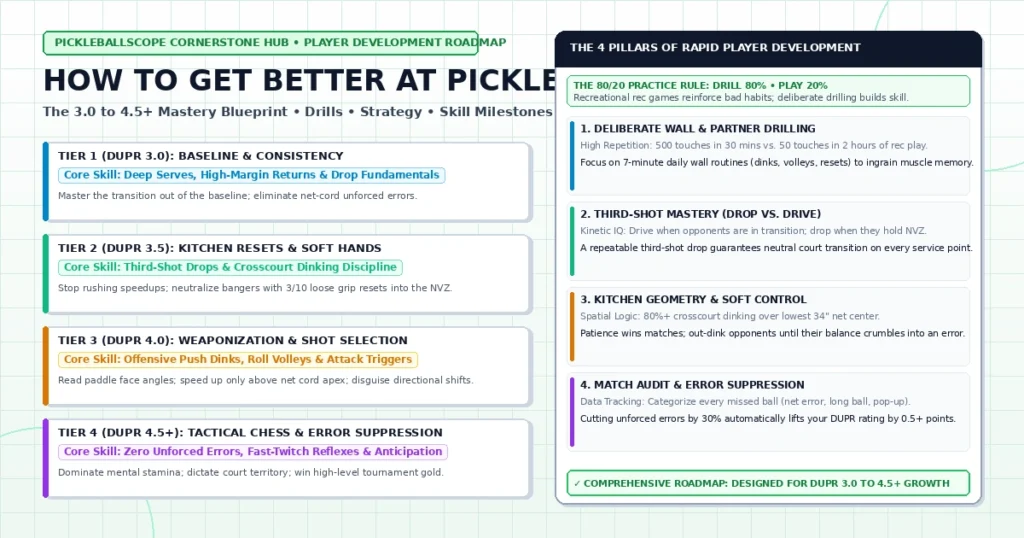
Understanding how to improve your pickleball game requires shifting your mindset from recreational entertainment to deliberate athletic skill acquisition. Elite players do not possess superhuman reflexes; they possess superior spatial awareness, repeatable kinetic mechanics, and disciplined decision-making algorithms that eliminate chaotic guesswork.
Every breakthrough in player development relies upon four foundational pillars:
1. High-Density Ball Repetition (The Muscle Memory Engine)
Muscle memory is an involuntary neurological pathway built through thousands of identical kinetic repetitions. When you play open rec games, you might face two backhand third-shot drops and three high backhand volleys in an entire afternoon. That trickle of random repetitions is completely inadequate to hardwire neural pathways.
By contrast, spending just twenty minutes on a dedicated practice wall or with a drilling partner yields 400 to 600 identical ball strikes. High-density repetition allows your nervous system to fine-tune paddle face angles, micro-calibrate swing speed, and eradicate erratic mishits. If you want to accelerate your development, your training must prioritize high-touch drilling over casual match play.
2. The Unforced Error Suppression Mindset
In tennis, professional players frequently win points by blasting 100 mph baseline winners into unreachable corners. In pickleball, the compact 20′ × 44′ court dimensions and the 7-foot kitchen buffer make hitting clean, unreturnable winners against balanced opponents virtually impossible. At the 3.0 to 4.0 levels, over 70% of all points end on an unforced error—a ball dumped into the net or sailed beyond the baseline.
The secret to winning matches is not hitting spectacular hero shots; it is becoming an impenetrable wall of consistency. When you commit to a high-margin, low-risk style of play, you place immense psychological pressure on your opponents. Eventually, their impatience boils over, they attempt a low-percentage speedup below net height, and you put the ball away into open court.
3. Geometric Court Positioning & Partner Tethering
Many intermediate players treat doubles as two isolated individuals playing singles side-by-side. Elite doubles teams operate as if connected by a tight 10-foot elastic tether. When your partner is pulled wide to the right sideline to retrieve a sharp crosscourt dink, you must shift dynamically toward the court center to seal the vulnerable middle passing lane. When they slide back toward the middle, you shift outward.
Furthermore, positioning discipline dictates that you must advance to the kitchen line immediately behind your return of serve or successful third-shot drop. Hanging back in the transition zone (“no-man’s land”) leaves your shoetops exposed to downward volleys and surrenders all offensive leverage.
4. Emotional Poise & Rally Reset Capability
Pickleball is a game of shifting momentum. You will miss routine dinks, your partner will pop up easy balls, and opponents will hit lucky net-cord dribblers. Players who plateau at 3.0 allow bad breaks to trigger emotional frustration, leading to rushed serves and reckless attacks. Advanced competitors cultivate a “next-shot” amnesia, taking deep breaths, maintaining relaxed 3/10 grip pressure, and sticking to high-percentage patterns regardless of the score.
| Developmental Factor | 3.0 Recreational Mindset | 4.5+ Championship Standard |
|---|---|---|
| Practice Split | 100% recreational games, 0% drilling | 70–80% focused drilling, 20–30% match play |
| Primary Tactical Goal | Hit hard winners to end rallies quickly | Suppress unforced errors; force opponent pop-ups |
| Third-Shot Preference | Hit 90% hard drives directly at defenders | Deploy calibrated drops (70%) and tactical drives (30%) |
| Kitchen Rally Patience | Impatient after 2–3 dinks; forces low speedup | Sustains 12+ dinks easily; attacks only high balls |
| Partner Coordination | Static; plays isolated half-court singles | Dynamic tether; shifts laterally to close middle gaps |
| Response to Pace | Tenses forearm (9/10 grip); swings back hard | Softens grip (3/10); absorbs and resets ball into NVZ |
DUPR Rating Milestones: How to Get Better at Pickleball from 3.0 to 4.5+
To navigate your development efficiently, you must recognize where you currently stand on the competitive rating spectrum and understand the precise technical hurdles required to unlock the next level. Here is the step-by-step roadmap for accelerating player development across every major rating threshold:
Level 1: The 3.0 to 3.5 Breakthrough (Mastering the Basics)
At the 3.0 level, players understand court rules and scoring, but their games are defined by mechanical inconsistency and poor positioning. Unlocking the 3.5 milestone requires mastering three core fundamentals:
- Deep Serves and High-Margin Returns: Eliminate service faults completely. Direct serves deep into the back third of the opponent’s court. Hit high-arching, deep returns that give you ample time to sprint comfortably to the kitchen line before the third shot is struck.
- Basic Third-Shot Drop Competence: Move away from driving 100% of third shots. Develop a dependable, soft third-shot drop from the baseline that lands in the opponent’s kitchen at least 50% to 60% of the time, allowing you and your partner to advance forward.
- Eliminating Transition Zone Freezes: Stop stopping halfway up the court. Either commit to staying at the baseline or advance all the way to the 2-inch kitchen line. Getting caught in no-man’s land is an automatic point penalty against competent opponents.
Level 2: The 3.5 to 4.0 Leap (The Great Soft-Game Filter)
The jump from 3.5 to 4.0 is the most difficult transition in recreational pickleball. Many players remain permanently stuck at 3.5 because they rely on athletic speed and hard baseline drives that work wonders against beginners but fail against seasoned players. Achieving a true 4.0 rating requires conquering the soft game:
- Crosscourt Dinking Discipline: Learn to sustain 8 to 10 crosscourt dinks without getting impatient. Understand that crossing the 34-inch center net over 21.4 feet of diagonal space is mathematically superior to hitting straight-ahead over a 36-inch net.
- Resetting Hard Speedups (Soft Hands): When opponents blast hard drives at your chest or hips, resist the urge to swing back. Loosen your grip to 3/10, present a flat paddle face, and absorb the ball’s kinetic energy, dropping it softly into the kitchen.
- Shot Selection IQ: Understand the difference between green-light balls (balls that bounce above net height, which you can attack) and red-light balls (balls that dip below net height, which you must patiently reset).
Level 3: The 4.0 to 4.5+ Mastery (Tactical Weaponization & Anticipation)
At 4.0 and beyond, every player possesses dependable mechanics, good consistency, and soft hands. Matches are decided by tactical deception, pattern recognition, and aggressive weaponization of neutral balls:
- Offensive Push & Roll Dinks: Transform passive dinking into an offensive weapon. Use topspin roll dinks to dip balls sharply at opponent shoetops, and fire disguised push dinks into their weak backhand hips to force panic pop-ups.
- The Third-Shot Drive-and-Drop Combo: Use hard third-shot drives intentionally—not to hit outright winners, but to force weak defensive blocks that set up an easy, aggressive fifth-shot drop into the kitchen.
- Anticipation and Hand Speed: Read opponent paddle face angles before contact. Recognize body cues that telegraph a speedup, shifting your weight forward and pre-setting your paddle to counter-attack attackable balls out of the air.
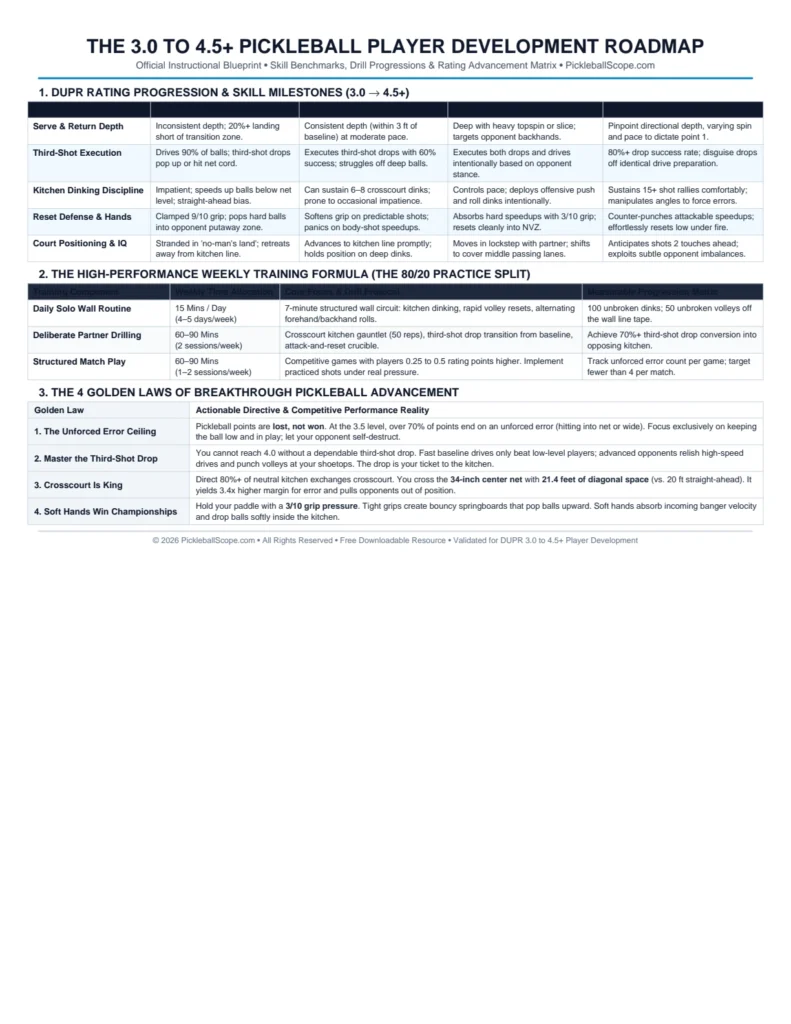
📄 Download the Free 3.0 to 4.5+ Development Roadmap
Keep this comprehensive training audit in your court bag or on your phone! Features complete rating milestone benchmarks, weekly drill allocation schedules, and the 4 golden laws of breakthrough advancement.
The 3 Essential Shots That Define High-Level Pickleball
If you analyze slow-motion footage of professional matches, you will discover that three specific shots dictate match outcomes. Mastering these three technical executions is central to advancing to higher skill tiers at an accelerated rate:
1. The Repeatable Third-Shot Drop
The third-shot drop is universally recognized as the most important single shot in pickleball. The serving team begins the point at an inherent structural disadvantage because the two-bounce rule forces them to remain back while the receiving team advances directly to the kitchen line.
The third-shot drop is your equalizer. By lifting an unattackable, softly descending ball from the baseline that lands dead inside the opponent’s non-volley zone, you prevent them from attacking downward. This buys you and your partner the crucial 2 to 3 seconds required to advance from the baseline to the kitchen line, establishing an even, neutral standoff.
2. The Mid-Court Transition Reset
When advancing forward from the baseline, you will frequently be caught in the transition zone when opponents fire a hard drive or angled dink at your feet. Amateur players panic and hit a wild half-volley that sails out of bounds.
The transition reset requires complete body stillness. Split-step right as your opponent contacts the ball. Drop your hips into a deep crouch, keep your paddle out in front of your chest, loosen your grip to 3/10, and gently cushion the incoming ball back into the opponent’s kitchen. Never swing forward on a transition reset; let the ball bounce off your paddle face like a pillow.
3. The Disguised Roll Volley (Offense at the NVZ)
When an opponent hits a dink that floats slightly above net cord height, advanced players do not wait for it to bounce. Reaching over the kitchen line without stepping into the zone, they strike the ball directly out of the air using a compact roll volley. By rolling the wrist and forearm upward through contact, they impart heavy topspin that pulls the ball down sharply at the opponent’s feet, converting a neutral exchange into an immediate offensive winner.
The 80/20 Training Regimen: Structuring Your Weekly Practice
To turn theoretical knowledge into tangible court results, you must implement a structured weekly schedule. The biggest secret of rapid player development is adopting the 80/20 training split: dedicating 80% of your dedicated practice time to deliberate drilling and 20% to competitive match play.
- Session 1: Daily Solo Wall Drilling (15 Minutes Daily, 4 Days a Week): Hit 100 alternating forehand/backhand dinks off a single bounce, 100 rapid-fire air volleys from 4 feet, and 50 baseline-to-wall drive-and-reset sequences. This yields 600+ high-frequency touches per day.
- Session 2: Deliberate Partner Drilling (90 Minutes Weekly): Spend 30 minutes on crosscourt dink gauntlets, 30 minutes on third-shot drop and drive transitions from the baseline, and 30 minutes on skinny singles constraint games.
- Session 3: Structured Match Play (90 Minutes Weekly): Compete against players rated 0.25 to 0.5 points higher than you. Focus entirely on executing your technical game plan and keeping unforced errors below 4 per match.
Frequently Asked Questions About How to Get Better at Pickleball
How long does it take to get better at pickleball from a 3.0 to a 4.0 rating?
With a structured training regimen following the 80/20 practice split (drilling 2 to 3 hours per week alongside competitive matches), most dedicated players can progress from a 3.0 to a 4.0 rating in six to nine months. Players who only play recreational matches without drilling often take two to three years or plateau permanently at 3.5.
What is the fastest way to get better at pickleball if I don’t have a practice partner?
The single fastest way to improve solo is daily wall drilling. Spending 15 to 20 minutes a day against an exterior wall or garage wall delivers 500+ ball touches, drastically sharpening hand speed, paddle face control, and reaction times faster than any live group clinic.
Why do I keep losing to bangers who just hit hard drives?
Intermediate players struggle against bangers because they panic, tense their grip, and try to swing back just as hard, causing erratic spraying errors. To defeat bangers, hold your ground at the kitchen line, loosen your grip to 3/10, present your paddle face out in front, and softly block their drives into the kitchen. Forcing a power hitter to dink completely neutralizes their speed advantage.
How important is paddle technology when trying to get better at pickleball?
While paddle technology cannot fix flawed mechanics, upgrading from a cheap wooden or thin fiberglass paddle to a quality 16mm raw carbon fiber paddle makes a noticeable difference. Thicker 16mm honeycomb cores absorb incoming velocity for effortless soft-game control, while raw carbon surfaces provide superior grit for heavy topspin dipping shots.
Should I focus more on singles or doubles to improve my game?
If your goal is to compete in club leagues and tournaments, focus primarily on doubles, as over 90% of organized pickleball is played in doubles format. However, playing skinny singles (crosscourt half-court singles) during practice is one of the most effective drills in the world for building baseline consistency and third-shot accuracy.
Key Takeaways: How to Get Better at Pickleball Through Deliberate Practice
- Prioritize High Repetitions: Spend 80% of your practice time drilling high-volume repetitions and only 20% playing recreational matches.
- Own the Third-Shot Drop: Make the third-shot drop your signature weapon; it is the non-negotiable ticket to advancing from the baseline to the kitchen line.
- Patience Over Power: Direct 80%+ of your neutral kitchen dinks crosscourt, maintain 3/10 soft hands, and let opponents make the first mistake.
- Advance to the Line: Never linger in no-man’s land; hustle to the 2-inch kitchen line immediately behind your returns and drops.
- Track and Eliminate Errors: Count your unforced errors after every match; suppressing mistakes is the fastest way to elevate your DUPR rating.