
Executing an intentional pickleball dinking strategy is the defining dividing line between recreational bangers stuck at the 3.0 level and tournament-caliber 4.5+ masters who command the court. Novice players often treat dinking as a passive, boring lull in the action—waiting impatiently for any high ball so they can blast a reckless drive into the net cord. Elite competitors recognize that the kitchen exchange is an intense chess match where every trajectory, bounce height, and paddle angle systematically engineers opponent errors.
According to tactical analysis and tournament coaching materials sanctioned by USA Pickleball, over 65% of all rally points in advanced doubles matches are ultimately won or lost within the Non-Volley Zone (the kitchen). The team that establishes consistent kitchen positioning and forces their opponents to strike balls below net height controls match tempo, forces upward pop-ups, and finishes putaway smashes at will.
Furthermore, rating analytics verified across DUPR (Dynamic Universal Pickleball Rating) reveal that ascending from a 3.5 rating to a 4.5+ rating is rarely about hitting faster groundstrokes; it is driven by cutting unforced kitchen errors in half. Pairing high-control paddles certified on the USA Pickleball Equipment Standards list with dialed-in footwork gives you the physical touch needed to neutralize aggression and dictate pace.
In this comprehensive instructional guide, you will master every core pillar of high-percentage pickleball dinking strategy. We break down the mathematical physics of crosscourt geometry, explore the 4 essential dink shot archetypes, examine footwork and grip pressure biomechanics, provide 4 structured partner drills, and present an actionable printable court bag cheat sheet to elevate your soft game immediately.
⚡ Executive Summary: The 30-Second Golden Rules of Kitchen Mastery
Short on time before your next competitive match? Memorize these foundational kitchen directives:
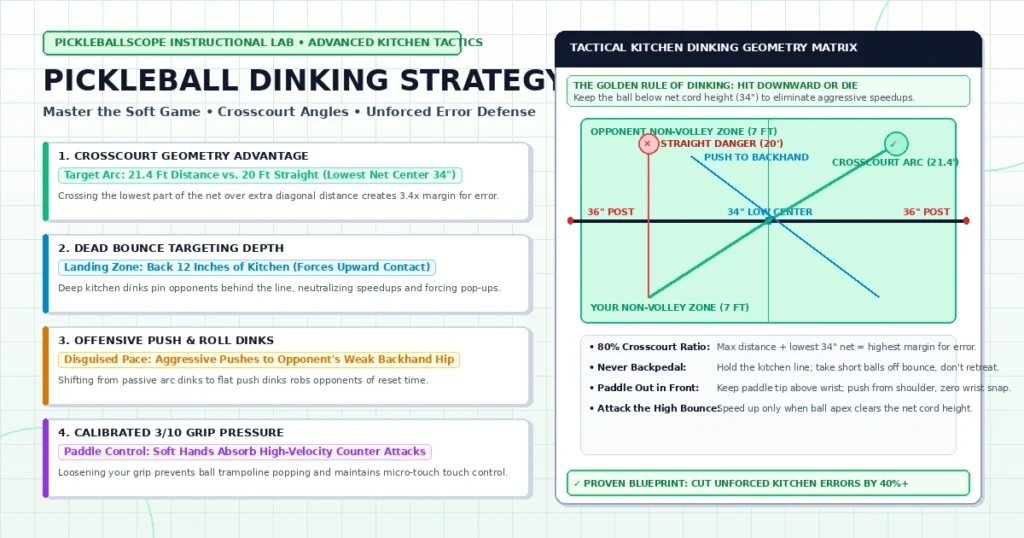
- The 80% Crosscourt Mandate: 80% or more of your neutral kitchen dinks must be directed crosscourt. The diagonal distance (21.4 ft) provides 1.4 extra feet of margin, and you cross the net at its lowest center point (34 inches vs. 36 inches at the sidelines).
- The Golden Rule of Dinking: Never attack a ball whose bounce apex remains below net cord height. Striking upward on low balls hands opponents an unmissable counter-punch.
- Feather Grip Pressure (3/10): Clamping your paddle with a white-knuckle grip turns your face into a trampoline. Maintain a relaxed 3 out of 10 grip to absorb incoming pace and drop resets dead in the kitchen.
- Hold the Non-Volley Line: Never backpedal when a ball lands deep at your feet. Drop your hips, stay balanced, and short-hop the ball out in front of your body. Surrendering the kitchen line surrenders the rally.
The Biomechanics of an Unshakable Pickleball Dinking Strategy
Before exploring tactical shot selection, you must build an unshakeable mechanical foundation. A flawed swing path or unstable stance will compromise even the smartest strategic intentions. An effective pickleball dinking strategy rests upon four fundamental mechanical pillars: grip pressure, paddle path, contact point, and lower-body stability.
1. Calibrated Grip Pressure: The 3 out of 10 Rule
The single most destructive mechanical habit among intermediate players is excessive grip tension. When players get nervous or anticipate a high-velocity speedup, they instinctively squeeze the paddle handle at an 8 or 9 out of 10 pressure. A tight forearm turns the paddle face into a rigid, unforgiving springboard. When a dipping dink strikes a stiff paddle, kinetic energy cannot dissipate—sending the ball floating 12 inches too high, right into the opponent’s strike zone.
Adopt a loose, relaxed grip pressure calibrated at approximately 3 out of 10. Hold the paddle as if you were holding a delicate ripe peach or a small bird: firm enough that it does not twist out of your hand upon contact, but loose enough that the muscles in your wrist and forearm remain soft. Soft hands absorb ball momentum like shock absorbers, allowing you to drop soft balls effortlessly into the opponent’s kitchen.
2. The Shoulder Pendulum: Eliminating the Wrist Snap
Dinking is not a wrist flick; it is a compact, pendulum-like lift generated entirely from the shoulder socket. Your wrist should remain relatively quiet and locked in a neutral or slightly laid-back position throughout the swing. Imagine your arm and paddle forming a single continuous unit.
Initiate the dink by hinging your paddle slightly below the ball. Push smoothly upward and forward through the ball toward your intended target zone, finishing with a compact follow-through that ends no higher than chest level. Eliminating erratic wrist snapping ensures repeatable trajectory and prevents spray errors under pressure.
3. Contact Point Out in Front
You must always strike the ball in front of your lead hip. Letting the ball travel behind your body forces an awkward, off-balance scoop that eliminates touch and leaves you vulnerable to kitchen foot faults. Keep your paddle tip tilted slightly upward above your wrist, presenting a clean paddle face to the incoming ball.
4. Athletic Knee Flexion vs. Waist Bending
When low dinks dip toward your shoetops, the natural human instinct is to bend forward from the lower back while keeping the legs straight. Bending at the waist drops your head, disrupts depth perception, and destabilizes balance. Instead, keep your chest proud and drop your hips by flexing deeply through your knees. Lowering your entire center of gravity brings your eyes closer to ball height, transforming difficult low resets into clean, comfortable lifts.
| Mechanical Component | Amateur Tendency (High Error Rate) | Mastery Standard (Low Error Rate) |
|---|---|---|
| Grip Pressure | White-knuckle clench (8–10 / 10 scale) | Loose, feathered soft hands (3 / 10 scale) |
| Primary Kinetic Joint | Flicking from wrist and elbow | Pendulum lift originating from the shoulder |
| Contact Point | Beside the hips or behind the body | 12–18 inches out in front of the lead foot |
| Vertical Leveling | Hunching over at the waist with straight legs | Bending deeply through knees and hips; chest proud |
| Paddle Face Angle | Wide-open face scooping balls high into air | Neutral to slightly open (5–10°); lifts through apex |
The Geometry of Dinking: Why Crosscourt Dominates the Kitchen
Every championship-caliber pickleball dinking strategy is built around a non-negotiable geometric reality: the crosscourt dink is vastly superior to the straight-ahead dink. While mixing in straight-ahead push dinks has tactical merit, hitting crosscourt should represent at least 75% to 85% of your standard neutral kitchen shots.
Understanding the mathematical and architectural physics behind this rule will instantly transform your court decision-making:
- The 1.4-Foot Distance Advantage: On a regulation court, straight-ahead dinking spans 14 to 20 feet, whereas crosscourt dinking spans 21.4 feet. That extra distance allows the ball to reach its apex and descend safely before crossing the line.
- The 2-Inch Net Height Window: Regulation nets measure 36 inches at the posts and 34 inches at the center strap. Crosscourt dinks travel over the lowest net center, providing crucial forgiveness.
- Forcing Lateral Opponent Displacement: Sharp crosscourt angles pull opponents outside the sidelines, opening massive gaps down the middle of the court.
The 4 Essential Dink Archetypes & Shot Selection
Advanced kitchen play is not a repetitive, robotic rally; it is a dynamic chess match where each shot serves a distinct strategic purpose. In a mature pickleball dinking strategy, players deploy four primary dinking archetypes depending on ball height, opponent positioning, and rally momentum.
1. The Crosscourt Reset Dink (The Defensive Workhorse)
This is your bread-and-butter shot when you are under pressure, off-balance, or recovering from a wide retrieve. The goal is to lift a soft, unattackable ball over the center of the net that lands comfortably in the opponent’s back kitchen corner. The trajectory features a gentle arc whose apex occurs on your side of the net, ensuring the ball is already falling downward as it crosses the net cord.
2. The Offensive Push Dink (The Pace Accelerator)
When an opponent hits a passive, floating dink that sits slightly above net cord height, do not settle for another soft reset. Deploy an aggressive offensive push dink. Instead of lifting softly upward, punch through the back of the ball with a flatter trajectory and a firmer wrist, directing the ball aggressively into the opponent’s backhand hip or trailing feet.
3. The Topspin Roll Dink (The Dipping Aggressor)
Popularized by modern pro players using raw carbon fiber paddles, the topspin roll dink introduces heavy forward spin into the soft game. By brushing upward across the back of the ball from low to high, you impart heavy topspin that forces the ball to dive violently downward immediately upon crossing the net cord, jumping aggressively at the opponent’s feet.
4. The Deceptive Middle Hold (The Disguise)
When you have established a predictable crosscourt rhythm, observant opponents begin shifting their weight early toward the sideline to anticipate the next crosscourt ball. This is your cue to strike the middle hold dink. Prepare your body posture, hips, and paddle angle as if you are hitting crosscourt, but freeze your paddle and push smoothly down the center dividing line.
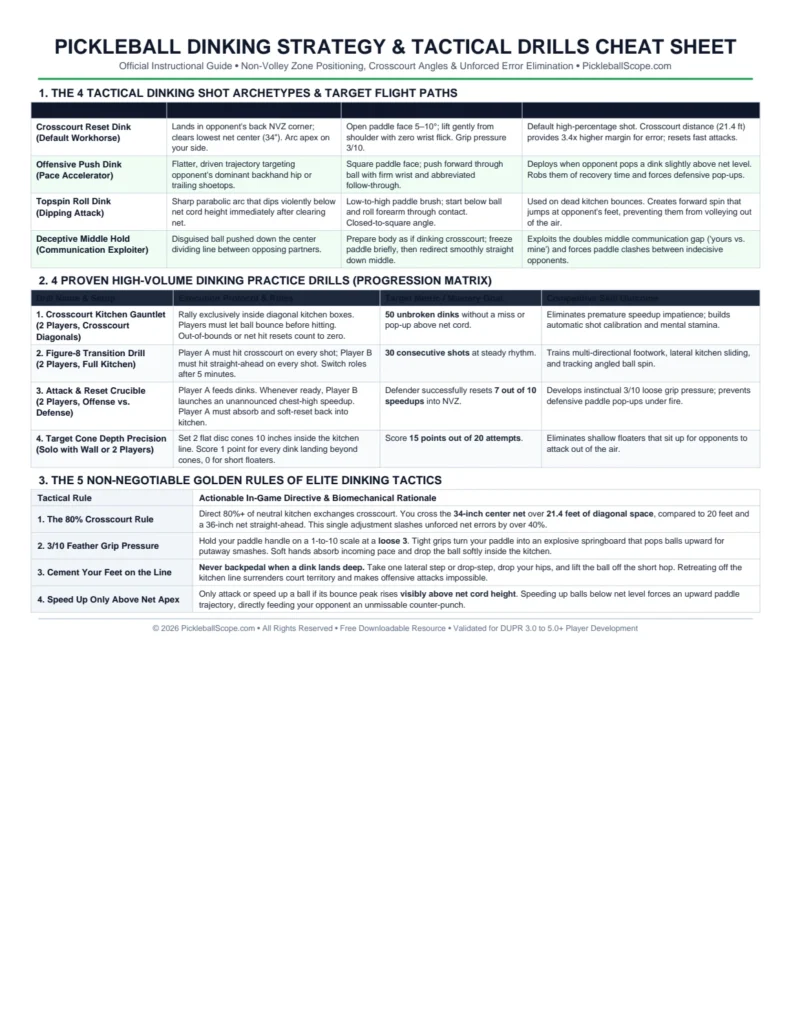
📄 Download the Free Dinking Strategy & Drills Cheat Sheet
Keep this tactical reference card in your bag or on your phone! Features complete shot-by-shot archetype matrices, 4 partner drill progressions, and the 5 non-negotiable golden rules of kitchen mastery.
4 High-Volume Dinking Practice Drills to Build Muscle Memory
You cannot develop elite touch during competitive tournament play where every missed ball costs points. True soft-game mastery is forged through deliberate, high-volume repetition. Incorporate these four court-tested drills into your weekly practice sessions to cement your pickleball dinking strategy:
- The Crosscourt Kitchen Gauntlet: Rally exclusively inside the diagonal 10′ × 7′ kitchen boxes. Maintain a 50-shot unbroken rally without missing or floating above net cord height to build mental stamina.
- The Figure-8 Transition Drill: Player A hits crosscourt while Player B hits straight-ahead, moving the ball in a continuous figure-8 pattern. Switch roles after 5 minutes to train lateral footwork.
- The Attack & Reset Crucible: Player A feeds soft dinks while Player B initiates unexpected chest-high speedups. Player A must absorb the pace with 3/10 grip pressure and reset softly into the kitchen.
- Target Cone Depth Precision: Place disc cones 10–12 inches inside the opposing kitchen line. Score points by landing dinks between the cones and the kitchen line, eliminating shallow floaters.
Common Dinking Mistakes to Avoid in Competitive Play
Refining your pickleball dinking strategy is as much about eliminating destructive habits as it is about executing great shots. Watch out for these four widespread pitfalls:
- Attacking Balls Below Net Cord Level: The cardinal sin of intermediate pickleball. When an opponent’s dink bounces below the top of the net, attacking with a flat drive forces an upward trajectory. Your opponent simply holds their paddle out and punches the ball downward at your feet. Unless the ball sits above net level, keep dinking!
- Backpedaling Away From the Kitchen Line: When a dink lands deep at a player’s feet, their natural instinct is to take two panic steps backward. Backpedaling concedes court positioning, creates a massive defensive gap, and turns an easy reset into a chaotic scramble. Hold the line, drop your hips, and short-hop the ball out in front.
- Excessive Wrist Snapping on Forehand Dinks: Trying to add extra spin by aggressively flicking the wrist causes inconsistent launch angles and spraying errors. Generate topspin through full-arm low-to-high paddle sweeps originating from the shoulder, keeping the wrist stable.
- Standing Flat-Footed Between Shots: Watching your dink float over the net while standing upright on flat heels leaves you frozen when opponents attack. Every time you strike a dink, immediately recover to an athletic ready position with knees bent, weight on the balls of your feet, and paddle held up in front of your chest.
Frequently Asked Questions About Pickleball Dinking Strategy
What is the primary objective of a pickleball dinking strategy?
The primary objective of a pickleball dinking strategy is to keep the ball low and unattackable, forcing opponents to strike the ball with an upward trajectory while waiting patiently for them to make an unforced error or pop up a ball that you can decisively smash.
Why is crosscourt dinking safer than straight-ahead dinking?
Crosscourt dinking is mathematically superior because the diagonal distance (21.4 ft) provides 1.4 extra feet of margin for error compared to straight-ahead dinking (20 ft). Additionally, crosscourt dinks cross the net at its lowest point (34 inches at the center strap) rather than 36 inches at the sideline posts, reducing net faults by over 40%.
How tight should I hold my paddle when dinking?
You should hold your paddle with a loose grip pressure of approximately 3 out of 10. A relaxed grip absorbs incoming pace, prevents the paddle face from acting like a bouncy springboard, and provides the delicate touch needed to drop balls softly into the non-volley zone.
Can I speed up a ball directly out of the air while dinking?
Yes, provided you do not step on or over the Non-Volley Zone line during or after the shot. If an opponent floats a dink high enough that you can contact it out of the air above net cord height while standing legally behind the kitchen line, you can execute a powerful roll volley or speedup winner.
What should I do if my opponent refuses to dink and only hits hard drives?
Do not get drawn into a reckless slugfest. Hold your position firmly at the kitchen line, soften your grip pressure to 3/10, present your paddle face out in front of your body, and execute a soft reset dink directly into their kitchen. Forcing a hard banger to play out of their kitchen completely neutralizes their power advantage.
Key Takeaways: Mastering Pickleball Dinking Strategy for Victory
- Patience Trumps Power: The player who can comfortably sustain an 8-to-12 shot kitchen rally will consistently outperform erratic power hitters.
- Favor Crosscourt Geometry: Direct 80%+ of your neutral kitchen balls crosscourt to leverage the 34-inch low center net and extra diagonal runway.
- Relax Your Hands: Maintain a 3/10 grip pressure to absorb high-velocity counters and execute feathered soft resets.
- Target the Backhand Hip: Deploy offensive push dinks into the opponent’s weaker backhand side to rush their preparation and force pop-ups.
- Hold the Line: Never retreat from the kitchen line; drop your center of gravity and take low balls off the bounce out in front of your body.