
Understanding official pickleball court dimensions is essential whether you are lining a temporary court on your driveway, converting an underutilized tennis surface, or planning a dedicated community sports complex. Unlike tennis, which requires distinct line boundaries for singles and doubles play, regulation pickleball utilizes one universal court footprint measuring exactly 20 feet wide by 44 feet long. Every match—from casual local round-robins to gold-medal championship finals—takes place on this exact same 880-square-foot field of play.
According to the official Rulebook published by USA Pickleball, court construction requires adherence to strict architectural parameters. These encompass not just outer boundary chalk lines, but also specific non-volley zone (kitchen) depth, centerline placements, net tension standards, and critical safety runoff buffers surrounding the active playing surface. Even a minor two-inch measurement error can invalidate kitchen foot faults or distort crosscourt dinking angles.
Furthermore, competitive match integrity tracked through DUPR (Dynamic Universal Pickleball Rating) relies upon standardized court geometry. While choosing approved paddles certified under the USA Pickleball Equipment Standards ensures consistent ball deflection and spin, playing on accurately dimensioned courts ensures your physical muscle memory translates seamlessly to any sanctioned venue in the world.
In this authoritative architectural guide, we break down every technical aspect of regulation pickleball court dimensions. You will learn the exact foot-by-foot measurements for all court zones, understand net height tolerances, discover the minimum clearance envelopes required for player safety, and follow an actionable 6-phase DIY court taping protocol to build your own regulation court on asphalt, concrete, or gym flooring.
⚡ Quick Blueprint: Official Pickleball Court Dimensions at a Glance
Need the critical specifications immediately before heading outside with a tape measure? Here are the official numbers:
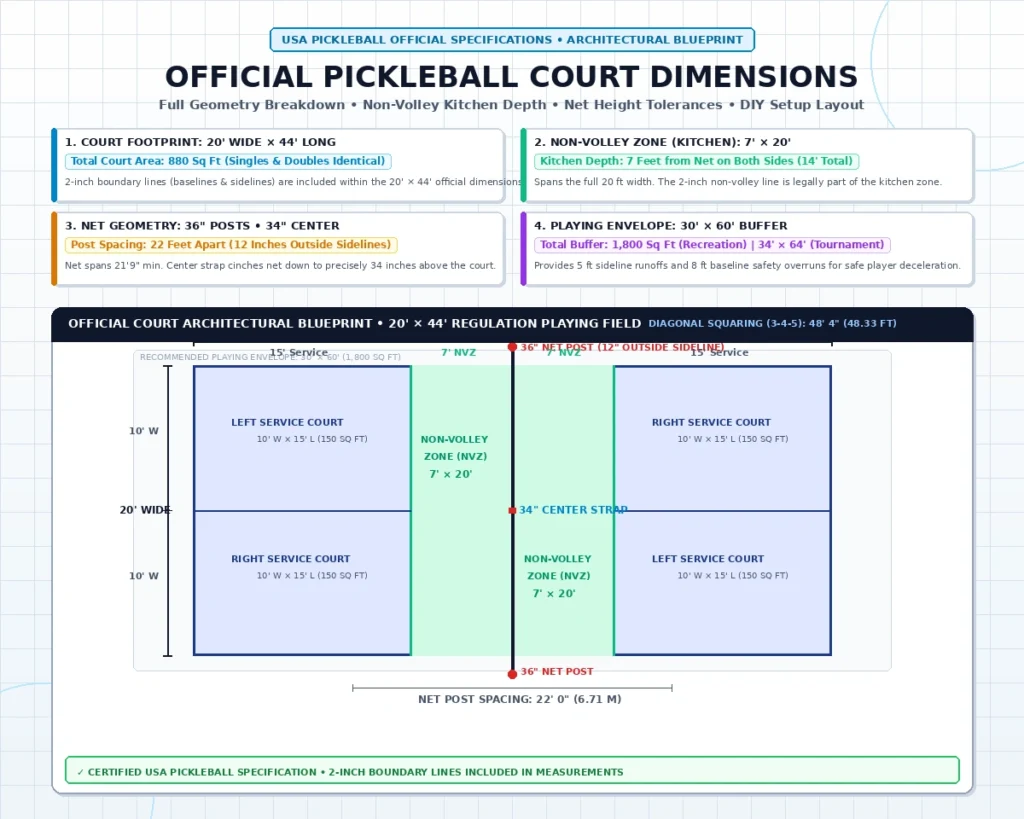
- Total Court Footprint: Exactly 20 feet wide by 44 feet long (6.10 m × 13.41 m). Total playing surface is 880 square feet. Identical for singles and doubles.
- Non-Volley Zone (The Kitchen): Extends 7 feet (2.13 m) from the net on both sides across the entire 20-foot court width. The 2-inch non-volley line is legally part of the kitchen.
- Service Courts: Two service courts per side (Left and Right), each measuring exactly 10 feet wide by 15 feet long (3.05 m × 4.57 m).
- Centerline: Measures 15 feet long, extending from the baseline to the kitchen line. Exactly centered at 10 feet. Does not extend through the kitchen.
- Net Heights: Exactly 36 inches (0.914 m) at the sidelines and posts, dipping to 34 inches (0.864 m) at the center strap.
- Recommended Playing Envelope: 30 feet wide by 60 feet long (1,800 sq ft) for recreational play; 34 feet by 64 feet (2,176 sq ft) for tournament competition.
- Boundary Line Width: Standard 2.0 inches (5.08 cm). All boundary lines are included in the overall court measurements.
Official USA Pickleball Court Dimensions (Full Geometry & Boundary Measurements)
The standard pickleball court dimensions were originally adapted from badminton court measurements by Joel Pritchard, Bill Bell, and Barney McCallum on Bainbridge Island in 1965. Over sixty years of sports evolution, USA Pickleball has refined these specifications into an exact engineering standard detailed in Section 2 of the Official Rulebook.
Let us examine the exact architectural anatomy of each section of the court, how lines are measured, and the legal rule context governing each boundary.
1. Outer Boundaries: Baseline and Sidelines (20′ × 44′)
The total perimeter is defined by two 20-foot baselines and two 44-foot sidelines. When constructing or measuring a court, a vital rule often overlooked by DIY builders is that all boundary lines are included in the overall dimensions. This means the 20-foot measurement spans from the outside edge of one sideline to the outside edge of the opposing sideline. Similarly, the 44-foot length spans from the outside edge of one baseline to the outside edge of the opposite baseline.
In pickleball, the lines are considered “in.” If any portion of the ball touches the outside painted edge of a sideline or baseline, the ball is legally in play. The lines must measure exactly 2 inches (5.08 cm) in width and be painted in a distinct color that strongly contrasts with the interior court and exterior perimeter surfaces.
2. The Non-Volley Zone (The Kitchen): 7 Feet Deep by 20 Feet Wide
The Non-Volley Zone—universally known as “the kitchen”—is the defining strategic element of pickleball. It occupies an area measuring 7 feet deep by 20 feet wide on both sides of the net, creating a combined 14-foot neutral corridor in the center of the court.
The non-volley line (kitchen line) is measured exactly 7 feet from the center of the net to the back edge of the 2-inch kitchen line. Crucially, under official rules, the 2-inch kitchen line itself is legally considered part of the non-volley zone. If a player volleys a ball in the air while their shoe, toe, or even dropped hat touches the kitchen line, an immediate fault is assessed. During the serve, however, the kitchen line is considered “short”—meaning a serve that strikes the kitchen line is a service fault.
3. Left and Right Service Courts: 10 Feet Wide by 15 Feet Long
The remaining 15 feet between the kitchen line and the baseline is divided into two equal rectangular service boxes: the Left Service Court (even/ad court depending on server score) and the Right Service Court (odd/deuce court). Each box measures exactly 10 feet wide by 15 feet long (150 square feet each).
A 2-inch-wide centerline divides these service courts. The centerline begins at the baseline and terminates at the kitchen line; it does not continue through the kitchen. The centerline is centered precisely at the 10-foot mark of the court width. Unlike tennis, where a serve landing on the service line is good, a pickleball serve that touches the kitchen line is a fault, while a serve touching the centerline, sideline, or baseline is in.
4. Net Specifications and Post Placement
Regulation pickleball nets feature a distinctive slight center droop that rewards accurate down-the-middle passing shots. The net must measure at least 21 feet 9 inches long, extending from post to post.
- Height at the Posts: The net must measure exactly 36 inches (3.0 feet) high at each sideline post.
- Height at the Center: The net must measure exactly 34 inches (2.83 feet) high at the center of the court, cinched into place by an adjustable center tie-down strap.
- Post Placement: Net posts must be positioned 22 feet apart from inside edge to inside edge. This places the posts exactly 12 inches (1.0 foot) outside the court sidelines on each side. This 12-inch gap is mandatory because it provides the legal clearance envelope necessary for around-the-post (ATP) shots.
| Court Component | Imperial Measurement | Metric Equivalent | Measurement Rules & Tolerances |
|---|---|---|---|
| Full Court Width | 20 Feet 0 Inches | 6.10 Meters | Measured outside edge to outside edge of sidelines |
| Full Court Length | 44 Feet 0 Inches | 13.41 Meters | Measured outside edge to outside edge of baselines |
| Kitchen Depth (NVZ) | 7 Feet 0 Inches | 2.13 Meters | Measured from center net line to outside edge of NVZ line |
| Kitchen Width | 20 Feet 0 Inches | 6.10 Meters | Spans entire court width from sideline to sideline |
| Service Box Width | 10 Feet 0 Inches | 3.05 Meters | Measured from sideline edge to center of dividing line |
| Service Box Length | 15 Feet 0 Inches | 4.57 Meters | Measured from kitchen line edge to outside baseline edge |
| Net Height at Sidelines | 36.0 Inches | 0.914 Meters | Measured vertically at the post / sideline line |
| Net Height at Center | 34.0 Inches | 0.864 Meters | Cinched via center strap above playing surface |
| Post-to-Post Distance | 22 Feet 0 Inches | 6.71 Meters | Posts set exactly 12 inches outside each sideline |
| Standard Line Width | 2.0 Inches | 5.08 Centimeters | All boundary lines included in total footprint |
Recommended Playing Envelope & Safety Clearance Zones
While the playing lines of regulation pickleball court dimensions require only 880 square feet (20′ × 44′), you cannot safely play pickleball in an area that only matches the boundary lines. Competitive players routinely track down angled dinks, sprint back to retrieve deep lobs, and slide aggressively past the sidelines on around-the-post attempts. Inadequate perimeter clearance creates severe safety hazards, including collisions with perimeter fences, light poles, or concrete retaining walls.
USA Pickleball defines three distinct playing envelopes based on the facility’s intended competition level:
- Minimum Playing Space: 28 Feet by 54 Feet (1,512 Sq Ft): This is the absolute minimum clearance required for tight residential backyard installations or converted tennis courts with space constraints. It provides 4 feet of sideline clearance and 5 feet of baseline overrun.
- Standard Recommended Envelope: 30 Feet by 60 Feet (1,800 Sq Ft): This is the universally recommended standard for municipal parks, commercial pickleball clubs, and community recreation centers. It provides 5 feet of lateral clearance beyond each sideline and 8 feet of rear runoff behind each baseline.
- Tournament Standard Envelope: 34 Feet by 64 Feet (2,176 Sq Ft): Sanctioned USA Pickleball tournaments, PPA Tour, and Major League Pickleball events mandate a spacious 34′ × 64′ perimeter (and 40′ × 60′ for center championship stadium courts) to accommodate referees, linesmen, and broadcasting cameras.
| Facility Category | Total Dimensions | Total Area | Sideline Clearance | Baseline Overrun |
|---|---|---|---|---|
| Absolute Minimum | 28′ × 54′ | 1,512 Sq Ft | 4 Feet (1.22 m) | 5 Feet (1.52 m) |
| Standard Recommended | 30′ × 60′ | 1,800 Sq Ft | 5 Feet (1.52 m) | 8 Feet (2.44 m) |
| Preferred Club Standard | 32′ × 64′ | 2,048 Sq Ft | 6 Feet (1.83 m) | 10 Feet (3.05 m) |
| Sanctioned Tournament | 34′ × 64′ | 2,176 Sq Ft | 7 Feet (2.13 m) | 10 Feet (3.05 m) |
| Stadium Center Court | 40′ × 60′ to 40′ × 70′ | 2,400–2,800 Sq Ft | 10 Feet (3.05 m) | 13 Feet (3.96 m) |
How Pickleball Court Dimensions Compare to Tennis and Badminton
To appreciate how accessible and compact pickleball court dimensions are, comparing them directly to other popular racket sports highlights why pickleball venues are flourishing in dense urban areas. You can comfortably fit three to four full pickleball courts inside the footprint of a single standard 60′ × 120′ tennis court.
A standard tennis court measures 36 feet wide by 78 feet long for doubles (2,808 sq ft of lines), requiring an overall fenced slab of 60′ × 120′ (7,200 sq ft). By contrast, pickleball requires only 880 sq ft of lines and an 1,800 sq ft recommended slab. Pickleball’s net is also 2 inches lower at the center (34″ vs. tennis’s 36″) and 6 inches lower at the sidelines (36″ vs. tennis’s 42″). This smaller footprint dramatically reduces running fatigue, places the emphasis on lightning-fast reflexes over baseline stamina, and enables continuous social banter across players.
Pickleball lines share the exact same outer boundary dimensions as a doubles badminton court (20′ × 44′). In fact, the original founders constructed the first pickleball court by lowering the net on an existing badminton court. However, the internal line structure differs fundamentally: badminton features short service lines at 6.5 feet, singles alleys (17 ft width), and a high 5-foot net, whereas pickleball features a 7-foot kitchen line, 20-foot universal width, and a low 34-inch center net.
| Sport Comparison | Playing Dimensions | Total Line Area | Center Net Height | Post Net Height |
|---|---|---|---|---|
| Pickleball | 20′ × 44′ | 880 Sq Ft | 34 Inches (86.4 cm) | 36 Inches (91.4 cm) |
| Tennis (Doubles) | 36′ × 78′ | 2,808 Sq Ft | 36 Inches (91.4 cm) | 42 Inches (106.7 cm) |
| Tennis (Singles) | 27′ × 78′ | 2,106 Sq Ft | 36 Inches (91.4 cm) | 42 Inches (106.7 cm) |
| Badminton (Doubles) | 20′ × 44′ | 880 Sq Ft | 60 Inches (152.4 cm) | 61 Inches (155.0 cm) |
| Platform Tennis (Paddle) | 20′ × 44′ (30′ × 60′ screen) | 880 Sq Ft | 34 Inches (86.4 cm) | 37 Inches (94.0 cm) |
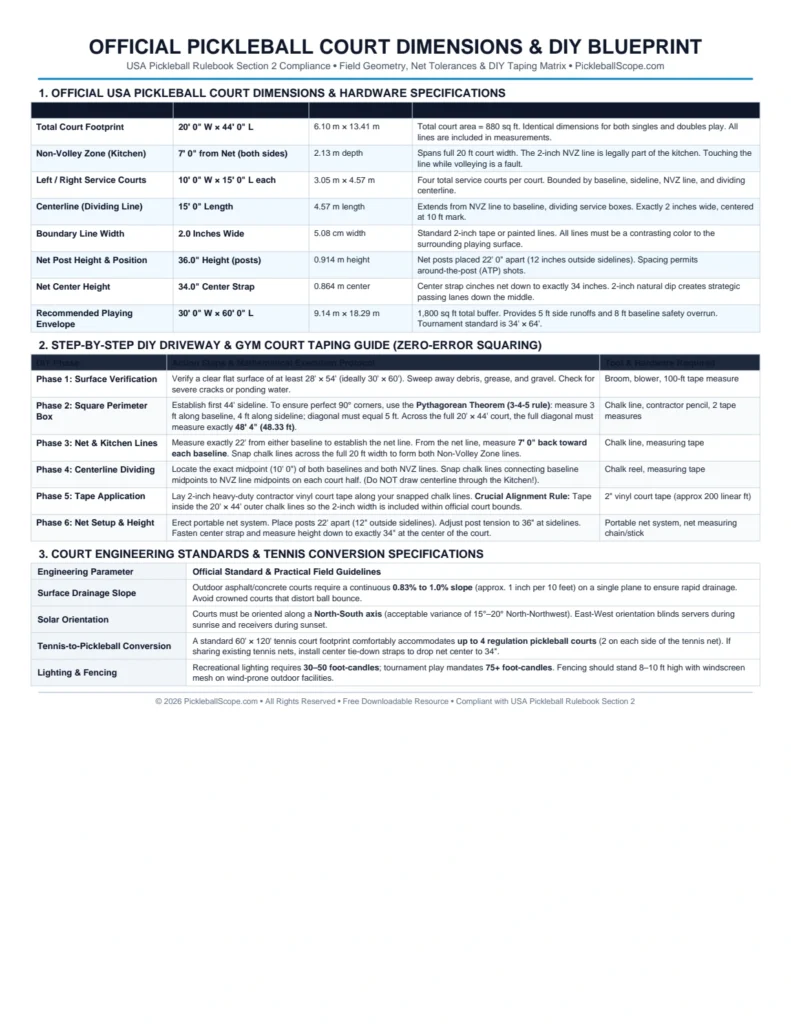
📄 Download the Free Court Dimensions & DIY Blueprint
Take this printable architectural blueprint to your driveway, club, or gym! Includes full engineering line diagrams, 3-4-5 squaring formulas, net post spacing charts, and surface slope guidelines.
Step-by-Step DIY Guide: How to Tape Pickleball Court Dimensions on a Driveway or Gym
Setting up temporary or permanent pickleball court dimensions on an asphalt driveway, concrete pad, or indoor gymnasium floor is straightforward when you follow proper geometry. The biggest hurdle amateur builders face is accidentally creating a skewed parallelogram instead of a square 90-degree rectangle. Follow this tested 6-phase DIY blueprint to tape a flawless regulation court in under 90 minutes.
- Inspect and Clear Your Surface: Measure your available space to verify you have at least 28′ × 54′ of continuous flat surface. Sweep away all loose sand, debris, and gravel. If setting up on asphalt, inspect for dips where water might collect or raised tree root expansion cracks that could trip players.
- Establish the First 44-Foot Sideline: Anchor your tape measure and snap a straight 44-foot chalk line where you want the first sideline. Mark the 0-foot start point (Corner A) and the 44-foot end point (Corner B). While your tape is laid out, place pencil marks at 15 feet (Kitchen Line #1), 22 feet (Net Line), and 29 feet (Kitchen Line #2).
- Square the Perimeter Using the Pythagorean Theorem (The 3-4-5 Rule): To ensure your corners form exact 90-degree right angles, use the Pythagorean Theorem ($A^2 + B^2 = C^2$). For a full 20′ × 44′ court, the diagonal distance between opposite corners must equal exactly 48 feet 4 inches (48.33 feet). Anchor one tape at Corner A (0 ft) extending 20 feet outward along the baseline. Anchor a second tape at Corner B (44 ft) extending diagonally. Where the 20-foot mark intersects the 48-foot 4-inch diagonal mark is your exact 90-degree corner.
- Snap the Net Line and Kitchen Lines: Locate the 22-foot mark on both sidelines. Snap a chalk line across the court to mark the net position. Next, measure 7 feet backward toward each baseline from the net line. Snap two full 20-foot chalk lines across the court. These represent your Non-Volley Zone lines.
- Snap the Centerlines: Measure the exact 10-foot midpoint of both baselines and both kitchen lines. Snap a chalk line connecting the baseline midpoint to the kitchen line midpoint on both halves of the court. Do not snap the centerline through the kitchen.
- Lay Down Your 2-Inch Line Tape: Tape inside the outer boundary lines so the 2-inch tape width is included within the 20′ × 44′ perimeter. For the kitchen lines, tape on the service court side of your 7-foot chalk mark. For the centerline, center the tape directly over your chalk line.
- Erect and Calibrate Your Portable Net: Place net posts 22 feet apart (12 inches outside each sideline). Adjust post tension until the net stands 36 inches high at the sidelines, and cinch the center strap until the net measures exactly 34 inches at the center.
Court Surface, Lighting, and Environmental Standards
If you are investing in permanent court construction—such as pouring a dedicated post-tensioned concrete slab or resurfacing a public facility—structural engineering requirements extend beyond line geometry:
Surface Materials: Asphalt vs. Post-Tensioned Concrete
- Post-Tensioned Concrete: The gold standard for commercial and municipal courts. Post-tensioned concrete slabs (4 to 5 inches thick) feature high-tensile steel cables that prevent surface cracking, settling, and moisture damage. Expect a 25+ year lifespan with minimal maintenance.
- Asphalt: A cost-effective alternative popular for residential driveways and converted tennis courts. While initially 30% to 40% cheaper than concrete, asphalt is susceptible to temperature cracking, oxidation, and settlement over time, requiring crack repairs every 3 to 5 years.
- Cushioned Acrylic Coatings: High-performance courts feature multi-layered 100% acrylic color systems infused with silica sand for traction, underlaid with rubberized cushioning layers to reduce joint impact on players’ knees and lower backs.
Surface Drainage Slope (The 1% Rule)
Outdoor courts must never be poured dead-level. Water ponding on court surfaces degrades acrylic coatings, damages balls, and creates dangerous slip hazards. American Sports Builders Association (ASBA) guidelines mandate a continuous single-plane slope of 0.83% to 1.0% (1 inch per 10 feet), ideally draining from side to side or from one baseline to the other. Never build a “crowned” court that peaks at the net; crowns distort ball bounce and deflect dinks erratically.
Solar Orientation: North-South Axis
Whenever designing outdoor courts, always align the longitudinal centerline along a North-South axis (with allowable variance up to 15 degrees North-Northwest). Courts oriented East-to-West force one side of players to look directly into blinding morning sunrise or low afternoon sunset glare, creating severe visibility problems and safety hazards.
Frequently Asked Questions About Pickleball Court Dimensions
Are pickleball court dimensions the same for singles and doubles?
Yes. Regulation pickleball court dimensions are exactly 20 feet wide by 44 feet long for both singles and doubles play. Unlike tennis, which features narrower singles sidelines (27 feet) and wider doubles alleys (36 feet), pickleball uses identical boundaries for every match format.
Can I fit a pickleball court on my residential driveway?
Yes, provided your driveway offers a flat surface of at least 28 feet by 54 feet. While a full 30′ × 60′ area is recommended for comfortable safety runoff, many recreational players successfully set up temporary courts on two-car or three-car driveways using portable net systems and removable vinyl tape.
What is the diagonal measurement of a regulation pickleball court?
The exact diagonal measurement of a regulation 20′ × 44′ pickleball court is 48 feet 4 inches (48.33 feet). Measuring the diagonals between opposite corners and ensuring they are equal is the most reliable way to verify your court corners are perfectly square 90-degree right angles.
How high is a regulation pickleball net?
A regulation pickleball net measures exactly 36 inches (0.914 m) high at the sidelines and posts, dipping smoothly to exactly 34 inches (0.864 m) high at the center of the court. The center height is maintained using an adjustable center tie-down strap anchored to the court surface or portable frame.
How far outside the sidelines should pickleball net posts be placed?
Official net posts must be placed 22 feet apart from inside edge to inside edge, which positions each post exactly 12 inches (1.0 foot) outside the court sidelines. This clearance allows players to execute legal around-the-post (ATP) shots.
Key Takeaways: Mastering Pickleball Court Dimensions for Building or Playing
- Universal Playing Area: Every court measures 20′ × 44′ (880 sq ft), regardless of whether you play singles or doubles.
- The 7-Foot Kitchen: The Non-Volley Zone spans 7 feet on both sides of the net, and the 2-inch non-volley line is legally part of the kitchen.
- Net Heights Matter: Always verify your net stands 36 inches at the posts and 34 inches at the center strap before starting match play.
- Clearance Saves Bodies: Allocate a minimum playing envelope of 30′ × 60′ (1,800 sq ft) to ensure safe deceleration and prevent wall collisions.
- Square Before Taping: Always verify the 48-foot 4-inch diagonal measurement when taping your perimeter to prevent skewed angles.