
Executing a dedicated pickleball warmup routine before stepping onto the court is the single most effective way to eliminate preventable soft-tissue tears, protect aging joints, and sharpen explosive first-step reaction times. Thousands of enthusiastic players arrive at local community courts, drop their bags, take three gentle practice swings with their paddle, and immediately start blasting baseline drives at full game speed. Within twenty minutes, tight Achilles tendons, strained hamstrings, or wrenched rotator cuffs force sudden medical timeouts that can sideline competitors for months.
According to certified athletic trainers and medical guidelines sanctioned by USA Pickleball, recreational racket and paddle sports generate intense multi-directional stresses—including abrupt lateral deceleration at the kitchen line, sudden backward pivots to track deep lobs, and explosive overhead smashes. Stepping into high-intensity match play without an elevated core temperature and pre-lubricated joint capsules drastically magnifies the probability of catastrophic orthopedic injuries.
Furthermore, competitive rating benchmarks tracked across DUPR (Dynamic Universal Pickleball Rating) demonstrate that players who arrive with a primed neuromuscular system consistently win opening games, commit fewer early unforced kitchen errors, and move with superior balance. Choosing high-performance paddles validated on the USA Pickleball Equipment Standards list delivers crisp pop and control, but your body remains the ultimate piece of sports equipment on the court.
In this clinical guide, you will master an evidence-based 5-minute dynamic pickleball warmup routine designed specifically for court-side execution without requiring resistance bands, yoga mats, or gym machines. We examine why traditional static stretching fails cold muscles, break down the 5 progressive phases of dynamic activation, and provide an actionable, printable court bag cheat sheet to keep your body healthy and agile every time you play.
⚡ The 30-Second Clinical Warm-Up Executive Summary
Short on time before your rec league round-robin begins? Here is the foundational framework every competitive player must remember:
- Never stretch statically while cold: Holding motionless 30-second hamstring or calf stretches before playing temporarily reduces explosive muscle contraction power by up to 15% and increases micro-tear susceptibility.
- The 5-Minute Golden Rule: A structured dynamic pickleball warmup routine requires only 300 seconds to elevate core body temperature, pump lubricating synovial fluid through joints, and activate fast-twitch neural reflexes.
- The 5 Sequential Phases: Phase 1 Cardio Elevation (0:00–1:00) → Phase 2 Lower Kinetic Chain & Achilles (1:00–2:15) → Phase 3 Hip & Lateral Groin Mobility (2:15–3:15) → Phase 4 Thoracic & Rotator Cuff Prep (3:15–4:15) → Phase 5 Match-Pace Split-Step Priming (4:15–5:00).
- Injury Prevention Payoff: Over 85% of acute pickleball muscle strains and tendon ruptures happen within the first 15–20 minutes of cold play. Five minutes of dynamic priming reduces that risk by over 60%.
Why Every Player Needs a Dynamic Pickleball Warmup Routine (The Science of Injury Prevention)
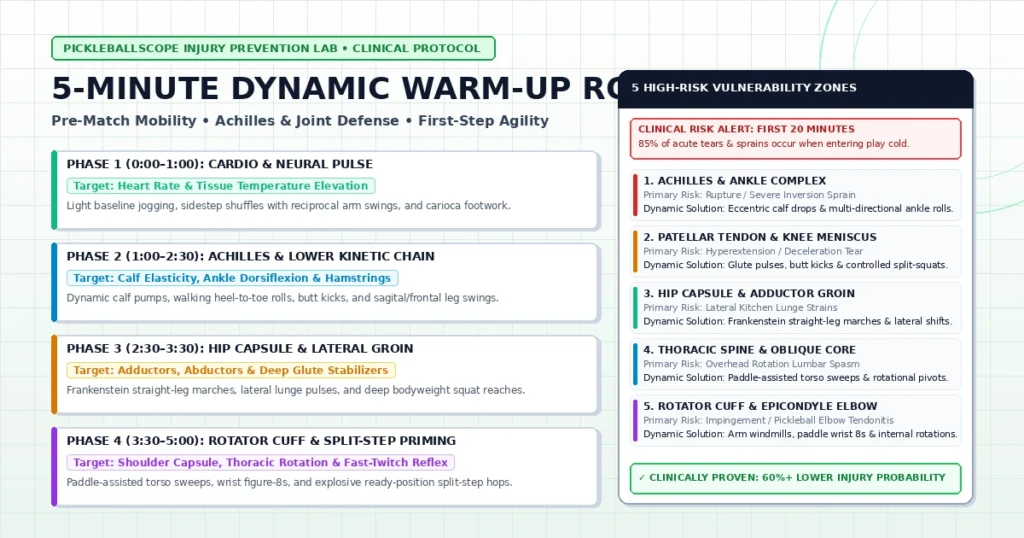
To understand the profound importance of a structured pickleball warmup routine, consider the biomechanical demands unique to the sport. Unlike distance running or cycling, which operate in predictable linear planes, pickleball demands continuous chaotic multi-planar movement. Players rapidly accelerate toward the non-volley zone, abruptly plant their feet on rigid concrete surfaces, lunge sideways into deep crosscourt dinks, and torque their spines to return dipping passing shots.
When muscle tissue is cold, muscle viscosity is elevated. Cold muscle fibers, tendons, and connective fascia act like cold rubber bands—stiff, resistant to elongation, and prone to snapping when subjected to sudden explosive loads. As players age past forty, connective collagen naturally loses hydration and cellular elasticity. An abrupt backward sprint to retrieve a high lob places monumental tensile strain directly onto an unprimed Achilles tendon, representing one of the most common catastrophic injuries seen in emergency rooms nationwide.
A properly structured dynamic pickleball warmup routine initiates several critical physiological adaptations within your cardiovascular and musculoskeletal systems:
- Core Temperature Elevation: Gentle full-body movement increases blood flow to working extremities, warming muscle tissue by 1 to 2 degrees Fahrenheit and allowing muscle actin-myosin cross-bridges to slide smoothly without friction.
- Synovial Fluid Secretion: Dynamic joint articulation triggers the synovial membrane to secrete natural biological lubricant into your knee, hip, ankle, and shoulder capsules, cushioning cartilage against high-impact deceleration shock.
- Enhanced Oxygen Dissociation: Higher tissue temperature speeds up hemoglobin’s release of oxygen to contracting muscle cells, delaying the onset of early-match lactic acid fatigue.
- Neuromuscular Facilitation: Rhythmic movement pathways wake up the central nervous system, drastically quickening neural signal transmission between your brain, peripheral nerves, and footwork motor units.
The Static Stretching Trap: Why Touching Your Toes Cold Harms Court Performance
For decades, traditional physical education classes taught athletes to begin athletic sessions by bending over, touching their toes, and holding static stretches for thirty seconds. Modern sports science and clinical orthopedic research have comprehensively debunked this practice before dynamic sporting events.
When you hold a prolonged static stretch on a cold muscle fiber, you trigger an inhibitory neurological reflex called the Golgi tendon organ response. This mechanism tells the muscle spindle to relax, temporarily reducing the muscle’s resting tone and viscoelastic stiffness. While this increases passive flexibility, it temporarily suppresses explosive twitch power, decreases vertical jumping ability, and blunts dynamic deceleration control. Even worse, overstretching cold tendons before rapid lateral movements leaves joints structurally vulnerable during sudden lateral cuts.
Static stretching is a fantastic athletic tool, but it belongs strictly at the end of your session as part of a post-match cooldown when muscle tissues are fully engorged with warm blood. Before the first serve, your warm-up must remain 100% active, dynamic, and movement-based.
| Warm-Up Category | Static Stretching (Outdated) | Dynamic Warm-Up (Modern Gold Standard) |
|---|---|---|
| Core Mechanism | Holding passive, motionless stretches for 30–60 seconds | Active, continuous movement through full joint ranges of motion |
| Tissue Temperature Effect | Little to no change; player remains cold while standing still | Elevates muscle and core body temperature by 1–2°F |
| Joint Lubrication | Minimal synovial fluid circulation | Stimulates rich synovial fluid secretion across all joints |
| Neuromuscular Impact | Inhibits muscle contraction power by 8% to 15% | Sharpens neural firing rate and accelerates reflex times |
| Injury Prevention Value | Ineffective; can increase joint vulnerability when cold | Reduces acute muscle tear and tendon strain probability by 60%+ |
| Recommended Timing | Post-match cooldown only (10–15 minutes after play) | Pre-match court-side (5–8 minutes immediately before play) |
The Complete 5-Minute Pickleball Warmup Routine: Step-by-Step Court-Side Protocol
This 5-minute dynamic pickleball warmup routine requires no gym equipment, elastic bands, or mats. You can perform it directly on the court surface, running between the baseline and the non-volley zone line (a distance of fourteen feet), or in the perimeter walkway beside the courts. Move systematically from head to toe, gradually increasing movement tempo as your body warms.
Phase 1: Core Cardio & Neural Pulse (Minutes 0:00 – 1:00)
The opening sixty seconds are dedicated to gently awakening your cardiovascular system, elevating resting heart rate from resting levels (60–80 BPM) to light aerobic activation (110–120 BPM), and breaking open peripheral blood vessels.
- Light Baseline-to-NVZ Jog (20 Seconds): Begin at the baseline and jog lightly forward to the kitchen line at 40% effort. Decelerate smoothly, pedal backward gently, and repeat for 3 to 4 easy laps. Focus on breathing deeply through your nose and exhaling through your mouth.
- Sidestep Shuffles with Reciprocal Arm Hugs (20 Seconds): Turn sideways along the baseline. Shuffle laterally from sideline to sideline, staying light on the balls of your feet. As you shuffle, swing your arms wide open across your chest, then cross them into a self-hug, alternating the top arm on each repetition. This simultaneously activates your adductors and warms the pectoral and rear deltoid musculature.
- Carioca / Grapevine Footwork (20 Seconds): Move laterally across the court by crossing your trailing foot alternately in front of and then behind your lead foot. Allow your hips and pelvis to rotate fluidly while keeping your upper torso relatively upright. Carioca stimulates pelvic mobility, rotational spinal flexibility, and foot-eye coordination.
Phase 2: Lower Kinetic Chain & Achilles Protection (Minutes 1:00 – 2:15)
The lower kinetic chain absorbs immense ground reaction forces in pickleball. The Achilles tendon, calf complex, hamstrings, and quadriceps require progressive dynamic loading to build elasticity before handling abrupt starts and stops.
- Dynamic Heel-to-Toe Rockers (20 Seconds): Stand tall with feet hip-width apart. Rock backward onto your heels, raising your toes toward your shins (dorsiflexion) to activate the anterior tibialis. Immediately roll smoothly forward onto the balls of your feet, pressing high into a calf raise (plantarflexion). Repeat rhythmically for 15 to 20 continuous repetitions to pump blood into the calf belly and Achilles tendon.
- Walking Butt Kicks with Quad Reach (20 Seconds): Walk forward across the court, kicking your heel directly toward your glute on each step. As your heel rises, reach down with your same-side hand to lightly tap or guide your ankle, feeling a brief, dynamic stretch across the front of your quadriceps and hip flexors. Do not hold the stretch; release immediately and alternate legs.
- High Knee Marches to Chest Hug (20 Seconds): Walk forward, driving your knee upward toward your chest on each stride. Cup your hands around your shin and gently guide the knee toward your torso for one second before stepping down and driving the opposite knee. This engages your gluteus maximus, mobilizes the posterior hip capsule, and warms your hip flexors.
- Sagittal & Frontal Leg Swings (15 Seconds): Place one hand lightly against the fence or net post for balance. Swing your outside leg forward and backward like a pendulum (sagittal plane) for 8 repetitions, feeling dynamic elongation through your hamstrings and hip flexors. Turn facing the fence and swing your leg across your body and out to the side (frontal plane) for 8 repetitions to activate inner groin and outer abductor muscles. Switch sides and repeat.
Phase 3: Multi-Planar Hip Mobility & Lateral Groin Priming (Minutes 2:15 – 3:15)
High-level dinking battles require exceptional hip mobility. When resetting dipping balls at your shoetops, you must hinge deeply through your hips rather than bending your lower back. Phase 3 primes your lateral stabilizers and adductor groin tendons.
- Frankenstein Straight-Leg Marches (20 Seconds): Extend both arms straight out in front of your chest at shoulder height with palms down. Walk forward, kicking your right leg straight up toward your outstretched left hand while keeping your knee relatively straight. Step forward and kick your left leg toward your right hand. This dynamic movement elongates your hamstrings and engages your core stability without passive overstretching.
- Lateral Side-Lunge Shifts with Glute Pulse (20 Seconds): Stand facing the net with feet twice shoulder-width apart. Shift your bodyweight smoothly to your right side, bending your right knee and sinking your hips backward as if sitting into a low chair while keeping your left leg straight. Hold for one second at the bottom, drive through your right heel to return to center, and shift smoothly to the left side. Perform 6 controlled repetitions per side to awaken your adductors and deep glute medius stabilizers.
- Deep Bodyweight Squat to Thoracic Sky Reach (20 Seconds): Set your feet shoulder-width apart with toes flared slightly outward. Sink into a deep, controlled bodyweight squat, pushing your knees outward in line with your toes. At the bottom of the squat, place your left fingertips on the court floor between your feet and rotate your right arm and chest toward the sky, following your right hand with your eyes. Return to center, rotate your left arm to the sky, and stand upright. Repeat for 5 smooth, controlled reps to mobilize both hips and upper thoracic spine.
Phase 4: Upper Body, Thoracic Spine & Rotator Cuff Preparation (Minutes 3:15 – 4:15)
Your upper body generates rotational torque for serves, drives, and roll volleys. Meanwhile, your rotator cuff stabilizes your arm during abrupt overhead counters. In Phase 4 of your pickleball warmup routine, use your paddle as a lightweight mobility bar to prime your shoulders and wrists.
- Paddle-Assisted Overhead Pass-Throughs (20 Seconds): Hold your paddle horizontally in front of your hips with a wide overhand grip, grasping both the handle and the top edge of the paddle face with opposite hands. Keeping your elbows straight, sweep the paddle up overhead and back behind your head as far as comfortable without arching your lower back. Reverse the arc smoothly to the front. Perform 10 fluid repetitions to open the anterior chest wall and mobilize the glenohumeral joint.
- Standing Torso Twists with Foot Pivot (15 Seconds): Hold your paddle with both hands horizontally against your chest. Rotate your torso vigorously to the right, allowing your trailing left heel to pivot off the court surface so your hips turn fully with your shoulders. Reverse direction smoothly, rotating to the left and pivoting your right foot. This replicates the kinetic chain rotation of forehand and backhand groundstrokes while protecting your lumbar spine.
- Rotator Cuff Internal & External Sweep Turns (15 Seconds): Tuck your hitting elbow snugly against your ribcage at a 90-degree angle with your forearm pointing straight ahead. Using your hitting arm holding your paddle, rotate your forearm outward away from your torso as far as comfortable without letting your elbow leave your side, then sweep it inward across your stomach. Perform 12 to 15 brisk repetitions to pump blood directly into your infraspinatus, supraspinatus, and subscapularis rotator cuff tendons.
- Paddle Wrist Figure-8s & Forearm Releases (10 Seconds): Hold your paddle in your standard continental or eastern grip. Trace large, smooth figure-8 loops in the air in front of your body, alternating pronation (turning palm downward) and supination (turning palm upward). This lubricates the carpal bones in your wrist and warms the common extensor tendon at your lateral elbow, creating powerful defense against tennis elbow.
Phase 5: Sport-Specific Ready Priming & Split-Step Reactions (Minutes 4:15 – 5:00)
The final forty-five seconds bridge the gap between general physical preparation and real-game intensity. You will transition from steady mobility movements into reactive, sport-specific footwork drills that fire up your fast-twitch motor units.
- Split-Step Reaction Hops (20 Seconds): Assume an athletic ready position at the baseline or kitchen line—knees bent, chest forward, paddle up in front of your chest. Perform small, active bounce hops on the balls of your feet. Every three bounces, execute an explosive “split-step” drop: hop slightly off the ground and land with feet wider than shoulder-width, dropping your center of gravity instantly into a loaded stance. Practice reacting immediately to an imaginary incoming shot.
- Non-Volley Zone Shadow Dinking Footwork (25 Seconds): Step up to the kitchen line. For twenty-five seconds, execute high-speed shadow footwork without a ball. Slide laterally two steps to your right, drop into a simulated forehand dink, push explosively back to center, slide two steps to your left, execute a simulated backhand dink, and immediately jump back to defend an imaginary overhead lob. Moving at 80% to 90% game speed primes your reactive balance and ensures you step into point one fully alert.
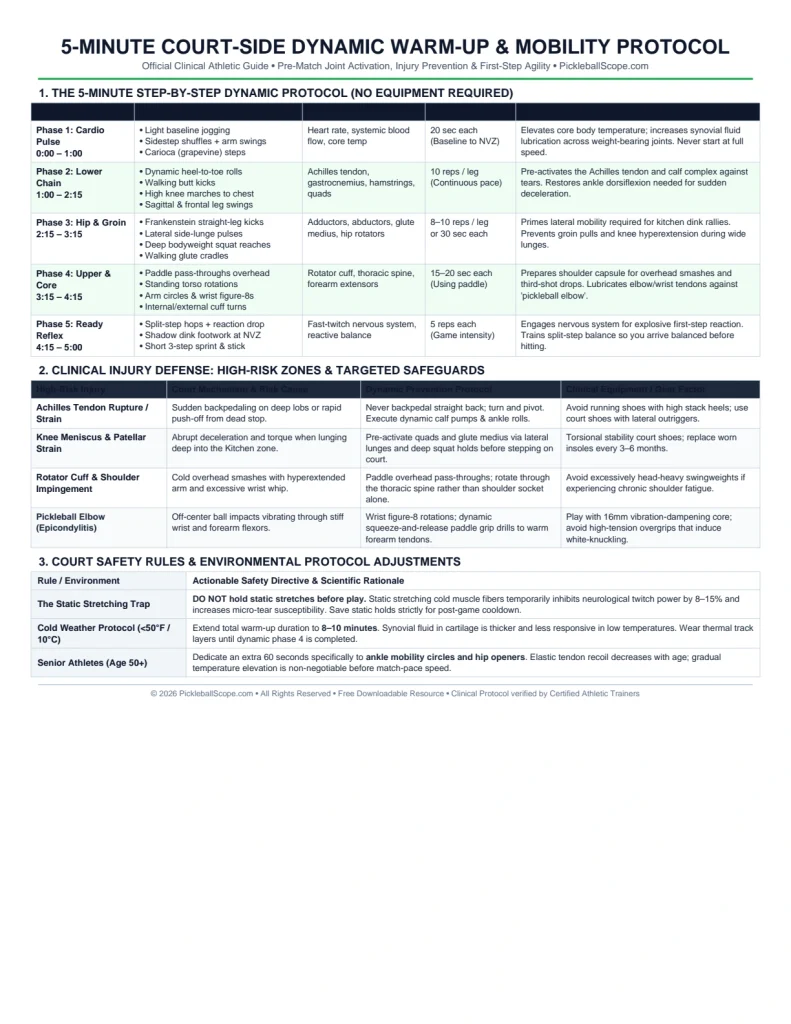
📄 Download the Free 5-Minute Dynamic Warmup Cheat Sheet
Keep this clinical pre-match protocol in your pickleball bag or on your phone! Features a high-density visual timing table, joint vulnerability checklist, and cold weather adjustment rules verified by certified athletic trainers.
Common Mistakes to Avoid in Your Pickleball Warmup Routine
Even well-intentioned players often undermine their pre-game preparation by falling into common traps that reduce warmup effectiveness or inadvertently trigger injury. Be vigilant against these four common mistakes when performing your pickleball warmup routine:
- Rushing Through Movements at 100% Speed Immediately: A dynamic warm-up is progressive. Starting with explosive sprints or high-velocity arm swings on minute one defeats the purpose. Always begin at 40% intensity during Phase 1 and build progressively to 85–90% by the end of Phase 5.
- Overlooking the Ankle and Achilles Complex: Many players focus exclusively on their shoulders or upper back, completely ignoring their lower legs. In pickleball, the Achilles tendon and lateral ankle ligaments absorb the greatest percentage of catastrophic trauma. Dedicating at least 60 to 75 seconds to ankle mobility and calf pumps is mandatory.
- Bending from the Lumbar Spine Rather Than the Hips: During lateral lunges, squats, and shadow dinks, keep your spine neutral and bend through your hips and knees. Hunching your lower back while cold places dangerous shearing forces onto your lumbar discs.
- Mistaking Dinking Warmups for a Physical Warmup: Stepping directly onto the court and casually hitting crosscourt dinks for two minutes is a skill calibration drill, not a physical warm-up. Casual dinking does not elevate your core body temperature, pump synovial fluid through your lower kinetic chain, or prepare your rotator cuff for an unexpected overhead smash. Always perform your 5-minute dynamic protocol before touching a ball.
Environmental & Age-Specific Warmup Adjustments
A standard 5-minute protocol provides ample activation under mild weather conditions. However, your body’s physiological requirements change based on environmental temperature and chronological age. Apply these targeted modifications to tailor your routine:
Cold Weather Protocol (Below 50°F / 10°C)
When playing outdoors in autumn or winter temperatures, ambient cold constricts peripheral blood vessels, slows nerve conduction velocity, and thickens joint synovial fluid. Under these conditions, a 5-minute warmup is insufficient:
- Extend Duration to 8–10 Minutes: Double the duration of Phase 1 (Cardio Pulse) and Phase 2 (Lower Chain) to ensure core body temperature rises adequately.
- Retain Warm Outer Layers: Keep your thermal warmup jacket and track pants on throughout the first four phases. Do not strip down to playing shorts and t-shirt until your body is actively sweating and ready for match play.
- Thermal Muscle Balms: Consider applying a warming topical cream to chronic trouble spots (such as stiff knees or Achilles tendons) 15 minutes before beginning your dynamic routine.
Senior Players (Ages 50+) & Post-Injury Rehabilitation
Master athletes bring incredible tactical court wisdom to pickleball, but joint cartilage and tendon vascularity naturally decline over time. Senior players should emphasize joint lubrication and gradual neural priming:
- Add 60 Seconds of Controlled Ankle Circles: Before starting Phase 1, sit on a court bench and perform 15 clockwise and 15 counter-clockwise ankle circles per foot to restore multi-directional mobility.
- Avoid Ballistic Bouncing: Emphasize smooth, controlled, continuous tension rather than sharp, ballistic bounces during Phase 3 and Phase 5 movements.
- Prioritize Rotator Cuff Activation: Spend an extra 30 seconds performing paddle internal and external rotations to ensure the shoulder joint capsule is thoroughly lubricated before hitting deep third-shot drops or lobs.
Frequently Asked Questions About Pickleball Warmup Routines
How long should a pickleball warmup routine last before a match?
A standard pre-match dynamic pickleball warmup routine should last between 5 and 7 minutes. This duration is clinically proven to elevate core body temperature, stimulate joint synovial fluid, and activate fast-twitch neural reflexes without depleting muscular glycogen or causing premature fatigue before your games begin.
Can I just do dinking drills as my warmup?
No. Casual dinking warms up your hand-eye coordination, touch, and paddle timing, but it does not adequately prepare your cardiovascular system, Achilles tendons, or spinal rotators for explosive match play. Hitting soft dinks while cold leaves you vulnerable to sudden tears if an opponent hits an unexpected pop-up or deep speedup that forces an explosive reaction.
What should I do if I feel acute pain during my warmup?
If you experience sharp, localized pain (particularly in the Achilles tendon, calf, knee, or rotator cuff) during your dynamic warm-up, stop immediately. Sharp pain signals micro-trauma or impingement. Do not attempt to “play through” acute pain with painkillers; rest, ice, elevate, and consult a sports medicine physician or physical therapist.
Is it better to do static stretches before or after playing pickleball?
Static stretches should be performed strictly after playing as part of a post-game cooldown. Holding static stretches after matches when muscles are warm helps normalize resting muscle length, reduces post-exercise tightness, and aids recovery without impairing dynamic performance.
What are the most common pickleball injuries prevented by a dynamic warmup?
A comprehensive dynamic warmup significantly reduces the risk of Achilles tendon ruptures, gastrocnemius calf strains, hamstring pulls, knee meniscus stress, rotator cuff impingement, and lateral epicondylitis (pickleball elbow). Over 85% of acute muscular strains occur within the opening twenty minutes of cold play.
Key Takeaways: Making Your Pickleball Warmup Routine a Daily Habit
- Dynamic Over Static: Never stretch cold muscles passively before play; always utilize continuous, multi-planar dynamic activation.
- Five Minutes Is All It Takes: Allocating just 300 seconds across 5 sequential phases thoroughly prepares your heart, joints, and nervous system for game speed.
- Protect the Achilles Complex: Prioritize calf pumps, heel-to-toe rolls, and dynamic leg swings to guard against catastrophic tendon tears.
- Warm Up Before Touching a Paddle: Perform your full dynamic routine before engaging in practice dinking or hitting baseline drives.
- Cool Down Responsibly: Save deep static stretching, foam rolling, and hydration protocols for the post-match recovery window.