
PILLAR 3: PLAYER DEVELOPMENT & INSTRUCTIONAL LAB
The complete home training masterclass to build lightning hand speed, feather-soft dinking touch, and transition resets without a partner.
Practicing solo pickleball wall drills is the single fastest and most efficient way to build lightning-fast hand speed, rock-solid dinking consistency, and instinctive defensive resets without needing a drilling partner or an open court. While playing recreational pickup games is fun, a typical two-hour rec session provides only a few dozen meaningful ball contacts amidst downtime, partner rotation, and ball retrieving.
In contrast, a 15-minute dedicated wall workout delivers over 800 to 1,000 clean repetitions. Because a solid concrete, garage, or basement wall returns the ball at twice the speed of a human partner—with zero pauses between shots—your neuromuscular pathways adapt rapidly. Your paddle prep shortens, your ready position becomes second nature, and your hand speed during kitchen firefights reaches tournament speed.
According to player development benchmarks published by USA Pickleball and competitive skill rubrics tracked by DUPR (Dynamic Universal Pickleball Rating), the jump from intermediate 3.0 rec play to advanced 4.0+ tournament competition hinges on unforced error reduction and reset reliability. The practice wall is where those championship instincts are forged.
Whether you have a dedicated outdoor court rebounder, a garage wall, or a quiet indoor basement space, this complete guide to solo pickleball wall drills provides everything you need: wall setup specifications, ten progressive daily training routines, ball selection tips from the USA Pickleball Equipment Standards, and a structured 15-minute daily workout card.
⚡ The 30-Second Solo Wall Drill Quick-Reference Routine
Short on time? Here is the structured 15-minute daily wall workout designed to sharpen touch, speed, and defense:
| # | Drill Name | Time | Distance from Wall | Primary Skill Focus |
|---|---|---|---|---|
| 1 | Forehand Roll Dinks | 90 Sec | 7 Feet (Kitchen Line) | Low-to-high brush, paddle face stability, soft grip. |
| 2 | Backhand Roll Dinks | 90 Sec | 7 Feet (Kitchen Line) | Shoulder-led push, lifting balls above 34″ net tape. |
| 3 | Alternating FH/BH Dinks | 90 Sec | 7 Feet (Kitchen Line) | Fluid grip transitions and lateral paddle repositioning. |
| 4 | Rapid-Fire Punch Volleys | 90 Sec | 4–5 Feet (Close) | Lightning hand speed and compact punch mechanics. |
| 5 | High-Low Volley Control | 90 Sec | 5 Feet (Close) | Alternating chest-high speed-up with ankle-high scoop. |
| 6 | Transition Zone Resets | 90 Sec | 12–14 Feet (Mid-court) | Absorbing hard drive pace into soft kitchen drops. |
| 7 | Two-Handed Backhand Drives | 90 Sec | 10–12 Feet (Baseline) | Non-dominant hand whip and drive consistency. |
| 8 | Forehand Topspin Dippers | 90 Sec | 10–12 Feet (Baseline) | Heavy topspin RPM shaping beneath net level. |
| 9 | Off-Balance Chaos Resets | 90 Sec | 7 Feet (Kitchen Line) | Lunging recoveries and stabilizing face flutter. |
| 10 | Burnout Speed Sprint | 90 Sec | 3–4 Feet (Ultra-Close) | Max unbroken volley speed until timer expires. |
1. The Science of Wall Practice: Why the Wall Makes You a 4.0+ Player
The practice wall is widely recognized by elite coaches as the ultimate training partner for one simple reason: the wall never misses, never gets tired, and never gives you an easy ball. When executing solo pickleball wall drills, every millisecond of human delay between shots is eliminated.
When you play against another human, the ball takes approximately 0.8 to 1.2 seconds to travel across the net and bounce. Against a wall positioned seven feet away, the ball returns in less than 0.4 seconds. This halved reaction window forces your nervous system to streamline swing mechanics. Big, looping tennis backswings get punished immediately, forcing you to adopt the compact, paddle-out-front posture essential for high-level kitchen battles.
Furthermore, wall drills provide immediate, objective diagnostic feedback. If your paddle face opens by just two degrees, the ball flies high over your target line. If you grip the paddle with excessive white-knuckle tension (8/10 instead of 3/10), the ball springs violently off the face rather than absorbing softly into the court. The wall forces you to master soft hands through pure repetition.
2. Home Wall Setup: Dimensions, Tape Lines & Practice Balls
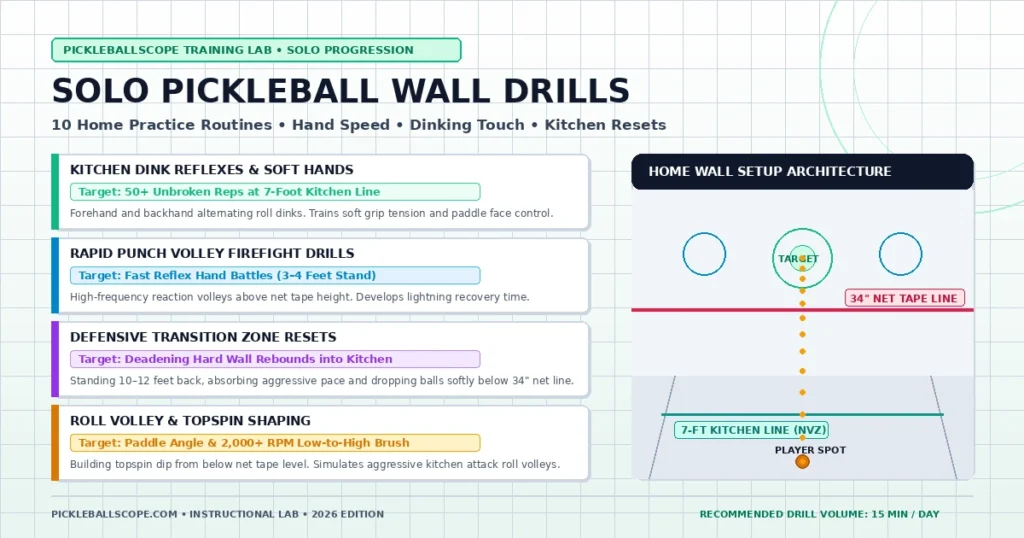
Setting up an effective home practice station for your solo pickleball wall drills requires minimal space and five minutes of prep. You can use an outdoor brick or concrete wall, an unfinished garage drywall, a basement foundation wall, or a portable freestanding rebounder.
Step 1: Mark the Net Line Tape (34″ Center / 36″ Sidelines)
Using standard blue painter’s tape or bright green masking tape, measure exactly 34 inches from the floor and apply a horizontal strip across the wall. This replicates the center regulation net height of an official pickleball net. For enhanced precision, angle the outer edges upward slightly to 36 inches to reflect regulation sideline net height.
Step 2: Mark the 7-Foot Non-Volley Zone (Kitchen) Line
Measure exactly 7 feet outward from the base of the wall across the floor. Place a parallel tape line on the ground. When practicing dinking drills, your toes must remain behind this line, simulating the exact distance of the Non-Volley Zone line on a tournament court.
Step 3: Mark the 12-Foot Transition Zone Line
Measure 12 to 14 feet back from the wall and mark a secondary line. This represents “no-man’s land”—the transition zone between the baseline and the kitchen. You will stand here to practice third-shot drops and defensive reset blocks.
Step 4: Choosing the Right Practice Ball
If you are practicing outdoors against brick or concrete, standard outdoor balls (such as the Franklin X-40 or Dura Fast 40) work well. However, for indoor drywall, garages, or shared residential spaces, standard balls can be loud and risk denting drywall. Use Gamma Quiet Balls, high-density foam training balls, or Franklin foam practice balls. They mimic regulation bounce and weight while deadening acoustic sound by over 60%.
3. The 10 Best Solo Pickleball Wall Drills: Step-by-Step Instructions
Integrate these ten foundational routines into your training regimen. Each drill targets a specific mechanical discipline:
Drill 1: Forehand Roll Dinks (Soft Hands & Lift)
Stand behind the 7-foot kitchen line in an athletic, knee-bent ready stance. Hit soft forehand roll dinks against the wall, aiming 2 to 6 inches above your 34-inch net tape line. Focus on a relaxed grip pressure (3 out of 10), brushing the paddle from low to high to impart gentle topspin. Allow the ball to bounce once before striking. Target: 40 unbroken reps.
Drill 2: Backhand Roll Dinks (Shoulder Stability)
Remain at the 7-foot line and switch entirely to backhands. Keep your paddle face square and push through the ball using your shoulder and core rather than flicking your wrist. The ball should bounce softly off the floor before contacting the wall. Target: 40 unbroken reps.
Drill 3: Alternating Forehand & Backhand Dinks (Grip Agility)
Combine Drills 1 and 2 by alternating forehand, backhand, forehand, backhand on every strike. This drill trains lightning-quick paddle repositioning and forces you to stay light on the balls of your feet. Maintain quiet, non-panicked paddle movement. Target: 50 continuous reps.
Drill 4: Rapid-Fire Punch Volleys (Hand Speed Firefight)
Move forward to 4 to 5 feet from the wall. Without letting the ball bounce, execute rapid-fire chest-high air volleys. Keep your backswing virtually non-existent—simply punch forward from your chest with a compact 2-inch stroke. This drill builds explosive fast-twitch reflex speed for kitchen firefights. Target: 60 continuous volleys.
Drill 5: High-Low Volley Control (Vertical Disruption)
Standing 5 feet from the wall, intentionally alternate between hitting a chest-high attack volley and absorbing the subsequent rebound down into a low ankle-height scoop volley. This teaches paddle angle discipline when opponents unexpectedly change ball elevation. Target: 40 reps.
Drill 6: Transition Zone Defensive Resets (The 3rd Shot Drop Master)
Back up to the 12-foot transition line. Hit a moderately firm groundstroke against the wall, then immediately soften your grip tension to 2/10 and “catch” the fast-rebounding ball, resetting it softly so it hits the wall below or just at the 34-inch net tape. This replicates digging out hard banger drives while advancing to the kitchen. Target: 30 clean resets.
Drill 7: Two-Handed Backhand Drives (Drive Consistency)
From 10 to 12 feet, practice full two-handed backhand groundstrokes. Drive the ball firmly against the wall, using your non-dominant hand to generate forward whip acceleration. Let the ball bounce, recover with a split-step, and drive again. Target: 35 deep drives.
Drill 8: Forehand Topspin Dippers (RPM Trajectory Shaping)
From 10 feet back, drop low and brush aggressively up the back of the ball to shape heavy topspin. Aim 3 to 5 inches above the net line. The topspin should cause the ball to dive toward the floor immediately after striking the wall. Target: 35 topspin reps.
Drill 9: Off-Balance Chaos Resets (Scramble Footwork)
Stand at the 7-foot line and intentionally hit balls at awkward, random angles off the wall. Force yourself to lunge left, right, forward, and back, stabilizing your paddle face to reset chaotic balls into a controllable rhythm. Target: 45 recovery reps.
Drill 10: 90-Second Burnout Sprint (Stamina & Twitch)
Step up to 3 feet from the wall. Execute maximum-speed, continuous volleys without letting the ball hit the floor. Count your total unbroken repetitions before fatigue sets in. This is the ultimate workout finisher that conditions forearm endurance. Target: Unbroken 90 seconds.
4. The 4 Golden Mechanics Rules of Wall Practice
Core Mechanical Rules:
- 1. Keep Grip Tension at 3 out of 10: Squeezing your paddle like a baseball bat is the primary cause of pop-ups and forearm fatigue. Keep your grip loose and fluid so the paddle core absorbs ball velocity naturally.
- 2. Keep the Paddle Out Front Always: After every shot, return your paddle immediately to a neutral ready position in front of your chest. If your paddle drops below your waist, you will be late on the subsequent rebound.
- 3. Execute a Split-Step on Every Hit: Do not practice flat-footed. As the ball rebounds off the wall, execute a subtle split-step hop onto the balls of your feet. This trains active court movement and balance recovery.
- 4. Watch the Ball Hit the Center of the Face: Track the ball into your paddle sweet spot with your eyes. Wall drills build laser-focused visual tracking that dramatically reduces off-center frame mishits in tournament matches.
5. Common Mistakes That Sabotage Wall Training Progress
- Swinging Too Hard at Close Range: Smashing balls against the wall from 5 feet away creates chaotic sprays rather than rhythmic muscle memory. Prioritize soft control and repeatable ball placement over raw power.
- Ignoring the Net Line Tape: Hitting balls aimlessly against an unlined wall does not build court awareness. You must have a clear 34-inch visual net tape line to gauge whether your shots would clear the net or clip the tape in a real match.
- Standing Static in One Spot: In a real game, you are constantly adjusting your footwork. Avoid freezing your feet; shift laterally, stay low in your stance, and actively step into every dink.
- Practicing When Fatigued: When your forearm burns and your reaction time slows, you begin compensating with sloppy wrist flicking. Stop when form deteriorates—quality reps always beat fatigued slop.
6. Connecting Wall Work to DUPR Rating Progress: The 3.0 to 4.5+ Ladder
Every dedicated drill session of solo pickleball wall drills translates directly into rating points on the DUPR scale. Here is how consistent wall training elevates your game across competitive divisions:
| DUPR Skill Division | Common Competitive Flaw | Wall Drill Solution | Weekly Drill Target |
|---|---|---|---|
| 3.0 – 3.5 Level | Pops up 3rd shot drops; panics during kitchen firefights. | Drill 1 (FH Dinks) & Drill 6 (Transition Resets) | 3 Sessions (45 Min Total) |
| 3.5 – 4.0 Level | Inconsistent backhand dinks; late on rapid reflex speed-ups. | Drill 3 (Alternating Dinks) & Drill 4 (Speed Volleys) | 4 Sessions (60 Min Total) |
| 4.0 – 4.5+ Level | Lacks topspin dip on roll volleys; misses transition resets under pressure. | Drill 8 (Topspin Dippers) & Drill 9 (Chaos Resets) | 5 Sessions (75 Min Total) |
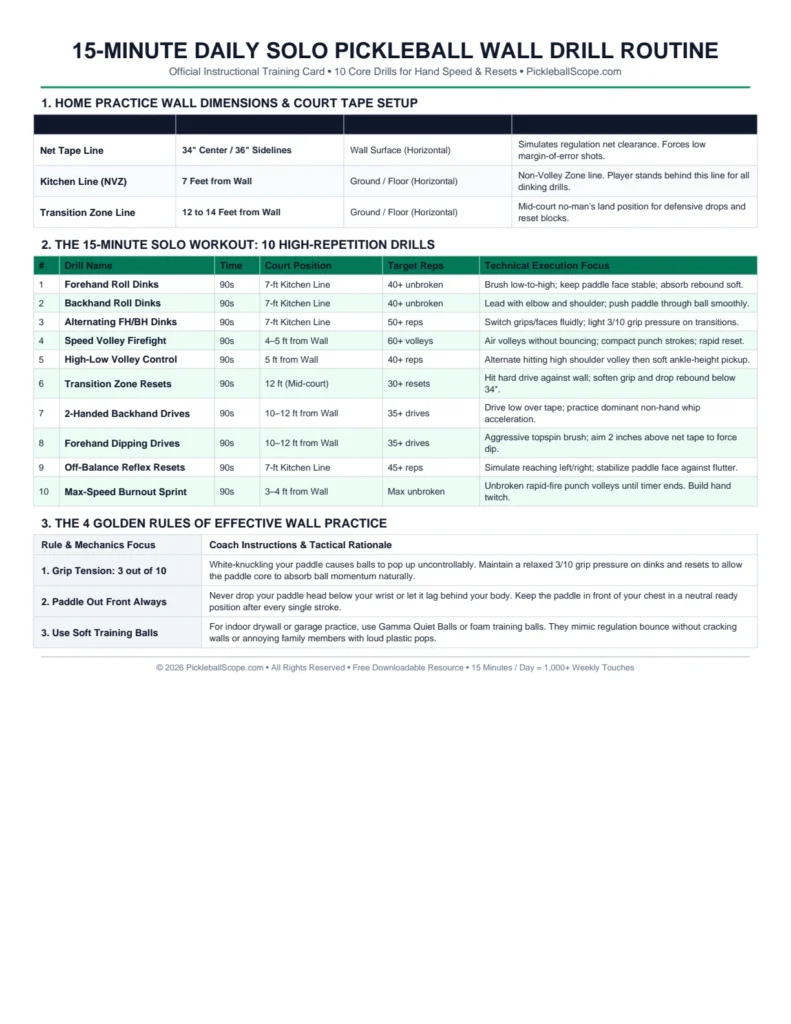
📄 Download the Free 15-Minute Solo Wall Drill Workout Card (PDF)
Want a structured, laminated reference sheet to tape to your garage wall or tuck into your paddle bag? Download our printable 1-page workout card featuring all 10 drills, timer allocations, rep targets, and footwork checklists.
Frequently Asked Questions About Solo Pickleball Wall Drills
How long should I practice wall drills each day?
A focused 15-minute daily session is ideal. Because the wall returns balls without pause, 15 minutes provides approximately 800 to 1,000 ball strikes—equivalent to nearly two hours of casual game play.
Can I practice pickleball wall drills inside my house or garage?
Yes. Garages, basements, or spare rooms with smooth drywall or concrete work well. When practicing indoors, use high-density foam training balls (such as Gamma Quiet Balls) to protect drywall from scuffs and eliminate loud plastic noise.
What height should the net line be on my practice wall?
Place a tape line horizontally at exactly 34 inches from the floor in the center, tapering slightly to 36 inches on the outer edges to match official USA Pickleball regulation net dimensions.
Will wall drills improve my hand speed during real matches?
Yes, dramatically. Because the ball returns from the wall in less than 0.4 seconds (more than twice as fast as a human partner), your brain and nervous system adapt to rapid visual tracking and compact paddle preparation.
What is the biggest mistake players make during wall drills?
The most common mistake is gripping the paddle too tightly. White-knuckling causes the ball to pop up unpredictably. Keeping grip pressure at a relaxed 3 out of 10 trains the soft hands needed for tournament-level dinking.
Key Takeaways: Mastering Solo Pickleball Wall Drills at Home
- High-repetition efficiency: 15 minutes of wall drills delivers over 800 ball touches—more than an entire afternoon of pickup games.
- Compact mechanics win: The wall forces you to eliminate long, looping swings in favor of compact, forward paddle preparation.
- Soft hands require loose grip: Maintain a 3/10 grip pressure to cushion hard rebounds and drop balls softly below net tape level.
- Set accurate dimensions: Mark a 34-inch net line on the wall and a 7-foot kitchen line on the floor to build precise court instincts.
- Consistent daily volume elevates DUPR: Just 3 to 4 wall sessions per week rapidly sharpens hand speed and eliminates unforced errors.