
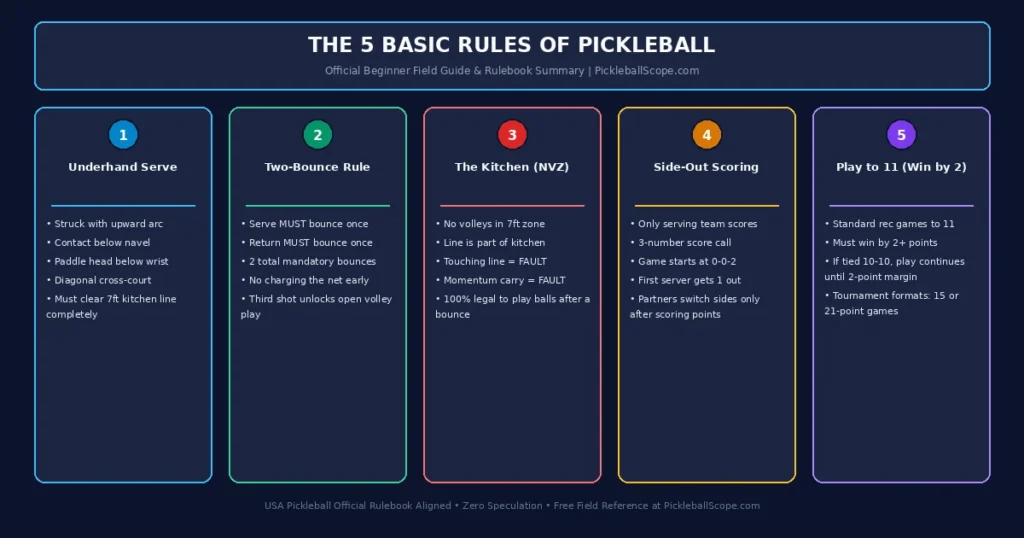
⚡ The 5 Basic Rules of Pickleball at a Glance
1. Underhand Serve: The serve must be hit with an underhand stroke below your navel, traveling diagonally across the court.
2. The Two-Bounce Rule: The ball must bounce once on the receiver’s side and once on the server’s side before anyone can hit a volley out of the air.
3. The Non-Volley Zone (“The Kitchen”): You cannot strike the ball out of the air while standing in or touching the 7-foot kitchen area or its line.
4. Only the Serving Team Scores: Points are only awarded to the team that served the ball (traditional side-out scoring).
5. Games to 11 (Win by 2): The first team to reach 11 points with at least a 2-point lead wins the game.
One of the biggest reasons pickleball has attracted over 24 million players across North America and Europe is its accessibility. You don’t need to spend months taking private lessons or studying a 90-page rulebook just to have fun on a Saturday morning.
In fact, the founders of pickleball specifically designed the sport so that anyone could learn the core mechanics in under 10 minutes. However, because pickleball borrows elements from tennis, badminton, and ping-pong while introducing its own unique quirks (like the famous “Kitchen”), beginners often get caught committing preventable foot faults or calling the score incorrectly.
Whether you are stepping onto the court for the very first time or looking to clarify a friendly on-court dispute, this in-depth guide walks you through the 5 fundamental rules of pickleball, complete with court diagrams, common rookie traps, and tactical tips.
5 basic rules of pickleball
Rule 1: The Underhand & Diagonal Serve
Every rally in pickleball begins with a serve. Unlike tennis, where the serve is an aggressive, overhead weapon hit with maximum power, pickleball serves are strictly designed to put the ball into play in a neutral, controlled manner.
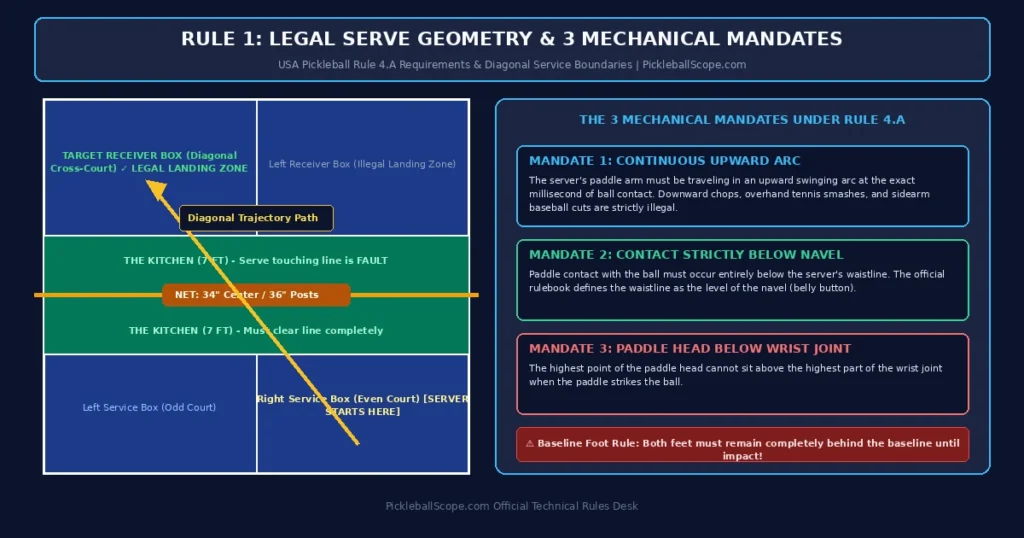
Diagonal service court boundaries and the three mechanical mandates under USA Pickleball Rule 4.A.
The 3 Mechanical Requirements of a Legal Serve:
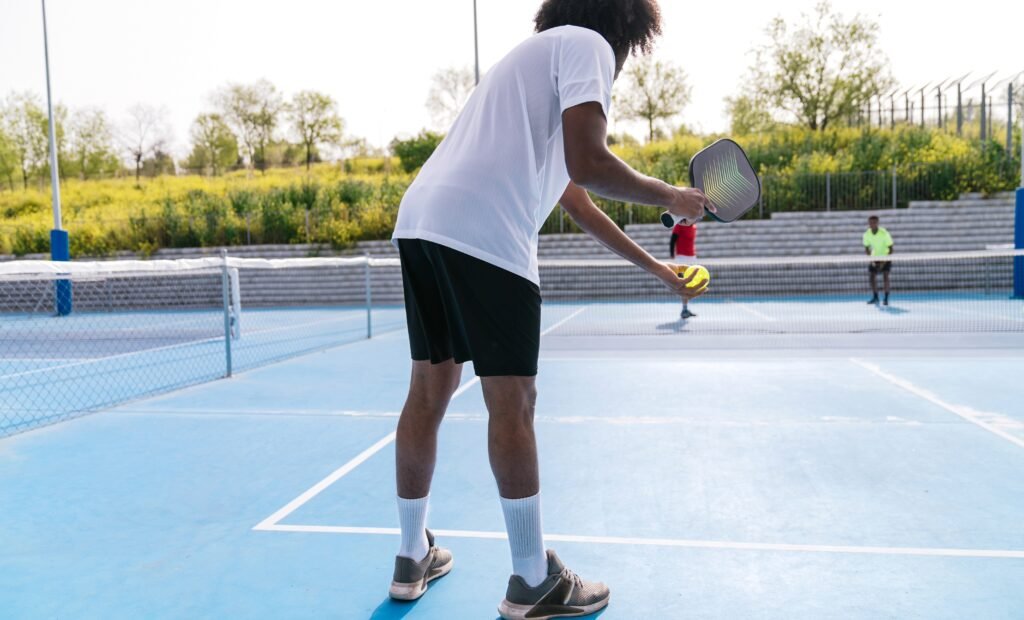
Under USA Pickleball Rule 4.A, a legal volley serve must satisfy three simultaneous conditions:
- Upward Arc: The server’s arm must move in a continuous upward arc at the moment the paddle makes contact with the ball. No downward chops or overhead slices are permitted.
- Contact Below the Waist: Paddle contact with the ball must occur strictly below the server’s waist (defined as the level of the navel / belly button).
- Paddle Head Below the Wrist: The highest point of the paddle head cannot sit above the highest part of the wrist joint when the ball is struck.
Court Positioning on the Serve:
- The server must keep both feet behind the baseline. You cannot step on or over the painted baseline until the paddle strikes the ball.
- The server must stand between the imaginary extensions of the centerline and the sideline.
- The ball must travel diagonally cross-court into the opponent’s opposite service box.
- The Kitchen Line Exception: The serve must completely clear the 7-foot kitchen line. If the serve lands on the 2-inch kitchen line, it is a service fault. (All other boundary lines, such as the baseline and centerline, are considered “in”).Watch this video for more info:
Rule 2: The Two-Bounce Rule (Double Bounce Rule)
The Two-Bounce Rule is arguably the most brilliant strategic rule in pickleball. It prevents the serving team from rushing the net immediately to smash easy put-aways, creating a fair, balanced rally from the baseline.
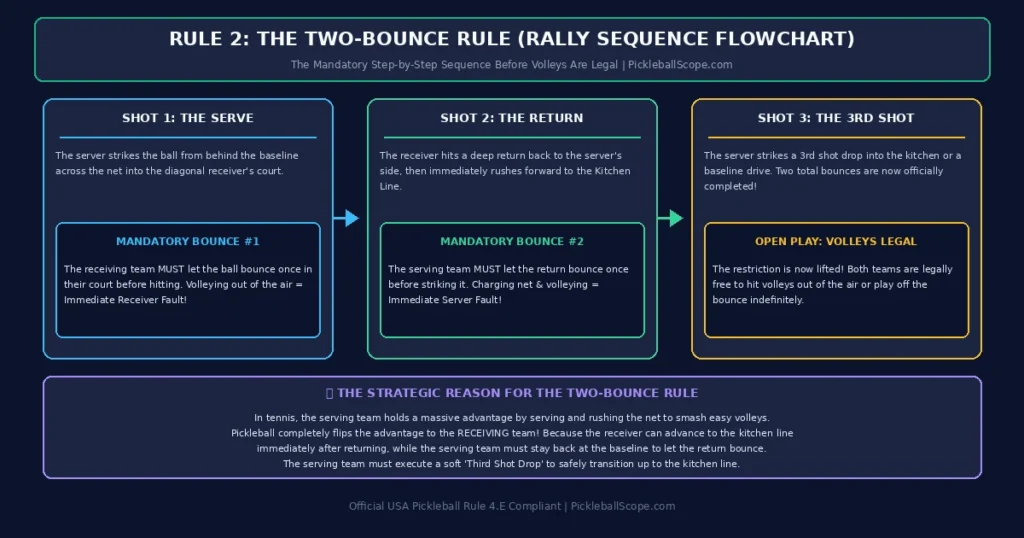
Figure 3: Step-by-step breakdown of Shot 1, Shot 2, and Shot 3 under the Two-Bounce Rule.
The Step-by-Step Two-Bounce Sequence:
- Bounce #1 (The Return): When the server serves the ball, the receiving team must let the ball bounce once before hitting their return. If the receiver hits the serve out of the air (a volley), it is an immediate fault, and the serving team scores a point.
- Bounce #2 (The 3rd Shot): When the receiver returns the ball over the net, the serving team must also let the ball bounce once before hitting it. If the server charges forward and volleys the return out of the air, it is a fault, and the serve is lost.
- Open Play After Two Bounces: Once the ball has bounced once on each side of the net (two total bounces in the rally), the restriction ends. Both teams are now legally free to either hit the ball out of the air (volleys) or play it off the bounce.
Rule 3: The Non-Volley Zone (“The Kitchen”)
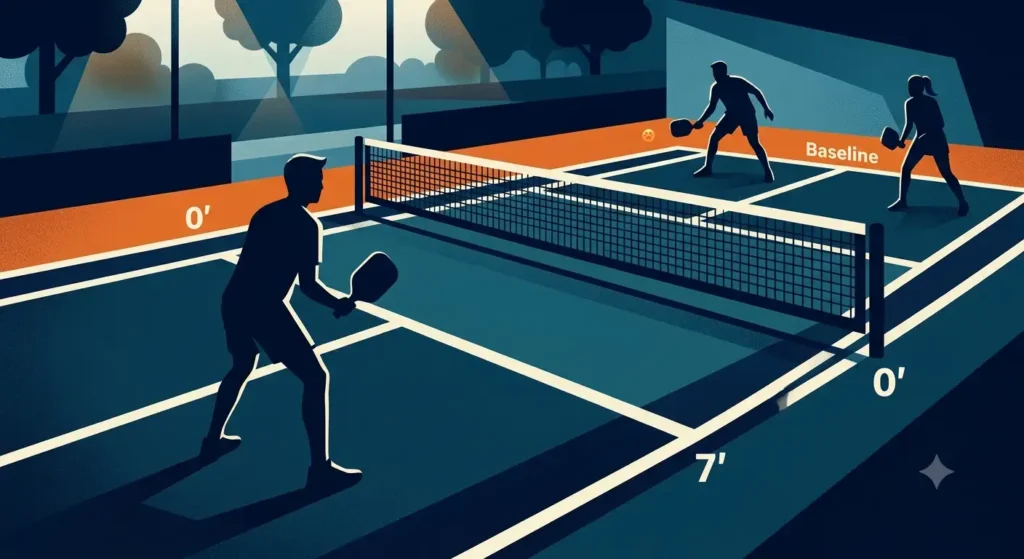
If there is one rule that defines pickleball, it is the Non-Volley Zone (NVZ), universally referred to as The Kitchen.
The Kitchen is a 7-foot deep by 20-foot wide rectangular zone on both sides of the net. Its sole purpose is to eliminate aggressive, unreturnable overhead spikes right at the net cord.
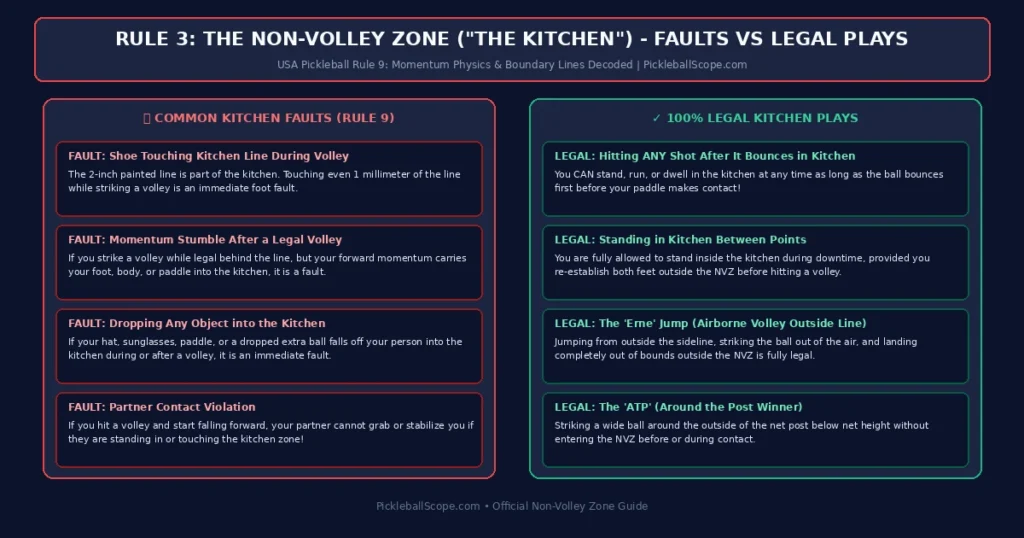
Side-by-side comparison of common kitchen foot faults versus 100% legal kitchen plays under USA Pickleball Rule 9.
The 4 Core Kitchen Tenets:
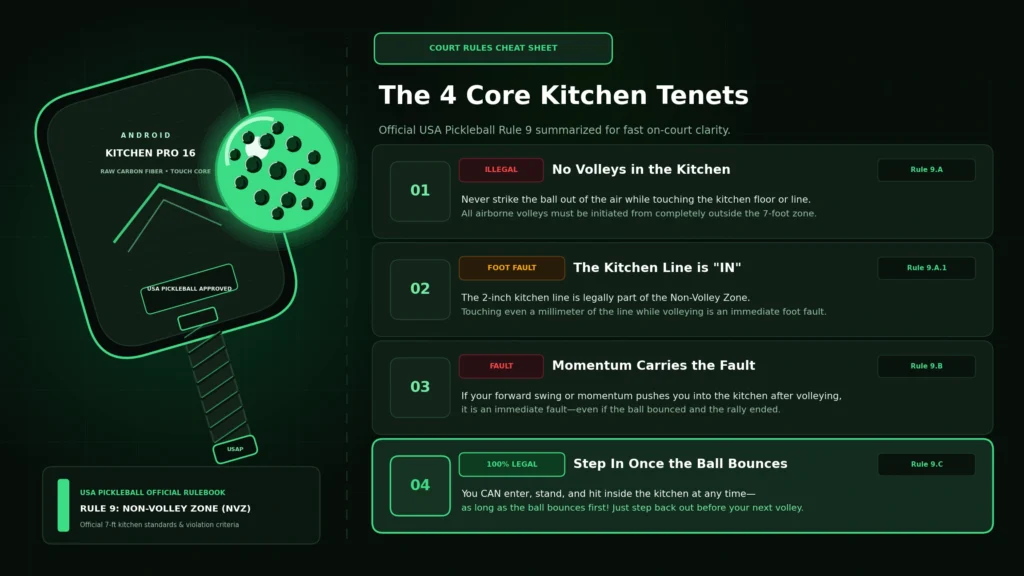
- No Volleys Inside the Zone: You cannot strike the ball out of the air while any part of your body, shoes, or clothing is touching the kitchen floor or the 2-inch kitchen line.
- The Kitchen Line is “In”: In tennis, boundary lines are in bounds. In pickleball, the kitchen line is considered part of the kitchen. If your shoe touches even a millimeter of the kitchen line while volleying, it is an immediate foot fault.
- Momentum Carries the Fault (Rule 9.B): If you hit a volley while standing legally behind the kitchen line, but your forward momentum causes you to stumble into the kitchen afterward, it is a fault.
- You CAN Step in the Kitchen If the Ball Bounces: You can stand, run, or dwell in the kitchen whenever you want—provided the ball bounces before you hit it.
Rule 4 & 5: Scoring Mechanics, Server Rotation & Winning by 2
In recreational and standard tournament pickleball, scoring operates on a traditional Side-Out system where only the serving team can earn points.
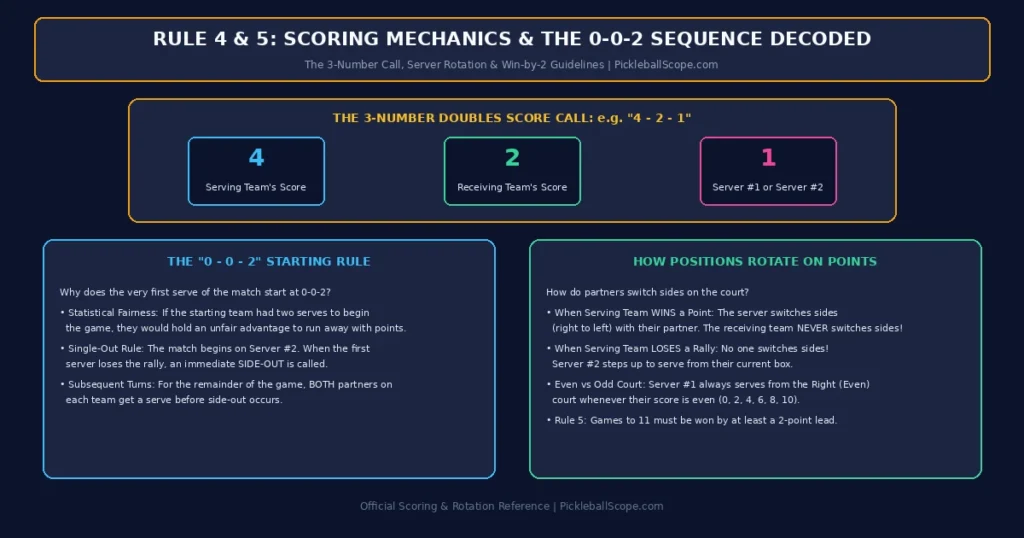
Caption: Figure 5: Decoding the 3-number score call (Server Score – Receiver Score – Server Number) and position switching mechanics.
📸 Alternative / Supplementary Photo Brief (Real Court Photography):
• Visual Description: A wide court photo of doubles partners switching court sides after winning a point, illustrating the server moving from the right court to the left court.
• File Name: pickleball-doubles-partner-switch-rotation.webp | Placement: Right below ‘How Doubles Server Rotation Works’.
Decoding the 3-Number Call:
The score is always announced as three distinct numbers before every serve: [Server’s Score] – [Receiver’s Score] – [Server #1 or #2]
- First Number: The serving team’s current score.
- Second Number: The receiving team’s current score.
- Third Number: Designates whether Server #1 or Server #2 on the serving team is currently serving.
The Opening Exception: The “0 – 0 – 2” Rule
At the very start of every doubles match, the score is called 0 – 0 – 2. The starting team is intentionally allowed only one server out to prevent them from gaining an unfair statistical head start. Once that first server loses a rally, a Side-Out is called immediately, and the serve transfers to the opponents.
Rule 5: Games to 11 Points (Win by 2)
- Standard games are played to 11 points.
- You must always win by a margin of at least two points. If the score is tied at 10 – 10, play continues indefinitely until one side secures a two-point lead (e.g., 12 – 10, 14 – 12).
Summary of Common Faults in Pickleball
| Fault Type | Description | Who Commits It | Consequence |
|---|---|---|---|
| Kitchen Foot Fault | Touching the NVZ line or surface while volleying. | Either Team | Loss of rally / point awarded to opponents. |
| Two-Bounce Violation | Hitting a volley before the serve or return has bounced. | Receiver or Server | Immediate loss of rally. |
| Service Line Fault | Serve lands on the 2-inch kitchen line or out of bounds. | Server | Loss of serve (Server 2 or Side-Out). |
| Out of Bounds | Ball lands completely outside the sideline or baseline. | Striking Player | Loss of rally. |
| Double Hit / Carry | Deliberately carrying the ball or striking twice intentionally. | Striking Player | Immediate fault. |
Frequently Asked Questions
Can a ball bounce in the kitchen?
Yes! A ball can legally bounce anywhere within the court boundaries, including the kitchen. If an opponent hits a soft dink that bounces in your kitchen, you can step into the kitchen to hit it back.
What happens if the ball hits the net and goes over?
During regular rally play, the ball remains live as long as it crosses the net and lands in bounds. Under modern USA Pickleball rules, there are no service lets—if a serve clips the net and lands in the diagonal service court beyond the kitchen line, it is live and must be played.
Can you hit the ball with two hands on the paddle?
Yes. Two-handed backhands and two-handed dinks are completely legal in pickleball and are widely used by advanced players for added stability and spin.
Internal Linking & Download Resources
- 📥 Download: Official 1-Page Beginner Pickleball Rules Cheat Sheet (Printable PDF)
- 🔢 Deep Dive: How to Keep Score in Doubles Pickleball (The 0-0-2 Rule Explained)
- 🚫 Master the Kitchen: The Definitive Kitchen Rules & Decision Flowchart Guide
- 📊 Interactive Tool: Free DUPR Skill Rating Calculator Widget